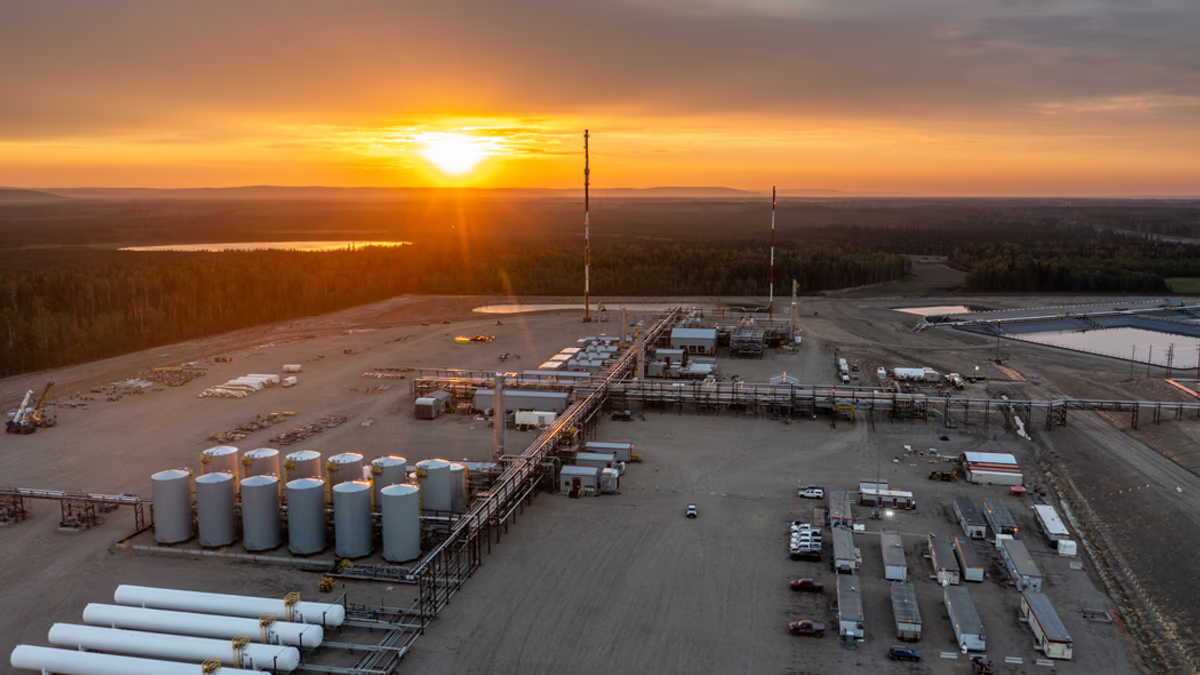
Devon Energy and Coterra Merger Clears Antitrust Review, Creating 58 Billion Dollar Shale Giant with 1.6 Million Barrels Per Day
Devon Energy and Coterra Merger Clears Antitrust Review, Creating 58B Dollar Shale Giant with 1.6M bpd. LNG export capacity is ramping aggressively.
The proposed combination of Devon Energy and Coterra Energy crossed a critical milestone on April 1, 2026, when the Hart-Scott-Rodino antitrust waiting period expired without challenge, clearing the final major U.S. regulatory condition for the all-stock merger announced February 2, 2026. The deal, valued at a combined enterprise value of approximately $58 billion, is now on track for a Q2 2026 close pending shareholder votes that have already been scheduled following the SEC's effectiveness of the Form S-4 in late March.
The transaction will create one of the largest independent oil and gas producers in U.S. history, with combined production exceeding 1.6 million barrels of oil equivalent (boe) per day, including more than 550,000 barrels per day of oil and 4.3 billion cubic feet per day of natural gas. The combined company will operate under the Devon Energy name and be headquartered in Houston, Texas.
Synergies, Scale, and Shareholder Returns
Management teams from both companies have outlined $1 billion in annual pre-tax synergies targeted by year-end 2027, driven by capital allocation optimization across overlapping basin positions, margin improvements from combined midstream commitments, and reductions in corporate overhead. The companies project that the fully combined entity will generate sufficient free cash flow to support a shareholder buyback program exceeding $5 billion in the first two years post-close, assuming WTI crude prices in the USD $70 to $80 per barrel range.
That assumption looks increasingly conservative given current market conditions. WTI has traded well above USD $90 per barrel through much of early 2026, driven by geopolitical supply disruptions affecting global tanker flows. The tighter the supply picture, the greater the cash flow leverage available to the combined Devon-Coterra entity from its 1.6 million boe per day production base on day one of closing. Every dollar of WTI price above the base case adds an estimated $200 to $250 million annually in pre-tax income to the combined company's income statement, based on its oil weighting.
Basin Footprint and Strategic Rationale
The merger combines Devon's strength in the Delaware Basin (a prolific sub-basin of the Permian) and Oklahoma's Anadarko Basin with Coterra's dominant position in the Marcellus Shale and Permian's Midland Basin. The combined portfolio spans six major U.S. producing regions, creating a geographically diversified shale platform with exposure to both oil-weighted and gas-weighted formations.
Coterra's Marcellus position, which produces roughly 2.8 billion cubic feet per day of natural gas in Pennsylvania, adds a meaningful LNG-exposed gas asset to the combined company at a time when U.S. LNG export capacity is ramping aggressively. Devon's Delaware Basin acreage, meanwhile, provides high-margin oil growth inventory with multi-decade drilling depth. Together, analysts have characterized the footprint as uniquely positioned to capture both oil and gas demand growth simultaneously.
U.S. Shale Consolidation Context
The Devon-Coterra deal is the latest in a wave of U.S. shale consolidation that has reshaped the independent producer landscape since 2023. ExxonMobil's acquisition of Pioneer Natural Resources set a precedent for integrating major Permian acreage blocks, while ConocoPhillips absorbed Marathon Oil to deepen its multi-basin position. The Devon-Coterra combination continues this pattern, with the combined entity gaining operational scale that is difficult to replicate organically.
The U.S. rig count context underscores the competitive intensity in shale basins. As of the April 2, 2026 Baker Hughes release, U.S. oil rigs stood at 411 and gas rigs at 130, for a total of 548 active U.S. rigs. North America's combined count reached 690, with Canada accounting for 142 rigs, down 11 week-on-week as spring break-up season begins to curtail drilling activity in Alberta and British Columbia. That Canadian seasonal decline contrasts with relative stability in U.S. basin activity, highlighting why Permian-focused deals like Devon-Coterra carry such strategic premium.
For context on how geopolitical supply pressures are shaping the oil price environment in which this merger closes, see our recent coverage of tanker disruptions in the Strait of Hormuz, which has significantly elevated WTI and Brent prices in 2026.
Shareholder Vote and Close Timeline
Both Devon and Coterra shareholders are expected to vote in May 2026. Proxy statements have been mailed following the SEC's declaration of effectiveness of the registration statement, and no material regulatory obstacles remain. The two companies have committed to maintaining dividend payments at current rates through close, with the combined entity's dividend policy to be established by the unified board post-merger.
If the transaction closes as scheduled in Q2 2026, the combined company will enter the second half of 2026 with immediate integration work focused on optimizing the shared capital program across overlapping acreage and renegotiating midstream service contracts at combined volume rates. The $1 billion annual synergy target, while ambitious, is considered achievable by most analysts given the basin overlap and corporate cost structure redundancies between two companies of similar organizational scale.
For the U.S. shale sector broadly, the Devon-Coterra merger signals that the consolidation era is far from over. With the combined entity controlling one of the largest independent production platforms in North America, the competitive bar for remaining independent shale producers has risen materially.
Sources: CNBC, East Daley Analytics, Rigzone.
Published by Oil Authority, edited by Adam Humphreys
Submit a Correction
Spotted a factual error? Free account required to submit a correction.