TotalEnergies Q1 2026 Net Income Climbs 51% to $5.81 Billion as $928 Million Wind-to-LNG Pivot Channels Capital Into Rio Grande Trains 1 to 4
TotalEnergies Q1 net income rocketed 51% to $5.81B as the $928M Interior wind buyout funnels capital straight into Rio Grande LNG Trains 1-4.
TotalEnergies posted first-quarter 2026 net income of $5.81 billion on Wednesday, up 51% year-over-year, with adjusted net income of $5.4 billion exceeding the $5 billion analyst consensus by 8%, according to the company's first-quarter results filing. The blowout quarter arrived alongside an unusually pointed strategic disclosure: the company has now drawn down the entire $928 million it pledged to invest in Rio Grande LNG, Gulf of America oil, and shale gas as part of its March settlement with the U.S. Department of the Interior to relinquish two Atlantic offshore wind leases.
The dual headlines, a quarterly earnings beat and a fully deployed wind-to-LNG capital pivot, frame Patrick Pouyanne's clearest statement yet that TotalEnergies is reweighting its U.S. portfolio decisively toward gas. The dividend rose 5.9% to EUR 0.90 per share.
Q1 2026 by the numbers
- Adjusted net income: $5.4 billion, up 29% year-over-year
- Reported net income: $5.81 billion, up 51% year-over-year
- Cash flow from operations: $8.58 billion, up 23% year-over-year
- Integrated LNG adjusted net operating income: $1.32 billion, up 43% quarter-over-quarter
- LNG sales: 12.4 million metric tons, up 16% year-over-year
- Organic production growth: 4% year-over-year
Brent crude settled at $118.03 per barrel on Wednesday's ICE close, up 6% on the session after President Trump confirmed an extended U.S. naval blockade against Iran. WTI front-month settled at $106.88 per barrel on the CME. Both benchmarks are running roughly 18% above first-quarter average prices, suggesting second-quarter trading economics for European integrated majors will look stronger still.
The $928 million pivot: deal mechanics
On March 23, 2026, the Department of the Interior signed settlement agreements with TotalEnergies relinquishing the Carolina Long Bay lease (OCS-A 0545, originally purchased for $133.3 million in 2022) and the New York Bight lease (OCS-A 0538, originally purchased for $795.0 million in 2022). The combined $928 million in lease fees will be reimbursed dollar-for-dollar against TotalEnergies' 2026 spending on Rio Grande LNG Trains 1 through 4, Gulf of America conventional oil, and U.S. shale gas, per the Interior Department announcement.
"TotalEnergies is pleased to sign these settlement agreements with the DOI and to support the Administration's Energy Policy," Pouyanne said in the company's press release. The cancelled wind projects, located off the coasts of New York and North Carolina, would have supplied power to over one million homes once built.
A subsequent Heatmap News investigation published April 19 found that the settlement allowed TotalEnergies to submit receipts for oil and gas spending dating back to November 18, 2025, including capital already committed to Rio Grande LNG Train 4, where the final investment decision was reached in September 2025. In effect, the $928 million reimbursement covers spending TotalEnergies was already conducting on its existing Texas LNG pipeline. Senator Sheldon Whitehouse opened a Senate Environment and Public Works inquiry into the Trump administration's deal structure on April 28.
Subsidiary synthesis: how Rio Grande LNG fits
Rio Grande LNG is the 24 million tonne-per-annum export complex in the Port of Brownsville, Texas, developed and operated by NextDecade Corporation. TotalEnergies holds a 17.1% stake in NextDecade itself, plus direct project-level interests of 16.7% in Phase 1 (Trains 1 to 3, 17.5 Mtpa, on-stream targeted 2027) and 10% in Train 4 (6 Mtpa, on-stream targeted 2030). The company has signed long-term offtake for 5.4 Mtpa from Phase 1 plus 1.5 Mtpa from Train 4, adding roughly 7 Mtpa of incremental U.S. LNG into TotalEnergies' marketing book by the end of the decade.
That 7 Mtpa contracted volume is meaningful at scale: it equals roughly 37% of TotalEnergies' entire 2025 global LNG export volume of 19 Mt, and represents the company's single largest U.S. LNG bet. The wind-buyout cash, even if mostly shifted spending rather than incremental, materially de-risks TotalEnergies' equity contribution to Phase 1 construction, which Bechtel is executing under EPC contract.
The math: how big is $928 million in TotalEnergies LNG terms
Integrated LNG generated $1.32 billion of adjusted net operating profit in Q1 alone. Put differently, the entire offshore wind reimbursement equals roughly 70% of one quarter's LNG segment earnings, or about 21 days of cash flow from operations at the current run rate. The reimbursement is not transformational at TotalEnergies' scale; the strategic signal is. Pouyanne is now publicly reallocating from the European majors' shared decarbonization track toward U.S. hydrocarbon assets at the same moment Golden Pass LNG shipped its first cargo and ConocoPhillips advanced its $5 billion 2026 divestiture push.
Forecaster split: TotalEnergies' U.S. gas thesis
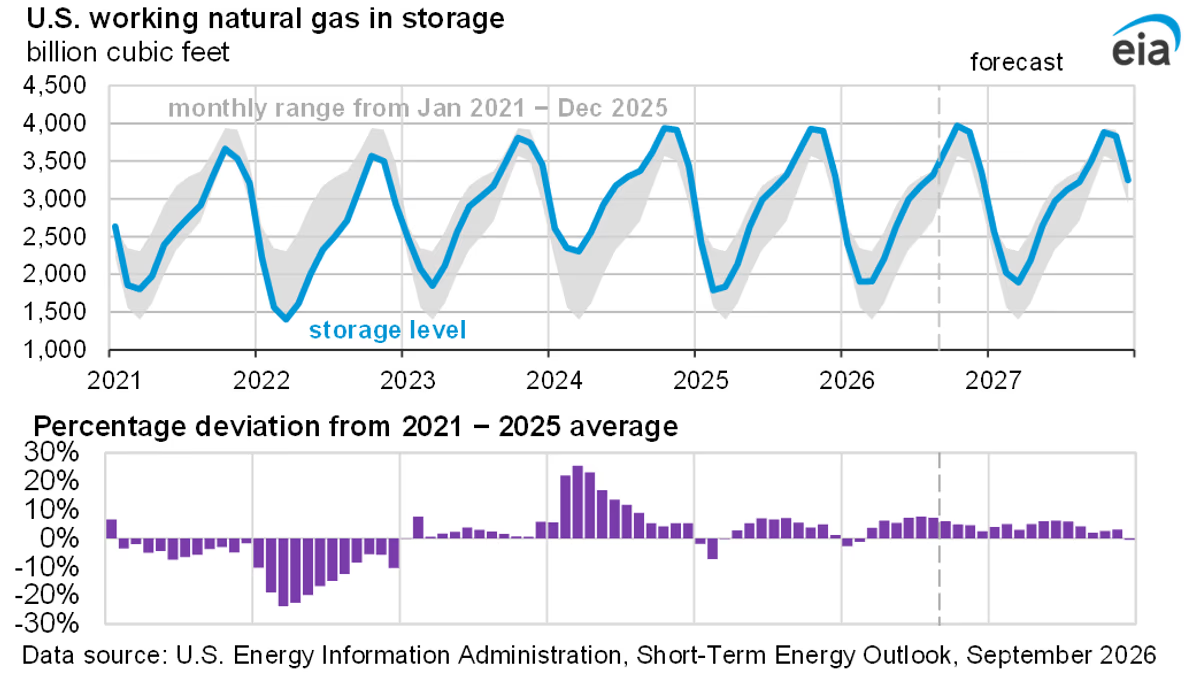
Wood Mackenzie's spring outlook projects U.S. LNG export capacity to reach 28 Bcf/d by 2030, up from 17.9 Bcf/d in March 2026, with TTF to Henry Hub spreads holding above $7 per MMBtu through end-2027 on continued European storage rebuild and Hormuz risk premium. Goldman Sachs commodity research has flagged the same thesis but warned that the second wave of U.S. LNG buildout, which Rio Grande Phase 1 anchors, could compress global gas prices into the 2028 to 2030 window if all FIDs deliver on schedule. The forecasters agree on capacity; they disagree on whether the marketers locking in offtake now (TotalEnergies, Shell, BP) will capture the spreads they have modelled.
The Q1 print suggests TotalEnergies is leaning into the Wood Mackenzie view: deploy capital to U.S. gas while the cash-flow picture remains exceptional, rather than wait for spread normalization.
Published by Oil Authority, edited by Adam Humphreys
Submit a Correction
Spotted a factual error? Free account required to submit a correction.