Alberta Synthetic Crude Swings to $19.25 Premium Over WTI as Middle East War Chokes Global Diesel Supply, Suncor and Imperial Oil Eye Windfall
Alberta Synthetic Crude Swings to $19.25 Premium Over WTI as Middle East War Chokes Global Diesel Supply, Suncor and Imperial Oil Eye Windfall.
Alberta's synthetic crude oil has swung from an $0.85 per barrel discount to a $19.25 per barrel premium over the West Texas Intermediate monthly average in less than a week, a nearly 200% price surge since March 27, 2026, driven by the Strait of Hormuz closure and its devastating effect on global diesel and jet fuel supply chains.
The move represents one of the most dramatic shifts in synthetic crude pricing in the history of Alberta's oil sands industry, benefiting producers including Suncor Energy, Imperial Oil, Canadian Natural Resources, and Cenovus Energy, who collectively could see windfall revenues of as much as $90 billion if crude prices hold near current levels, according to analysts tracking the Canada-Middle East market dynamics.
Why Alberta Synthetic Crude Is the Most Sought-After Barrel in the World
Synthetic crude oil (SCO), produced by upgrading bitumen from Alberta's Athabasca oil sands, is characterized by its low sulfur content and chemical profile that yields a disproportionately high share of diesel and jet fuel during refinery processing. These are precisely the product streams that global markets are most desperate for as the Hormuz closure strands approximately 20 million barrels per day of Middle Eastern production, the majority of which is destined for Asian refiners.
European diesel futures have surged to over $200 per barrel, their highest level since 2022, while jet fuel markets face an accelerating shortage that International Energy Agency Executive Director Fatih Birol described as the defining challenge of the current crisis: "The biggest problem today is the lack of jet fuel and diesel; these are the main challenges and we are seeing it already in Asia," Birol stated, adding that the shortage would spread to Europe by April or May.
North American Diesel Futures Approach US$4.20 Per Gallon as Refinery Margins Hit 18-Month High
The pricing pressure extends to retail markets. Patrick De Haan, Head of Petroleum Analysis at GasBuddy, estimated an 85% probability that U.S. diesel prices will set a new all-time record high within approximately two weeks as refinery feedstock costs translate into pump prices. Canada faces similar dynamics, with its diesel market pricing referenced against WTI, the current global benchmark at $107.85 per barrel as of April 3, 2026.
Brent crude, the international reference grade, traded at $112.42 per barrel on the same date. The inversion of the typical WTI discount to Brent reflects a premium on accessible North American supply as Middle Eastern crude sits stranded behind a closed shipping corridor that carried 20% of the world's daily oil exports before the February 28 military strikes that triggered the crisis.
Suncor, Imperial Oil, Canadian Natural Resources, and Cenovus Positioned for Revenue Windfall
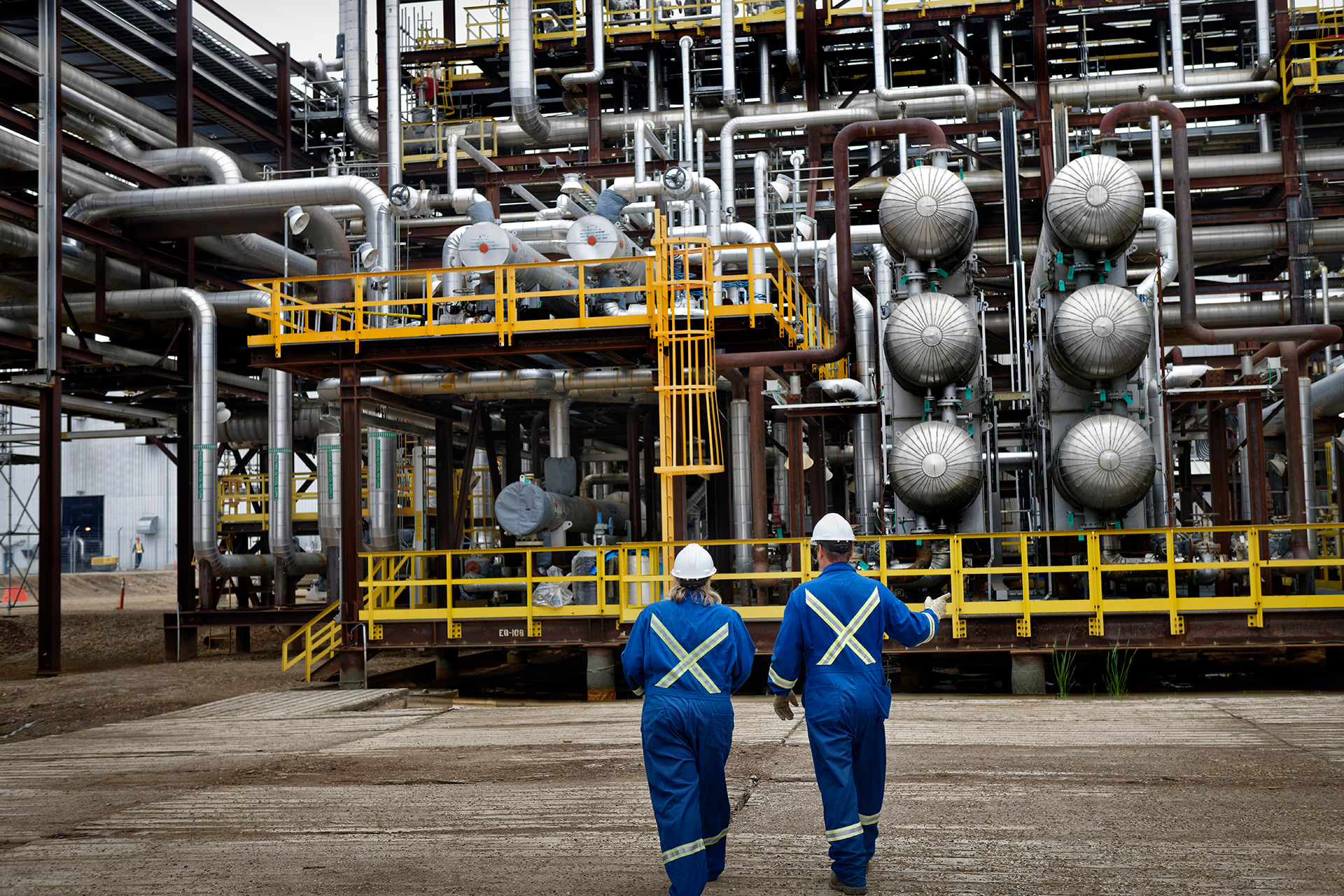
Alberta oil sands producers are uniquely positioned to capture the synthetic crude premium. Suncor Energy, which operates one of North America's most complex upgrading operations in Fort McMurray, produces SCO at its oil sands base plant and Syncrude joint venture. Imperial Oil, through its Kearl and Cold Lake operations, similarly produces bitumen-derived barrels that command the current premium.
Canadian Natural Resources (CNQ) and Cenovus Energy, each approaching or exceeding 1 million barrels of oil equivalent per day in 2026 output, have significant exposure to synthetic crude pricing through their upgrading operations. Analysts note that the $90 billion windfall estimate for Canadian producers assumes WTI prices remain above $100 per barrel for the balance of 2026, a scenario that appears increasingly plausible given the deepening of the Hormuz crisis.
WCS and SCO: Two Benchmarks, Both Rising
Western Canadian Select (WCS), the heavy oil blend that trades at a differential to WTI based on quality and transportation costs, has also benefited from the broader market tightening, though the premium dynamics are more complex for heavier grades. The more immediate and dramatic move has been in synthetic crude, which trades closer to WTI parity in normal conditions and has now broken sharply above it.
For Canadian oil sands producers, all revenues are received in U.S. dollars, meaning the current WTI level above $107 per barrel translates to record Canadian dollar earnings after currency conversion, amplifying the windfall on financial statements reported in CAD. At a USD/CAD exchange rate near recent levels, the per-barrel revenue in Canadian dollars represents a multiple of what was assumed in most operators' 2026 capital planning scenarios.
The question for markets is how long the Hormuz premium persists. According to OilPrice.com, BMI/Fitch analysts extended their conflict scenario estimate to up to eight weeks, while the first commercial tankers attempting to transit the strait have faced significant risk. Until a navigable corridor reopens, Alberta's synthetic crude is positioned as the world's preferred diesel feedstock, and its producers are the primary beneficiaries.
Published by Oil Authority, edited by Adam Humphreys
Submit a Correction
Spotted a factual error? Free account required to submit a correction.