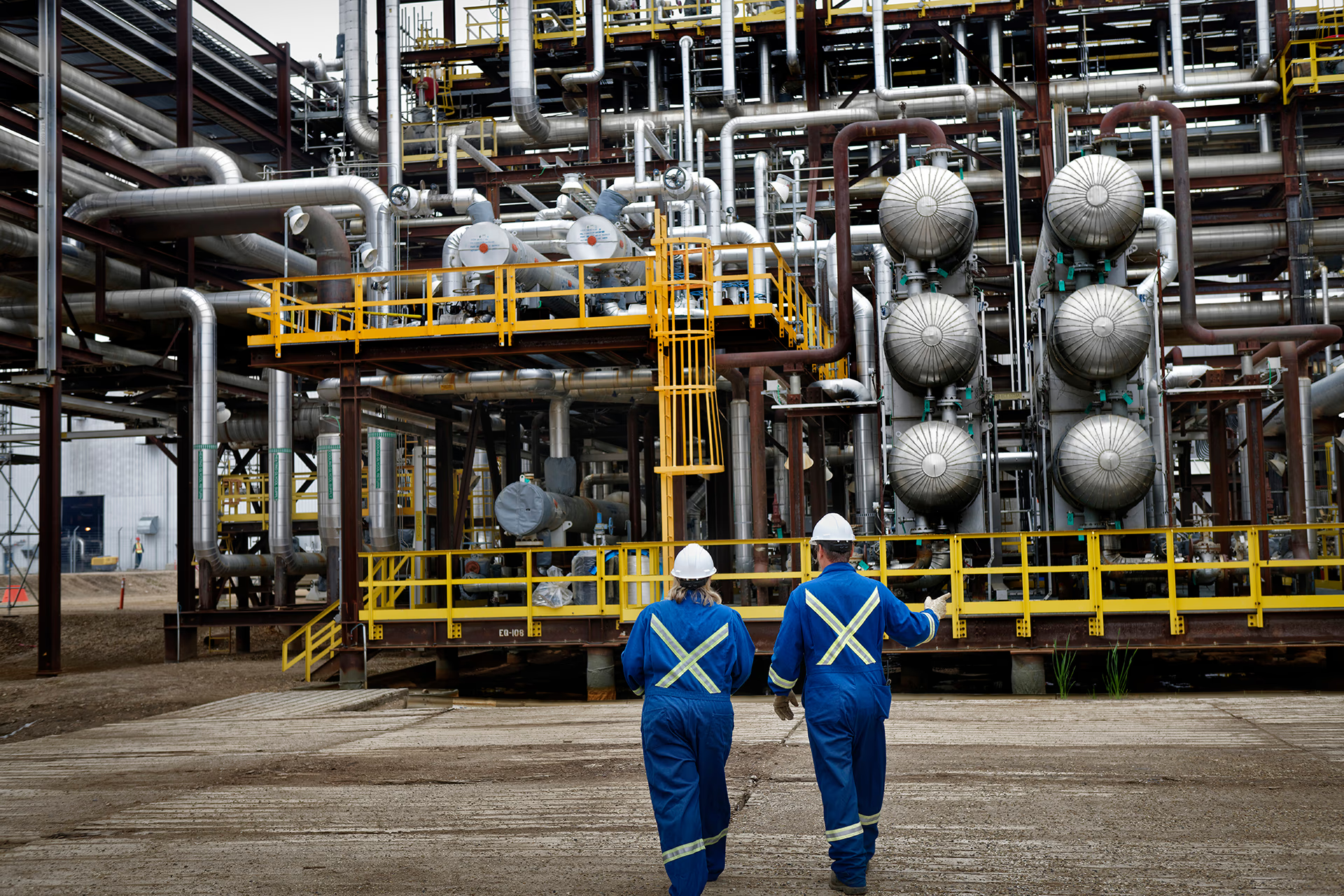
CNRL Targets Record 1.6 Million BOE/Day in 2026 as WCS Differential Widens to $15 Below WTI
Canadian Natural Resources Limited (CNRL) is on track to post the highest production figures in its history in 2026, targeting a record 1.6 million barrels o...
Canadian Natural Resources Limited (CNRL) is on track to post the highest production figures in its history in 2026, targeting a record 1.6 million barrels of oil equivalent per day (boe/d) across its Alberta oil sands and conventional operations. The milestone arrives at a pivotal moment for Canadian heavy oil producers: with WTI crude trading near $100 per barrel for the first time since 2022, Western Canadian Select (WCS) at Hardisty, Alberta is fetching approximately $84 to $85 USD per barrel after a differential that has widened to roughly $15.25 below WTI.
The differential expansion has been a source of frustration for Alberta producers. While the global price spike has been driven by the Strait of Hormuz supply disruption, WCS is competing against Venezuelan heavy crude flowing to US Gulf Coast refineries, placing added downward pressure on Canadian oil sands grades. Still, at $84 to $85/bbl, WCS prices remain highly profitable for CNRL and its peers by historical standards.
CNRL Acquires Full Albian Ownership From Shell Canada
CNRL completed a significant asset swap in early 2026, acquiring full ownership of the Albian oil sands mines in northern Alberta from Shell Canada. The Albian complex, which includes the Jackpine and Muskeg River open-pit mines, carries nameplate capacity of approximately 315,000 barrels per day of bitumen production. Shell Canada has now fully exited Alberta's oil sands business, redirecting its Canadian capital toward carbon capture and storage initiatives.
With the Albian acquisition folded into CNRL's existing oil sands portfolio, which includes its flagship Horizon Oil Sands upgrading facility north of Fort McMurray and its Pelican Lake and Cold Lake thermal operations, the company's consolidated production base has grown materially. CNRL has also initiated front-end engineering and design work in 2026 on expansion projects that could unlock an additional 260,000 bbl/d of new oil sands capacity across three separate development phases, with incremental volumes expected to reach full production between 2030 and 2033.
Cenovus Approaches 1 Million BOE/Day Milestone
CNRL is not alone in posting record output. Calgary-based Cenovus Energy is approaching the symbolic 1 million boe/d production mark, with 2026 guidance topping out at 985,000 boe/d. Cenovus has roughly doubled its production since 2020, when it was producing approximately 471,000 boe/d, through a combination of acquisitions, including the Husky Energy merger, and organic oil sands growth at its Foster Creek and Christina Lake steam-assisted gravity drainage (SAGD) projects in the Athabasca region.
Together, CNRL and Cenovus now account for more than 2.5 million boe/d of Canadian oil sands output, underscoring the sector's outsized contribution to North American supply.
Pipeline Capacity Remains the Long-Term Constraint
Alberta Premier Danielle Smith's government is advancing a proposal for a new crude oil pipeline to British Columbia's north Pacific coast with a targeted capacity of 1 million barrels per day. The province plans to submit a formal proposal to the federal government by June 2026. The pipeline, if approved and built, would provide Alberta producers with direct Pacific Rim export access, reducing dependence on US Gulf Coast markets and helping narrow the chronic WCS discount.
In the near term, Trans Mountain Pipeline expansion and planned Enbridge capacity additions are expected to provide incremental relief by mid-to-late 2027. However, analysts forecast that export capacity could become constrained again as soon as the third quarter of 2028, as oil sands production growth outpaces available pipeline space.
Pathways Carbon Capture Project Faces Indigenous Opposition
The oil sands sector is also contending with a growing challenge to the Pathways Alliance carbon capture and storage (CCS) project, a major industry initiative to reduce emissions from Alberta's oil sands. A coalition led by Chief Allan Adam of the Athabasca Chipewyan First Nation, along with farmers and rural landowners in the region, is demanding a full federal environmental assessment of the proposed CO2 pipeline and underground storage complex that forms the backbone of the Pathways CCS project. The opposition could delay the project's timeline and add regulatory uncertainty for the sector.
WCS at $84 USD: Strong But Below Global Benchmarks
For Alberta producers, the current price environment is highly profitable despite the widening discount. WCS at approximately $84 USD per barrel sits well above the $50 to $60/bbl range that characterized much of 2023 and 2024. Most integrated oil sands operators carry operating costs in the range of $28 to $40 USD per barrel on an all-in basis, leaving substantial netbacks even after royalties and transportation tariffs to Hardisty, Alberta.
However, the widening differential is a reminder that Canada's landlocked heavy oil producers remain exposed to pipeline bottlenecks, refinery preferences, and competing heavy crude sources in a way that Gulf Coast or Permian Basin producers are not. Should tensions in the Strait of Hormuz ease and WTI retreat from current highs, WCS producers could find the pricing environment tightening relatively quickly.
For now, CNRL's record production targets and the broader oil sands growth trajectory point to a sector entering a new phase of expansion, backed by strong balance sheets and the most favorable global crude price environment in four years.
Published by Oil Authority, edited by Adam Humphreys
Submit a Correction
Spotted a factual error? Free account required to submit a correction.