QatarEnergy Extends LNG Force Majeure Through August as TTF Jumps 4% to 47.56 Euros Per MWh
QatarEnergy extends LNG force majeure through mid-August as TTF spikes 4% to 47.56 euros per MWh, with EU gas storage 17 points below seasonal norms.
QatarEnergy has extended its force majeure declaration on long-term LNG contracts through mid-August 2026, covering supply agreements disrupted by the Strait of Hormuz closure that began February 28. The Ras Laffan LNG complex sustained damage in Iranian strikes in mid-March; repair assessments indicate work could take up to five years, per OilPrice.com. Qatar supplied 12 to 14 percent of Europe's LNG imports before the crisis and was among the continent's most reliable long-term counterparties.
TTF Rebounds 4.31 Percent as Iran Rejects Hormuz Proposal
Dutch TTF front-month natural gas futures climbed to 47.56 euros per MWh on Tuesday, a gain of 4.31 percent, per Trading Economics. The move reversed a 4.22 percent selloff on Monday, when markets responded to reports of a near-term US-Iran agreement. Iran's Foreign Ministry rejected the latest US Hormuz proposal on Tuesday, and US forces conducted fresh strikes on Iranian missile sites, removing near-term diplomatic optimism. TTF has risen 28 percent over the past year and sits within the 42-to-55-euro range that analysts at ING and Wood Mackenzie cite for the coming four to eight weeks.
European Gas Storage: 17 Points Below Seasonal Norms
European underground gas storage stood at 38.2 percent capacity as of May 25, per EnergyRiskIQ data based on AGSI+ tracking. The five-year seasonal norm for late May is near 55 percent, placing Europe 17 percentage points below where inventories typically sit at this time of year. That deficit represents 184,800 gigawatt-hours of gas that would need to be sourced and stored to reach seasonal parity. The Netherlands stood at 5.8 percent full, Germany at 20 percent, and France at 27 percent.
To reach the revised EU mandatory target of 80 percent by November, Europe needs to inject 3,584 gigawatt-hours per day over the next 159 days. The current seven-day injection pace of 4,471 GWh per day exceeds that rate. Equinor CFO Torgrim Reitan said he has "doubt about Europe's ability to achieve the 80 percent storage target," and Eurasia Group's Henning Gloystein said refilling will be "slower than typical market conditions." The TTF seasonal spread, summer against winter, sits in negative territory near 1.30 euros per MWh, a pricing signal that discourages industrial-scale injections.
The $11 Spread: What Henry Hub-TTF Means for US Exporters
Henry Hub front-month futures were quoted at $3.064 per MMBtu as of 7:35 AM EDT Tuesday on the New York Mercantile Exchange, up 1.42 percent on the day. Wood Mackenzie's May 26 market note valued TTF at US$14 per MMBtu in comparable dollar terms. The implied Henry Hub-to-TTF spread is $11 per MMBtu, consistent with Wood Mackenzie's figure.
A standard 160,000-cubic-metre LNG carrier holds 3.4 billion cubic feet of natural gas. At an $11 spread, each cargo carries a gross arbitrage value of $37 million before shipping and liquefaction costs, which typically run $2 to $4 per MMBtu combined. US LNG export capacity ran at 14 billion cubic feet per day in May, per EIA data. The gross spread across the entire US export slate totals $154 million per day at that rate. These calculations are Oil Authority's; source inputs are Yahoo Finance for Henry Hub, Wood Mackenzie's May 26 note for the TTF equivalent, and EIA capacity data.
US LNG Fills the Qatar Gap, at Maximum Capacity
The US share of EU LNG imports rose to 63 percent in the first quarter of 2026, up from 57 percent a year earlier, per the Institute for Energy Economics and Financial Analysis. The IEA forecasts Europe will import a record 185 billion cubic metres of LNG in 2026 as buyers race to replace Qatar's pre-crisis volumes. All US LNG export facilities are running at or near maximum capacity, capping additional supply response. Three US LNG cargoes are scheduled to arrive in China in June 2026, the first US-origin shipments to China since February 2025, according to Natural Gas Intelligence, a sign that Asian buyers are also competing for US supply.
The force majeure extension covers European buyers including Edison SpA of Italy. Botas of Turkey and Edison signed a separate LNG cooperation accord in May 2026, seeking to diversify supply options beyond Qatar. The industrial strike at Australia's Ichthys LNG facility was called off in late May, restoring one additional supply stream for Asian buyers, per Natural Gas Intelligence.
Analyst Scenarios Range From 30 to 90 Euros Per MWh
Wood Mackenzie published three price scenarios on May 26. A quick peace with Hormuz reopening in June 2026 would send TTF toward 30 euros per MWh by year-end. A settlement by September 2026 would keep prices elevated through the third quarter. An extended disruption lasting into 2027 could push TTF above 90 euros per MWh.
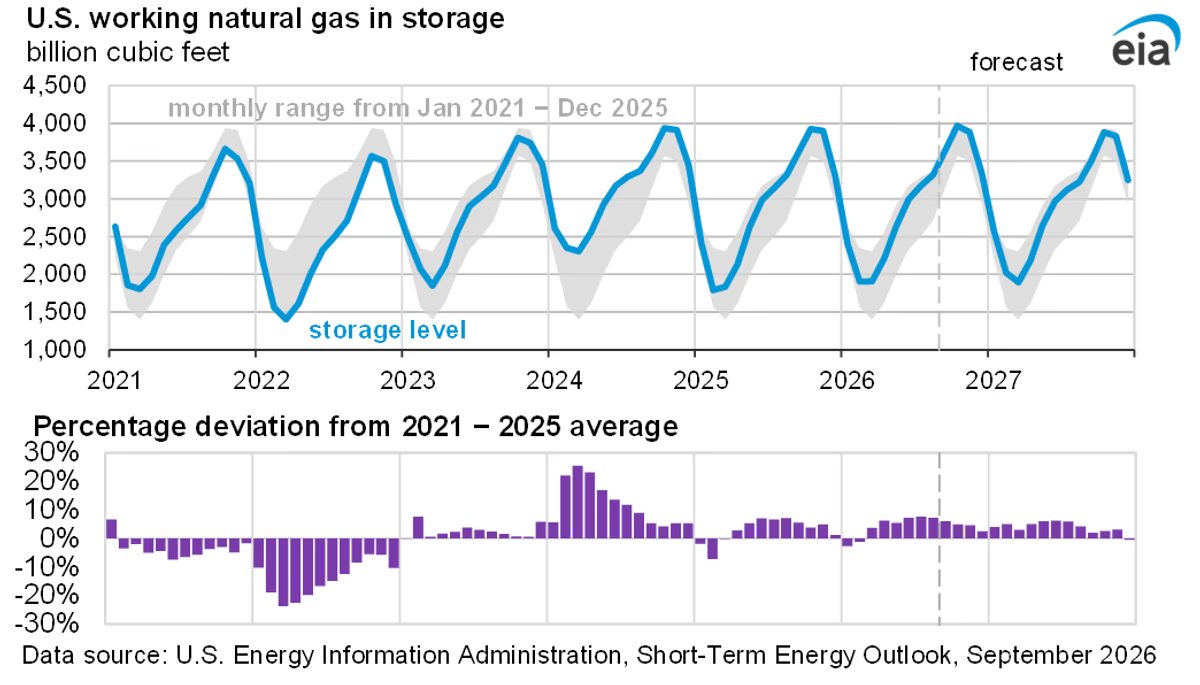
Equinor separately warned that a one-to-three-month Hormuz blockage would make the European supply situation "highly critical." IEA chief Fatih Birol warned markets could enter a "red zone" by July or August as global gas and oil inventories deplete. The EIA Short-Term Energy Outlook, published May 12, estimated that disruptions across Gulf producers totaled 14 million barrels per day of oil-equivalent energy, a figure that also captures LNG volumes stranded behind Hormuz. Wednesday's EIA Weekly Petroleum Status Report, due tomorrow, will provide an updated read on US inventory draws that set broader energy market sentiment.
Published by Oil Authority, edited by Adam Humphreys
Submit a Correction
Spotted a factual error? Free account required to submit a correction.