Suncor Energy Targets 960,000 BOE Per Day by 2028 with Fort Hills Autonomous Haul Systems and Firebag Stages 5 and 6 Expansions
Suncor Energy Targets 960,000 BOE Per Day by 2028 with Fort Hills Autonomous Haul Systems and Firebag Stages 5 and 6 Expansions.
Suncor Energy laid out an ambitious three-year growth plan at its Investor Day on March 31, 2026, targeting production of 960,000 barrels of oil equivalent per day (BOE/day) by 2028. The plan represents an increase of approximately 100,000 BOE/day from current operated volumes and sets a WTI break-even target of $38 per barrel (USD), positioning Suncor among the most cost-competitive integrated operators in the global oil sands sector.
With WTI trading above $111 per barrel (USD) on April 3, the current price environment generates free cash flow of more than $70 per barrel above Suncor's break-even threshold. That margin creates exceptional financial capacity to fund growth at Fort Hills and Firebag, reduce net debt, and return capital to shareholders simultaneously. RBC Capital Markets and Goldman Sachs both raised their price targets for Suncor following the Investor Day, citing the clarity and achievability of the three-year plan.
Fort Hills: Autonomous Haul Systems and Extraction Optimization
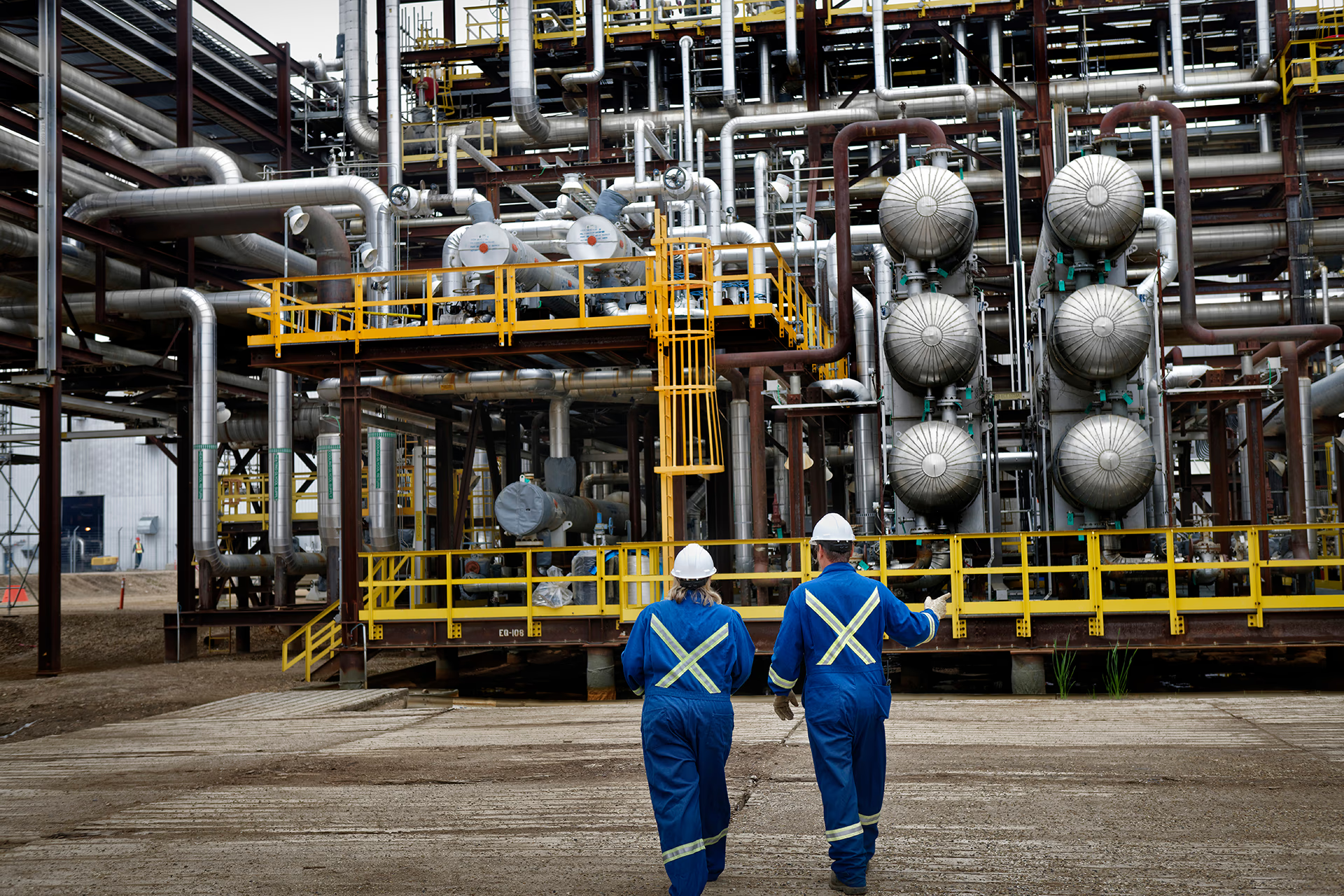
Fort Hills, the oil sands mining operation north of Fort McMurray, Alberta, is central to the 2028 growth strategy. Suncor acquired 100 percent ownership of Fort Hills after purchasing TotalEnergies' 24.58 percent stake in 2023, and the operation now runs under a unified optimization mandate that was not possible under the prior joint venture structure.
The company is deploying a fleet of Autonomous Haul System (AHS) trucks across the Fort Hills mine, replacing conventional operator-driven haulage with software-guided electric-drive trucks that run continuously without shift changes or fatigue-related downtime. Suncor expects AHS deployment to reduce unit mining costs at Fort Hills and to improve ore throughput consistency, contributing incremental production volumes within the existing mine footprint without requiring additional regulatory approvals or surface disturbance. Debottlenecking work completed in 2024 and 2025 already lifted Fort Hills toward its nameplate capacity of approximately 180,000 barrels per day of bitumen, and further extraction optimization through advanced froth treatment chemistry and real-time process control targets improved bitumen recovery rates in the years ahead.
Firebag Stages 5 and 6: In-Situ SAGD Expansion
Firebag, Suncor's steam-assisted gravity drainage (SAGD) operation northeast of Fort McMurray, will be the primary source of net production growth under the 2028 plan. Suncor is advancing Firebag Stages 5 and 6, which add new well pairs, steam generation capacity, and processing infrastructure to an existing operated complex with established regulatory approvals and proven reservoir performance.
SAGD expansions at Firebag carry lower development risk than greenfield in-situ projects because the reservoir characterization, surface infrastructure, and skilled workforce are already in place. Incremental capital cost per flowing barrel is lower than for new projects, and ramp-up to plateau production typically occurs within 18 to 24 months of first steam injection, making Firebag Stages 5 and 6 among the faster-payback capital investments available to the company. The $2 billion in incremental free cash flow identified through debottlenecking and operational efficiency measures across the portfolio represents internal capital generation that does not depend on commodity price assumptions above $60 per barrel WTI.
West White Rose and Downstream Integration
Suncor is also progressing West White Rose, the offshore Newfoundland extension to the White Rose oil field operated under the Terra Nova JV structure, as a lower-volume but high-margin conventional crude addition to the portfolio. West White Rose crude trades at a premium to WTI due to its light, sweet specifications, providing a natural hedge against any widening of the WCS-to-WTI discount. The WCS discount stands at approximately $15 per barrel (CAD-impacted) as Strait of Hormuz disruptions reduce Gulf Coast demand for heavy crude grades that compete with Canadian barrels.
Suncor's integrated downstream segment captures the full barrel value from wellhead to fuel station, processing a significant share of its own upstream bitumen at the Edmonton, Alberta and Sarnia, Ontario refineries. The elevated crack spreads of $22 to $28 per barrel that North American refiners are currently earning on $100-plus WTI feedstock provide an additional downstream earnings boost that pure-play upstream producers do not capture, reinforcing Suncor's integrated business model.
Capital Return Framework
CEO Rich Kruger outlined a financial framework prioritizing balance sheet strength before accelerating shareholder returns. Suncor is targeting a net debt floor of $8 billion (CAD), below which 100 percent of excess free funds flow will be directed to share buybacks. At current commodity prices, the company expects to reach that net debt threshold within fiscal 2026, initiating the full buyback program before year-end.
The structure reflects a disciplined approach to capital allocation that the current management team has consistently applied since Kruger took over as CEO in 2022. Rather than committing to a fixed dividend payout that creates obligations through the commodity cycle, Suncor has used buybacks as the primary return mechanism, reducing the share count significantly since 2022 and amplifying per-share earnings growth as production volumes rise.
Sector Context
Suncor's 2028 plan arrives as the Canadian oil sands sector is experiencing a period of exceptional profitability. Canadian Natural Resources recently raised its 2026 production guidance after a $765 million Peace River acquisition, and Cenovus Energy is approaching 1 million BOE per day following the MEG Energy integration, reflecting sector-wide momentum toward higher output targets. WTI above $100 per barrel (USD) and a $15 WCS differential leave producers with strong wellhead netbacks supporting aggressive reinvestment across the basin.
The Trans Mountain Expansion pipeline, now in commercial operations, provides Alberta producers including Suncor with tidewater access to Asia-Pacific refiners willing to pay Brent-linked prices, partially reducing the structural WCS discount. For Suncor, expanded access through Trans Mountain means that future Firebag and Fort Hills production increasingly competes in global markets rather than only in landlocked North American crude systems, improving long-run price realizations relative to the WTI benchmark and supporting the economics of the $38 per barrel break-even target.
Published by Oil Authority, edited by Adam Humphreys
Submit a Correction
Spotted a factual error? Free account required to submit a correction.