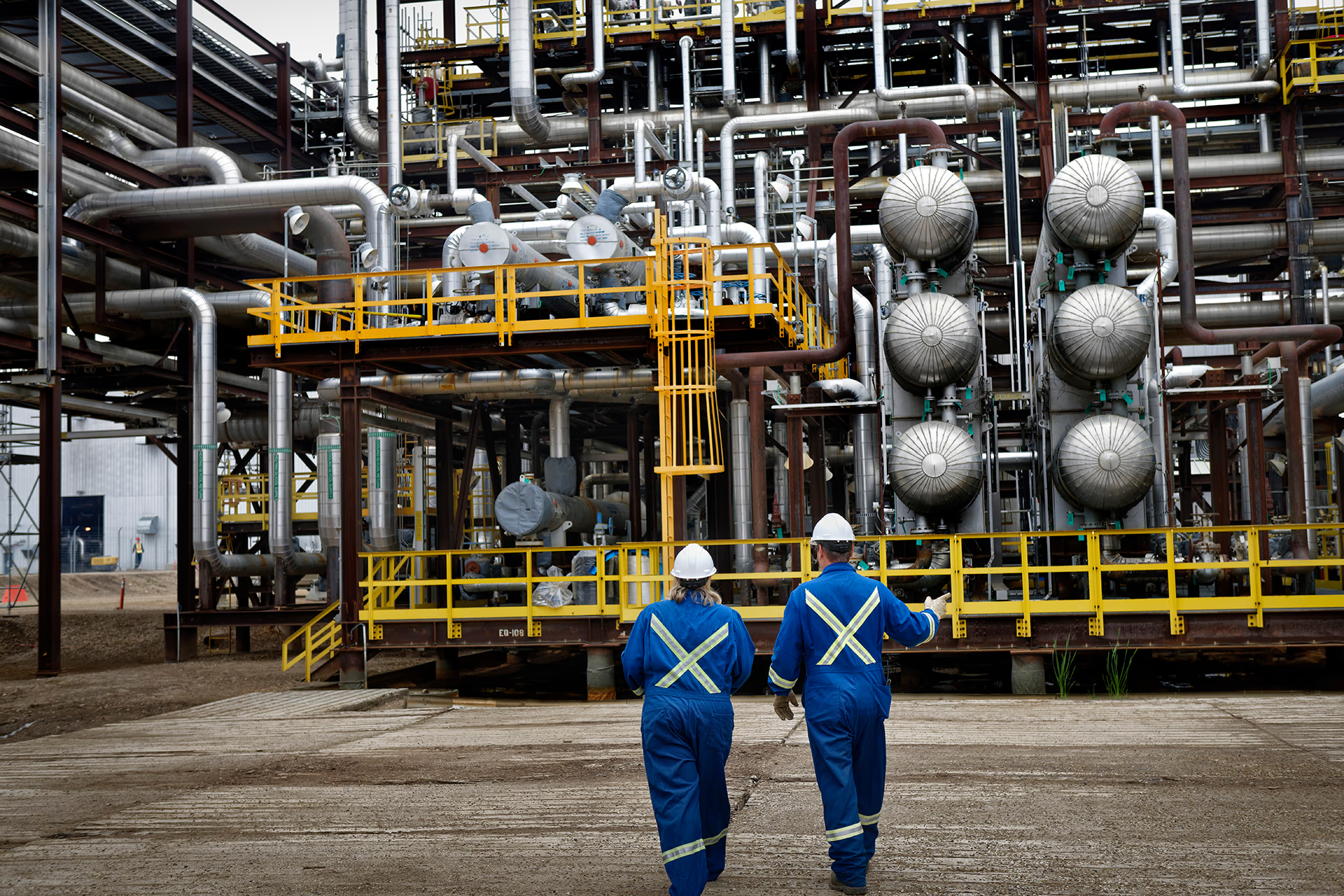
Alberta Sets $32.4 Billion Oil Capex Record in 2025 as AER Projects Record Oil Sands Output
Alberta crude hit 4.4 MMbpd in 2025 and oil capex reached $32.4B, a decade high. The AER's new 10-year outlook targets record oil sands output in 2026.
Alberta's oil and gas sector posted its highest capital spending in a decade in 2025 and is on track for a record oil sands production year. The Alberta Energy Regulator released its 2026 Alberta Energy Outlook on September 29, showing total capital expenditures across crude oil, natural gas, oil sands, and emerging resources reached $32.4 billion last year. Crude oil and equivalent output rose 4% to 4.4 million barrels per day, with Alberta accounting for 84% of Canada's total oil equivalent production.
Investment Cycle Reaches a Ten-Year High
The $32.4 billion capex total is the largest annual capital commitment in Alberta's oil and gas sector in the past decade, according to the AER's ST98 report. A Canadian federal-provincial memorandum supporting oil production growth and U.S. policy changes shaped market conditions through 2025, per the AER. Alberta also supplied 60% of Canada's natural gas output in 2025. Middle East conflict beginning in February 2026 has since further elevated crude benchmarks through the current forecast period.
WTI crude traded at $90.28 per barrel on Wednesday, per Yahoo Finance, down 0.15% on the day. Brent crude traded at $97.74 per barrel at the same time. At Alberta's 4.4 million barrels per day of production, every $1 per barrel move in WTI translates to $4.4 million per day in aggregate provincial production revenue, or $1.606 billion annualized. That revenue sensitivity illustrates why the $32.4 billion capex cycle was economically viable. With WTI above $80 per barrel through most of 2025, operators had the cashflow to fund new wells, SAGD pads, and facility expansions.
Oil Sands Operators Drive the Production Record
Oil sands production is the dominant component of Alberta's output. S&P Global Commodity Insights projects Canadian oil sands will reach a record 3.5 million barrels per day in 2026, per World Oil. At that level, oil sands would represent 79.5% of the 4.4 MMbpd total the AER cited for 2025, with S&P Global expecting continued growth as sanctioned expansion projects ramp up.
Six operators drive nearly all oil sands volumes: Canadian Natural Resources, Suncor Energy, Cenovus Energy, Imperial Oil, MEG Energy, and ConocoPhillips. Imperial Oil operates the Kearl oil sands mine and Cold Lake thermal project; ExxonMobil holds a 70% stake in Imperial, making it the American supermajor's primary Canadian upstream vehicle. Suncor Energy holds a 58.74% operated stake in Syncrude Canada alongside its own oil sands mines. Capital allocation for both companies flows in part from corporate decisions made in Houston and Calgary respectively.
Canadian Natural Resources holds no US multinational parent and operates Horizon Oil Sands plus thermal assets at Pelican Lake and Cold Lake, making it the largest single oil sands operator by output. Cenovus Energy, formed partly from ConocoPhillips Canada assets, runs Christina Lake and Foster Creek SAGD projects. Together, the six Pathways Alliance operators represent nearly all of Alberta's oil sands production capacity.
Pathways CCS Linked to Production Growth
Canada and Alberta have formally tied long-term oil sands production growth to the Pathways Alliance Carbon Capture and Storage project, per World Oil. Pathways Alliance members are the same six major oil sands operators cited above. The alliance is developing a CCS pipeline and storage network in the Cold Lake and Athabasca regions targeting carbon dioxide capture from upgraders and extraction facilities. The federal-provincial memorandum referenced in the AER's 2026 outlook formalizes the policy connection between production growth and carbon abatement commitments.
Netback Pressure Persists Despite Record Output
Record production and capital investment do not automatically translate into record operator profits. As Oil Authority reported this week, the WCS-WTI differential reached $11.93 per barrel, squeezing Alberta oil sands netbacks. Western Canadian Select trades at a persistent discount to WTI because pipeline takeaway capacity remains constrained even after Trans Mountain expansion. Using that $11.93 differential, today's WTI of $90.28 implies WCS at $78.35 per barrel before transportation costs and royalties.
At 3.5 MMbpd of oil sands production, every $1 per barrel widening of the WCS-WTI differential costs Alberta operators $3.5 million per day in foregone revenue, or $1.278 billion annually. The record $32.4 billion capex cycle was funded despite this structural constraint. Trans Mountain expansion has added tidewater capacity for Alberta crude, and Pathways Alliance CCS commitments represent a long-term producer commitment to Alberta's oil sands expansion. The AER's 2026 outlook provides a 10-year framework through which investors can assess the province's energy trajectory.
Published by Oil Authority, edited by Adam Humphreys
Submit a Correction
Spotted a factual error? Free account required to submit a correction.