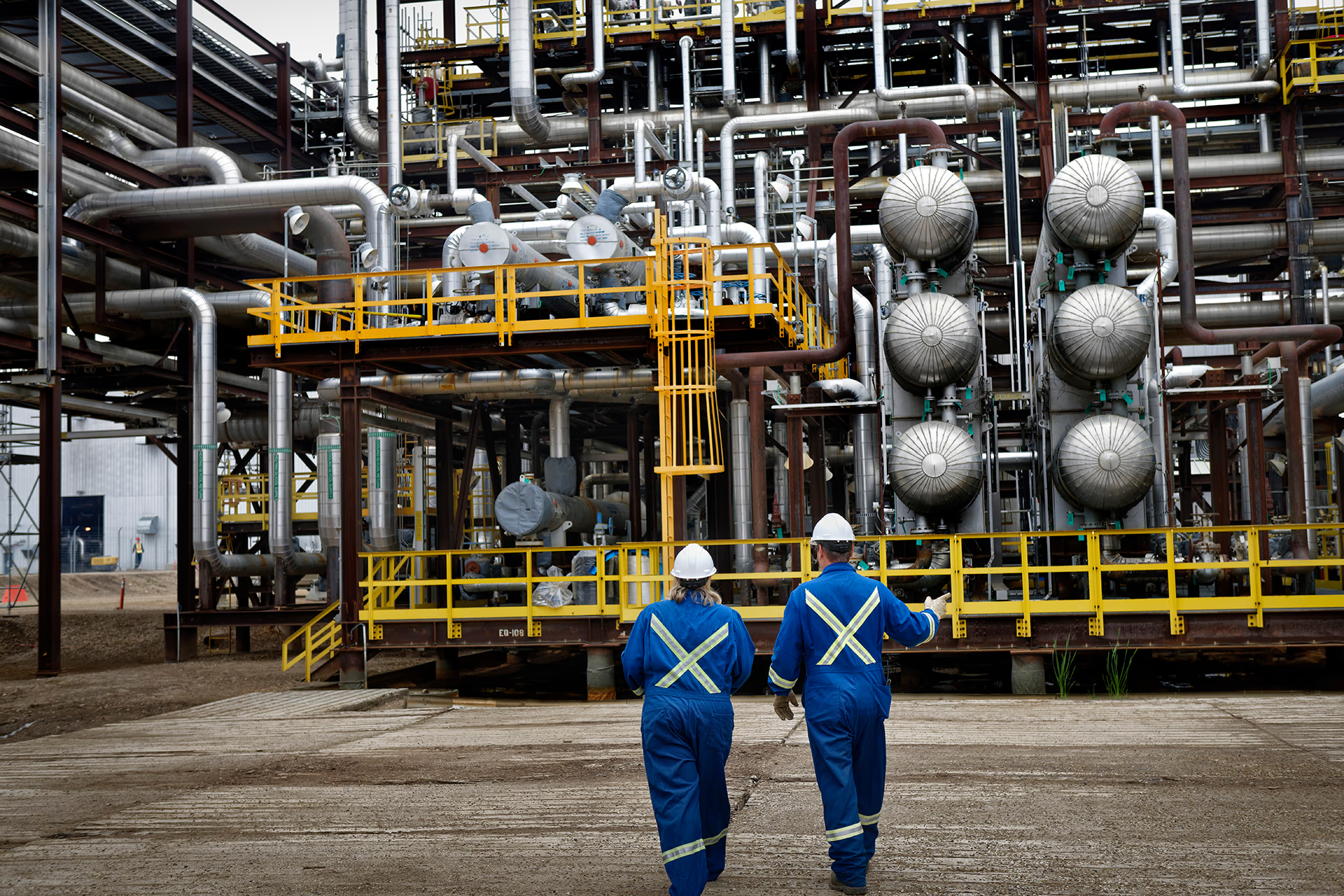
Rosneft Loads First Vostok Oil Cargo on Arc7 Tanker Valentin Pikul at Bukhta Sever, Targeting 1 Million bpd by 2030 From 51-Billion-Barrel Reserve
Rosneft loaded its first Vostok Oil cargo on Arc7 tanker Valentin Pikul at Bukhta Sever, commissioning a $157B Arctic project targeting 1 million bpd by 2030.
Rosneft loaded its first Vostok Oil crude cargo onto the ice-class tanker Valentin Pikul at Bukhta Sever port on the Kara Sea on September 6, 2026. Russian President Vladimir Putin oversaw the commissioning via video link, with Rosneft CEO Igor Sechin and Deputy Prime Minister Alexander Novak attending in person. The project draws from three Arctic deposits: the Vankor cluster, the Payakhskoye field, and the West-Irkinsky site, together holding seven billion tonnes of low-sulphur crude. A second cargo loaded immediately onto the Aframax tanker Akademik Gubkin, which had anchored offshore awaiting the lift.
Infrastructure: 790-Kilometre Pipeline, World's Northernmost Oil Terminal
The Vankor-Payakha-Bukhta Sever trunk pipeline runs 790 kilometres from the Arctic deposits to the Kara Sea terminal. Engineers buried a 5.8-kilometre section beneath the Yenisei River to complete the route. Bukhta Sever's 18-metre-deep berth accommodates Aframax-class vessels up to 120,000 deadweight tonnes, and the port operates year-round behind a specially constructed protective dam. Rosneft plans to expand terminal storage to 102 tanks as production scales.
The project holds seven billion tonnes of oil, or approximately 51 billion barrels at a standard conversion of 7.33 barrels per metric tonne. Sulphur content ranges from 0.01% to 0.1%, placing Vostok crude in the ultra-low-sulphur category. Rosneft deployed over 50,000 workers and sourced all equipment domestically after Western sanctions barred international suppliers. More than 2,000 production wells have been drilled to date across the three deposits.
Ownership Structure: Trafigura and Vitol Withdrew, Leaving Rosneft as Sole Owner
Vostok Oil was originally structured as a joint venture. Commodity traders Trafigura and Vitol each held equity stakes alongside Rosneft before withdrawing in early 2022, following Western sanctions imposed after Russia's invasion of Ukraine. Their exit removed a combined planned capital contribution of approximately $7 billion, forcing Rosneft to rely entirely on Russian state and domestic bank financing. Rosneft is Russia's largest oil producer, with the Russian government controlling approximately 40% of shares through Rosneftegas.
Rosneft has invested 4 trillion roubles, or approximately $46.5 billion at current exchange rates, through the project's construction phase. The total expected capital cost over the project's full life reaches $157 billion, per OilPrice.com analysis of Rosneft financial disclosures. Because all financing and equipment are domestic, Vostok Oil's output sits outside Western trading infrastructure and standard crude benchmark reporting. Russia has no formal obligation to share cargo destinations with Western market monitors.
Revenue at ICE Brent $96.28: Payback Math at Current Prices
ICE Brent front-month crude traded at $96.28 per barrel in Monday's session, per Yahoo Finance data for the BZ=F contract. NYMEX markets closed for the US Labor Day holiday; WTI front-month settled at $91.48 per barrel on Friday September 5, 2026, per the CME close. Rosneft's 2030 production target of 50 million tonnes per year converts to approximately 1 million barrels per day. At that rate and today's Brent, gross annual revenue reaches roughly $35.3 billion.
Arctic extraction typically costs $18 to $25 per barrel in lifting expense. At a $22 mid-range assumption against today's $96.28 Brent, the per-barrel margin is $74.28, producing approximately $27.2 billion per year in operating cash flow at 2030 production levels. Payback on the $46.5 billion invested to date takes roughly 1.7 years at sustained 2030 output and current prices. Payback on the $157 billion lifetime project cost takes approximately 5.8 years at the same assumptions. CEO Sechin cited a long-run ceiling of 100 million tonnes annually, which would represent approximately 2 million barrels per day.
Northern Sea Route: Vostok Bypasses Hormuz Entirely
Oil Authority coverage this week tracked the Strait of Hormuz narrowing to as few as five tanker transits per day as US-Iran tensions escalated, pushing ICE Brent from $89 to the current $96.28 range. Vostok Oil's export route avoids Hormuz entirely. Crude moves from the Vankor deposits through the 790-kilometre pipeline to Bukhta Sever, then onto the Northern Sea Route westward toward European refineries or eastward into Asian markets. Neither direction transits Iranian-controlled waters.
Goldman Sachs maintained its Q4 2026 Brent target at $80 per barrel in its July 23, 2026 research note, citing reduced Middle East supply balanced against seasonal demand softening. Current ICE Brent at $96.28 sits $16.28 above that target. Goldman separately modelled an upside scenario of $120 per barrel if Mideast shipping attacks intensify. Wood Mackenzie holds its 2026 full-year Brent estimate at $92 per barrel, per analysis published in June 2026. The $12 spread between Goldman Q4 and Wood Mackenzie reflects divergent assumptions about Hormuz normalization timing.
Vostok's initial 2027 ramp rate of 600,000 barrels per day cannot offset the 19 to 20 million barrels per day that normally transit Hormuz daily. As a structural signal, the first cargo confirms that Russia has opened a commercially viable supply corridor that has never been Hormuz-dependent. No prior Arctic oil project reached commercial-scale loading at the Kara Sea.
Analyst Spread: Goldman, Wood Mackenzie, and EIA $27 Apart on 2027 Brent
Three major forecasters sit more than $27 apart on 2027 Brent crude. Goldman Sachs projects Brent averaging $75 per barrel in 2027, assuming Hormuz reopens and supply normalizes. Wood Mackenzie cut its 2027 Brent estimate to $78 per barrel in June 2026, following a US-Iran memorandum of understanding targeting a staged Hormuz reopening, per Hydrocarbon Engineering. The EIA Short-Term Energy Outlook projects Brent at $69 per barrel for 2027, reflecting base-case assumptions of resumed OPEC+ production and easing geopolitical risk premiums.
Western Canadian Select crude settled at $70.01 per barrel in the most recent trading session, per pricing reflected in Oil Authority market coverage. The WTI-WCS differential stood at approximately $21.47 per barrel, based on WTI's Friday CME settlement of $91.48. A sustained Brent and WTI decline driven by supply normalization would widen the WTI-WCS spread further, compressing netbacks for Alberta oil sands producers. Vostok Oil's addition to global supply is not large enough to shift 2027 benchmarks on its own. All three forecasters, however, embed the same scenario: a supply surplus that deflates the Hormuz risk premium over time as output from new Arctic corridors grows.
Published by Oil Authority, edited by Adam Humphreys
Submit a Correction
Spotted a factual error? Free account required to submit a correction.