Alberta-Ottawa Bitumen Pipeline MOU Misses Two April Deadlines, July Application Filing Looms for Tidewater Corridor
A landmark memorandum of understanding between the Alberta government and Ottawa on energy cooperation has already stumbled at its first milestone.
A landmark memorandum of understanding between the Alberta government and Ottawa on energy cooperation has already stumbled at its first milestone. Premier Danielle Smith acknowledged in late March 2026 that two of four April 1 deadlines embedded in the November 2025 agreement with Prime Minister Mark Carney would not be met, leaving the centerpiece of the deal, a new bitumen pipeline from Alberta to British Columbia tidewater, further from construction than the agreement's drafters envisioned.
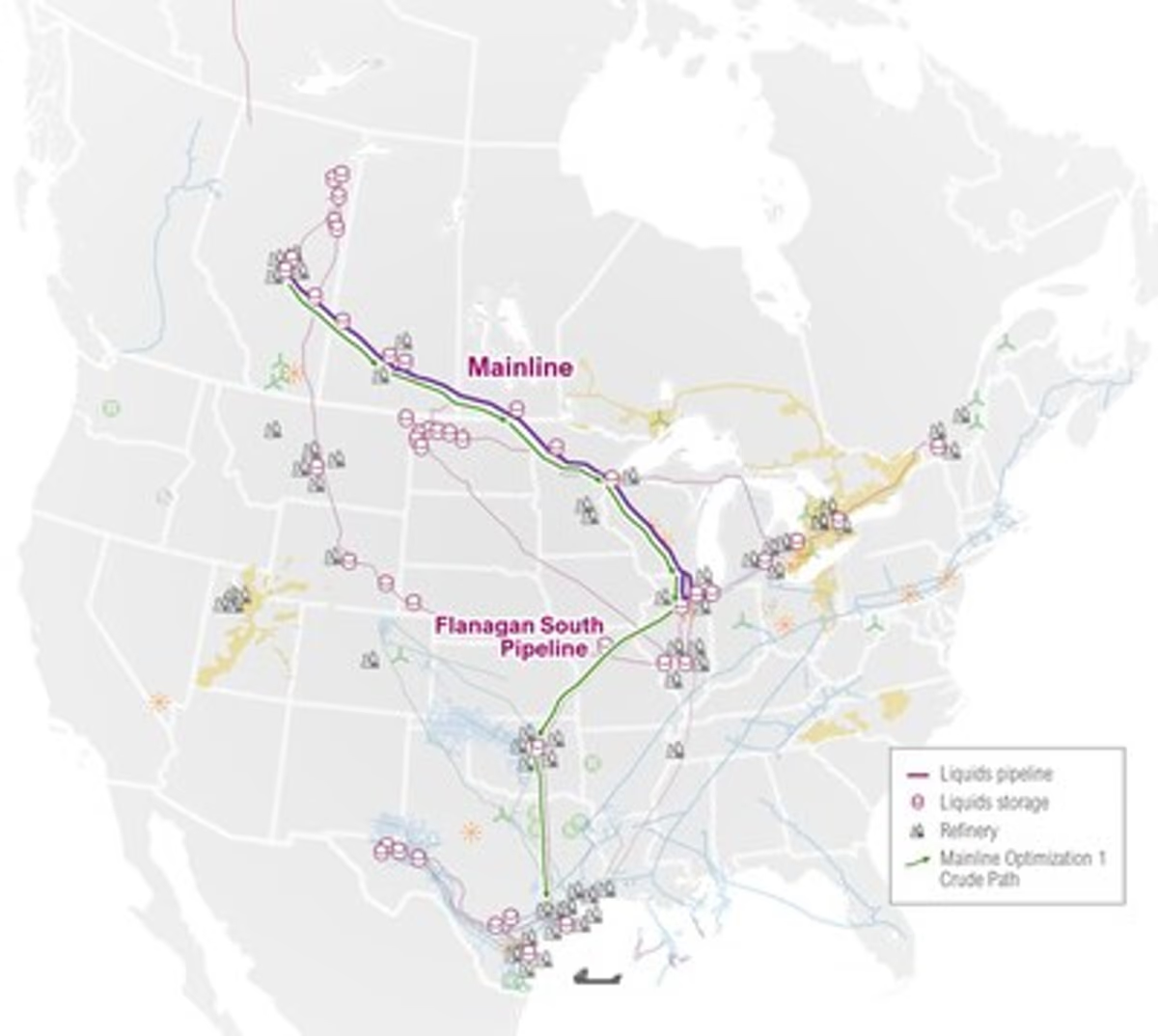
The MOU, signed in November 2025, was intended to clear the path for a new export pipeline capable of carrying an additional 300,000 to 400,000 barrels per day of Alberta bitumen to Pacific tidewater for shipment to Asian markets. With Trans Mountain Expansion now running at capacity and U.S. export routes facing tariff and political uncertainty, the tidewater corridor has taken on heightened strategic importance for Alberta's oil sands producers.
What Was Agreed, What Was Missed
Of the four April 1 benchmarks, Alberta and Ottawa reached agreements in principle on two: a harmonized approach to methane emissions standards and a revised federal project assessment process. Both sides characterized those agreements as meaningful but acknowledged they fell short of legally binding commitments.
The two unresolved items are more contentious. The first is industrial carbon pricing. The MOU stipulates that Alberta's carbon price must eventually reach $130 per tonne, but Smith said the pace of reaching that level remains in dispute. Smith told reporters on March 31: "I have a different number than the prime minister at the moment." Carney's office confirmed negotiations are ongoing but declined to specify a revised timeline.
The second unresolved item is a separate MOU with the Oil Sands Alliance, the consortium of the five largest oil sands producers in Canada: Suncor Energy, Canadian Natural Resources, Cenovus Energy, ConocoPhillips, and Imperial Oil (majority-owned by ExxonMobil). The alliance controls roughly 85 percent of Alberta's oil sands output and is a necessary commercial partner for any new pipeline project.
The July 1 Hard Deadline
While April's missed benchmarks are embarrassing for both governments, the more consequential deadline is July 1, 2026. Under the MOU, Alberta must submit a formal pipeline application to Ottawa's Major Projects Office by that date. Failure to file would effectively reset the regulatory clock and could delay any potential construction start by years.
Pipeline regulatory processes in Canada typically take three to five years from application to approval, meaning a July 2026 filing would put construction no earlier than 2029 to 2031. Industry analysts note that at current Brent crude prices above $100 per barrel, the commercial incentive to build additional tidewater export capacity has never been stronger. However, regulatory and political delays risk eroding that window if prices moderate before shovels reach the ground.
Industry at Stake: 300,000 to 400,000 BPD of Stranded Export Capacity
Alberta's oil sands are on an aggressive production growth trajectory. Suncor Energy has unveiled a plan to reach 960,000 bpd by 2028. Canadian Natural Resources is targeting a record 1.6 million barrels of oil equivalent per day this year. Cenovus Energy is pursuing 780,000 bpd. Without new export infrastructure, growing volumes of Western Canadian Select (WCS) crude will remain landlocked, subject to widening discounts to WTI as pipeline capacity fills.
The WCS differential, which tracks the price gap between Alberta heavy oil and the WTI benchmark at Cushing, Oklahoma, has historically averaged between $12 and $20 per barrel. In periods of pipeline congestion, it has widened to $40 or more. Access to tidewater, where Alberta bitumen could compete for Asian buyers alongside Middle Eastern and Russian grades, is widely seen as the structural solution to chronic differential weakness.
Opposition and Environmental Hurdles
Environmental Defence, a prominent Canadian environmental advocacy organization, issued a statement on April 2 calling the missed deadlines evidence of "fatal flaws" in the pipeline project, arguing that the economic and emissions case for new bitumen export capacity is incompatible with Canada's net-zero commitments under the Paris Agreement. The group has signaled it will intervene in any formal regulatory process.
British Columbia's cooperation remains an open question. Any new pipeline traversing BC to tidewater requires provincial environmental approvals and First Nations consultation, both of which have complicated and extended prior pipeline projects including the Trans Mountain Expansion and the now-cancelled Northern Gateway.
Smith's government has framed the project as a matter of national economic sovereignty, particularly given U.S. tariff threats on Canadian energy exports. With WTI prices above $95 per barrel and Alberta's royalty revenues at multi-year highs, the provincial government has significant financial incentive to push the pipeline file forward aggressively before the next election cycle.
Sources: CBC News (March 31, 2026); Global News; BOE Report; Environmental Defence.
Published by Oil Authority, edited by Adam Humphreys
Submit a Correction
Spotted a factual error? Free account required to submit a correction.