Trans Mountain Pipeline Hits Record High-90s Utilization as Iranian Supply Crisis Steers Asian Crude Buyers to Alberta Oil Sands
Trans Mountain's 890,000-bpd pipeline hits high-90s utilization as Middle East supply cuts funnel Asian crude buyers toward Alberta oil sands.
Canada's Trans Mountain pipeline is running at near-record utilization in April 2026, with CEO Mark Maki confirming the 890,000-barrel-per-day conduit is operating in the "high-90s" as a percentage of capacity. The milestone represents the highest utilization rate since the system's C$34 billion expansion was completed in 2025, arriving at least two years ahead of projections that full capacity would not occur until 2027 or 2028.
The surge in throughput is directly tied to global supply disruptions stemming from the conflict in the Middle East. Iranian crude exports have been heavily curtailed, and OPEC+ output disruptions have left more than 230 loaded tankers stranded in the Persian Gulf, reducing reliable access to regional barrels. Asian refiners, particularly in China and South Korea, have pivoted to alternatives, and Alberta oil sands producers are capturing that demand through Trans Mountain's Pacific coast terminal at Westridge in Burnaby, British Columbia.
"We will be very, very close to full here shortly now," Maki told investors in late March. "It's really the disruption around the globe" driving demand for Canadian crude.
WCS Differential and Pricing Context
Western Canadian Select crude is trading at a differential of approximately USD $12 per barrel below West Texas Intermediate. With WTI holding above $90 per barrel in April 2026 amid the broader supply shock, WCS prices are clearing around $78 to $80 per barrel. For Canadian producers, the weaker Canadian dollar provides a revenue cushion: WCS is priced in USD while operating costs are largely denominated in CAD. At a CAD/USD exchange rate near 0.72, WCS revenues translate to approximately C$108 to C$111 per barrel at current levels.
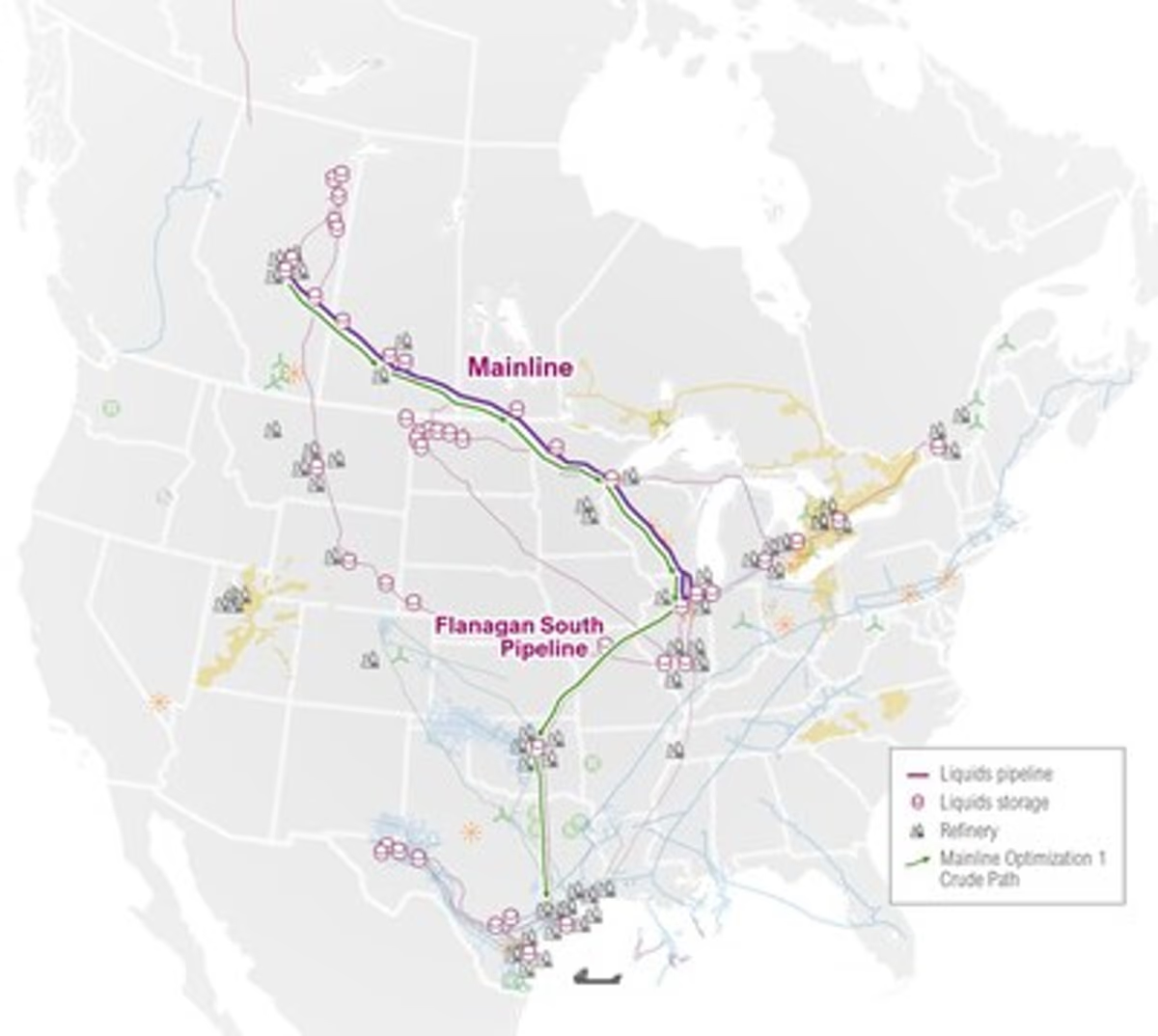
The WCS-WTI differential is expected to widen modestly to $13 per barrel by 2027 as oil sands production continues to grow. Canadian oil sands output is projected to exceed the 2025 record of 5.3 million barrels per day in 2026, adding further pressure on the limited egress available outside of Trans Mountain and Enbridge's Mainline system.
Trans Mountain Capacity Optimization Plans
Trans Mountain is pursuing engineering optimization programs that could add as much as 300,000 additional barrels per day of throughput capacity by the end of 2028. These programs involve the introduction of drag-reducing agents in pipeline flow and the addition of new pumping stations along the route. If successful, total system capacity could approach 1.2 million barrels per day, significantly expanding the volume of Canadian crude reaching Pacific tidewater for export to Asia.
In a longer-range scenario, the Alberta government is exploring a separate one-million-barrel-per-day export corridor to the province's northwest coast. No private sector consortium has yet committed capital to the project, and regulatory timelines suggest any new pipeline would require a decade-long development process even with an investment decision made in 2026.
Canadian LNG Adds to Export Momentum
Trans Mountain's near-full utilization is part of a broader shift in Canadian energy export dynamics. Canadian LNG exports are also drawing strong interest from Asian buyers as the Iranian conflict has reduced Qatar's supply capacity by approximately 20 percent. Together, Trans Mountain crude volumes and LNG exports flowing through British Columbia represent Canada's emerging role as an alternative supplier to Middle Eastern barrels.
Baker Hughes data shows that US rig counts have fallen 7 percent year over year to 545 active rigs, with Permian Basin production leveling at 7.12 million barrels per day. This relative plateau in US lower-48 output growth makes Canadian oil sands production, with its long project cycles and large reserve base, increasingly valuable to Asian importers seeking supply reliability.
ExxonMobil and BP have both flagged exceptional Q1 2026 trading results tied to price volatility, underscoring how the Hormuz disruption is reshaping global crude flows and benefiting producers positioned at tidewater access points. Canadian producers exporting through Trans Mountain are similarly positioned to capture elevated Brent-linked pricing in Asian markets rather than WTI-linked mid-continent discounts.
Outlook
Trans Mountain's record utilization is a validation of the C$34 billion investment that was completed in 2025 after years of delays and cost overruns. For the Canadian oil industry, full pipeline access to Pacific markets is critical for achieving benchmark pricing rather than mid-continent discounts. The current geopolitical environment has accelerated the timeline for demonstrating that value. The EIA projects Brent crude averaging $96 per barrel in 2026, with a Q2 peak near $115 per barrel if Hormuz shut-ins persist. At those price levels, Canadian oil sands remain highly economical, with break-even costs for most in-situ and mining operations well below $60 per barrel USD equivalent.
Published by Oil Authority, edited by Adam Humphreys
Submit a Correction
Spotted a factual error? Free account required to submit a correction.