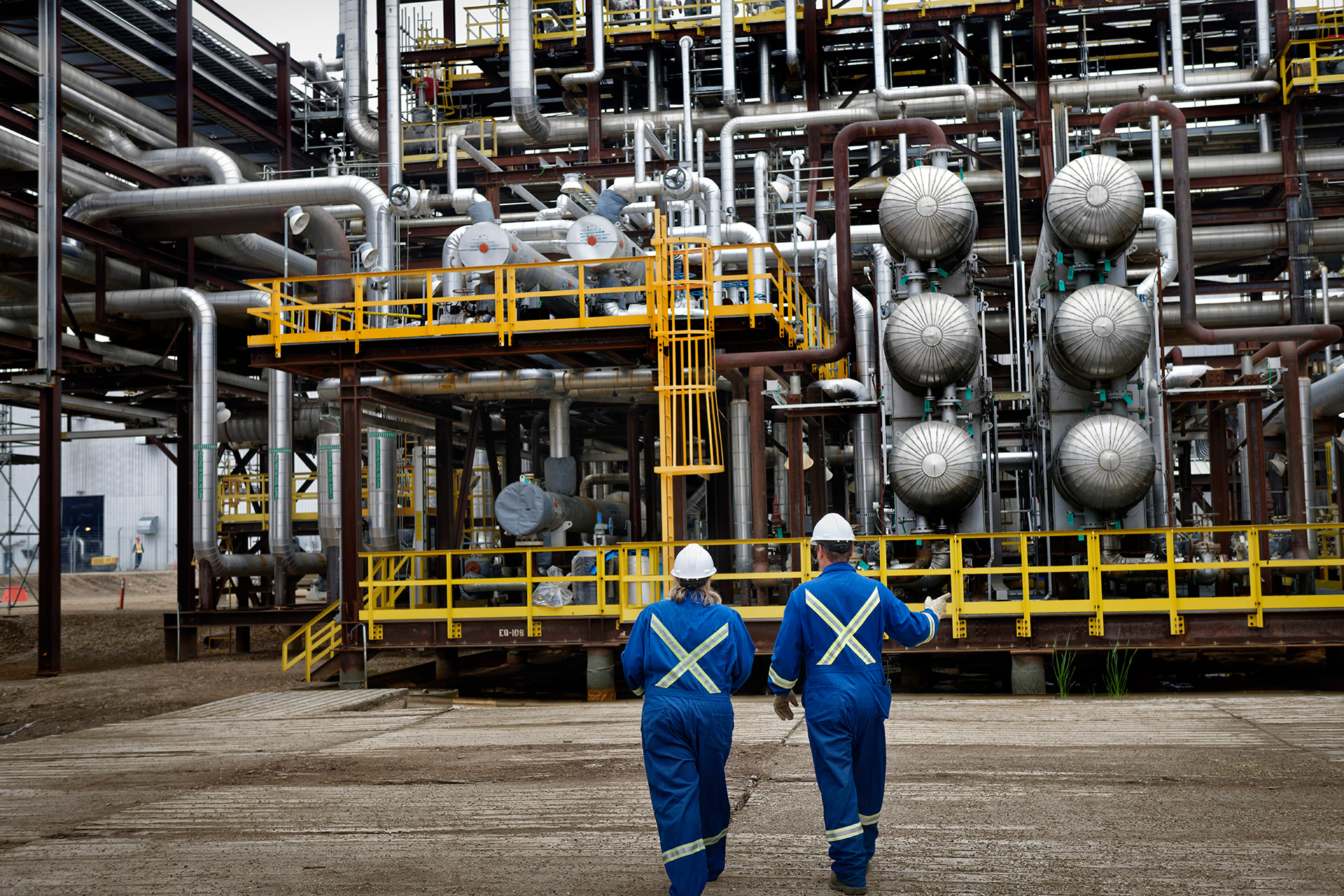
IPC's Blackrod SAGD Achieves First Oil on Budget, Alberta's First New Oil Sands Greenfield in a Decade
IPC's Blackrod SAGD project achieved first oil May 31 on a $855M budget, marking Alberta's first new greenfield oil sands development in a decade.
International Petroleum Corporation (IPC), a member of the Lundin Group of Companies, achieved first oil at its Blackrod Phase 1 SAGD project in northern Alberta on May 31, 2026. The milestone arrived ahead of the originally targeted third quarter of 2026. Capital spend came in at approximately $855 million (USD), just $5 million above the original $850 million estimate and within the approved budget.
Chief executive William Lundin called the event "a transformational moment" for the company. He described Blackrod as "the largest greenfield thermal development project developed in Alberta in a decade." The project is located roughly 3.5 hours north of Edmonton and is 100 percent owned by IPC. Shares trade on the Toronto Stock Exchange and on Nasdaq Stockholm under the ticker IPCO.
Lundin Group Lineage and IPC's Canadian Roots
Lundin Petroleum created IPC in 2017 by spinning off its non-Norwegian producing assets into a standalone company. The Lundin Group is a Stockholm-based family of energy and mining businesses that retains significant ownership in IPC. William Lundin serves as chief executive, connecting the company to the Lundin family's four-decade track record in resource development. Wire coverage of the Blackrod first-oil announcement rarely identified IPC's Lundin Group lineage, which shapes the company's long-term capital strategy and investor base.
IPC's portfolio produced approximately 43,000 barrels of oil equivalent per day across Canada and international assets in Q1 2026. The company reported Q1 operating costs of $17.60 per barrel of oil equivalent, ahead of full-year guidance. Operating cash flow for the quarter was $68 million, with free cash flow of negative $17 million as Blackrod capital spending continued.
Reserves, Phases, and Expansion Runway
Phase 1 targets plateau production of 30,000 barrels per day, now expected by late 2027, a full quarter ahead of the original schedule. The Blackrod asset holds 311 million barrels of oil equivalent in proven-plus-probable reserves. IPC also reports 1.1 billion boe in contingent resources on the property, underpinning the multi-phase expansion case.
Alberta regulators have approved Blackrod for expansion to 80,000 barrels per day across future development phases. IPC projects sustaining capital intensity below $5 per barrel of oil equivalent after Phase 1 reaches plateau. A production life exceeding 25 years is anticipated.
The SAGD method injects steam to heat bitumen-bearing formations, reducing viscosity until oil flows to producing wells. IPC ran a SAGD pilot at Blackrod continuously since 2011, averaging 630 barrels per day through 2025. Fifteen years of pilot data preceded the Phase 1 investment commitment, which was approved in 2023.
Economics at Current WCS Prices
Western Canadian Select was quoted at $61.51 per barrel as of Monday morning on OilPrice.com, reflecting an approximately $11.34 discount to WTI. WTI crude traded at $72.85 per barrel on the CME in late morning on June 23, down $1.01 or 1.37 percent on the day.
Applying IPC's Q1 2026 portfolio operating cost of $17.60 per barrel to Blackrod's 30,000-barrel-per-day plateau rate gives an estimated operating margin of approximately $43.91 per barrel at current WCS prices. At that rate, Blackrod Phase 1 at plateau would generate roughly $1.32 million in daily operating cash, or about $481 million annually. Against a Phase 1 capital cost of $855 million (USD), that run rate implies a simple payback period of under two years at current prices.
Those economics would compress materially if WCS fell toward $55 per barrel, a level reached during prior OPEC-driven sell-offs. Conversely, the WCS differential has narrowed from a Q1 2026 average of $14 per barrel to roughly $11 per barrel in late June trading. That narrowing partially offsets the broader crude price decline seen since early June.
First Greenfield Project in Alberta in a Decade
Greenfield oil sands starts became rare in Alberta after crude prices collapsed in 2014 and 2015. Most Alberta oil sands production growth over the past decade has come from expansions of existing mines, steam optimization at producing SAGD pads, and debottlenecking work at existing facilities. Blackrod's commercial production demonstrates that SAGD projects with long-running pilot histories and disciplined capital budgets can reach first oil in a lower-price environment.
Published by Oil Authority, edited by Adam Humphreys
Submit a Correction
Spotted a factual error? Free account required to submit a correction.