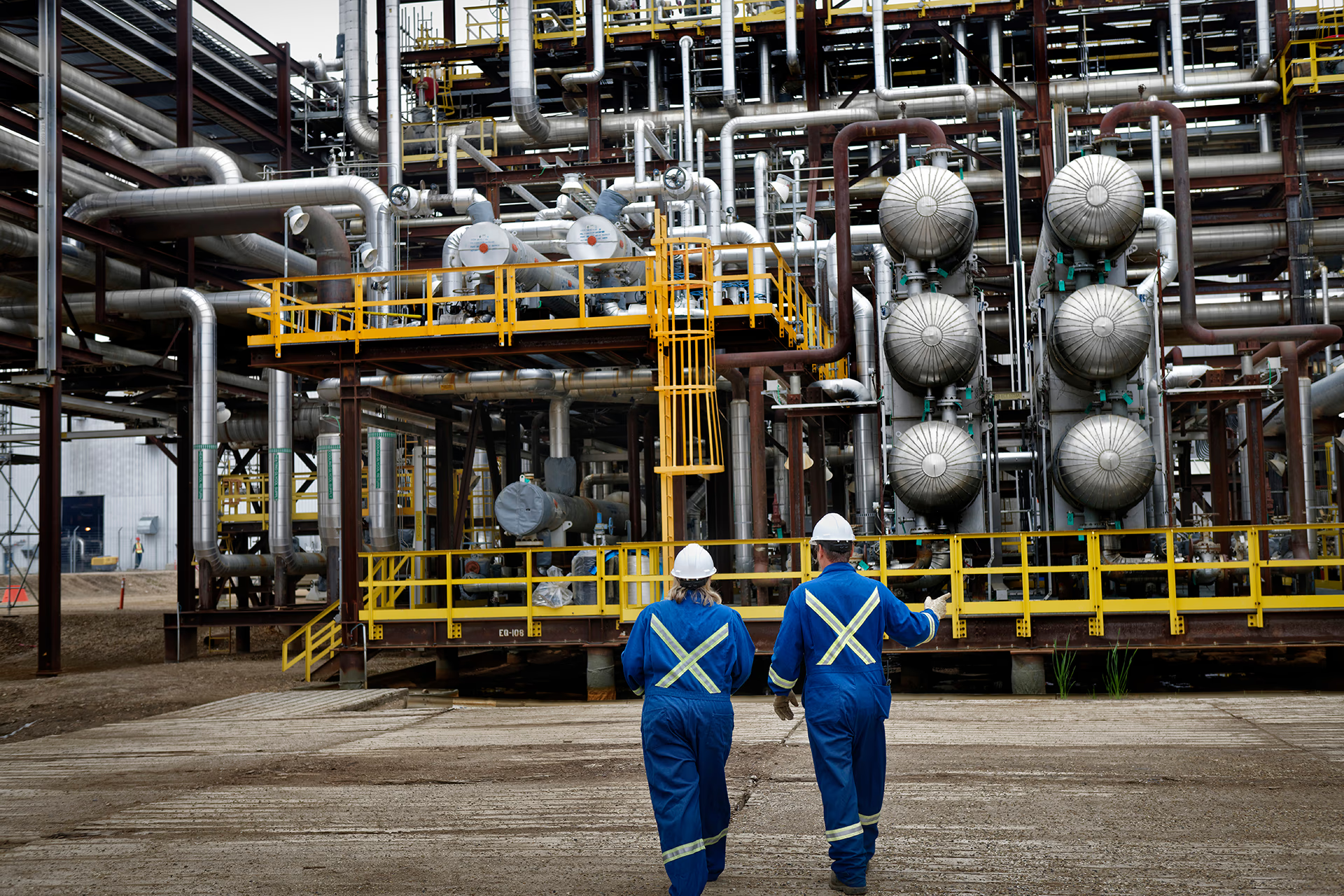
Canadian Natural Resources Q1 2026: Jackfish Sets SAGD Record and Horizon SCO Hits 106% Utilization With C$4.4 Billion Funds Flow
Canadian Natural Resources hit record SAGD output in Q1 2026 as Jackfish exceeded nameplate by 14,000 bpd and adjusted funds flow reached C$4.4 billion.
Canadian Natural Resources (CNR) delivered record production across several asset categories in Q1 2026, beating analyst expectations on both revenue and adjusted earnings per share. Total output reached 1.643 million barrels of oil equivalent per day (boe/d), up 4% year over year. Adjusted funds flow came in at C$4.4 billion, or C$2.10 per share, against quarterly revenue of C$10.74 billion.
Jackfish SAGD Exceeds Nameplate by 14,000 Bpd
CNR's Jackfish steam-assisted gravity drainage (SAGD) complex in the Athabasca region produced 134,000 barrels per day in Q1 2026, a quarterly record. That pace ran 14,000 bpd above nameplate capacity. The Pike 1 pad group contributed 41,000 bpd combined to the Jackfish total.
A steam-oil ratio of 1.8 at Jackfish reflects efficient heat utilization for an Athabasca SAGD operation: lower ratios mean less natural gas burned per barrel of bitumen produced. CNR has two active expansions in progress at the complex. The Jackfish expansion will add 30,000 bpd of nameplate capacity, while the Pike 2 project targets 70,000 bpd of additional in-situ production.
Horizon SCO Running at 106% Upgrader Utilization
The Horizon Oil Sands mining and upgrading operation produced 587,946 barrels per day of synthetic crude oil (SCO) in Q1 2026 at an operating cost of C$23.73 per barrel. Upgrader utilization reached 106% of nameplate, driven by continuous reliability improvements across the integrated mining and upgrading complex. In April, management reported post-quarter oil sands output at 630,000 bpd, a step-up from the Q1 average.
CNR President Scott Stauth cited a "relentless focus on continuous improvement" and "a unique competitive advantage" in capital allocation across diverse assets. CFO Victor Darel described the portfolio's "significant cash generating capability" as a function of its long-life, low-decline character. Since CNR acquired Shell Canada's Albian Sands assets in 2017, operating costs at that segment have fallen from C$42 per barrel to C$25 per barrel, a reduction management cites as a model for integration efficiency.
Funds Flow Calculation: C$48.9 Million Per Day Across the Asset Base
WTI crude traded at $93.50 per barrel in late-morning CME trading on June 1, 2026, up $6.14 on the day, per OilPrice.com. CNR's SCO commands a US$5.70 per barrel premium over WTI on the forward strip for the remainder of 2026, per management guidance from the Q1 earnings call. The implied SCO realized price is $99.20 per barrel before hedging adjustments.
CNR's adjusted funds flow of C$4.4 billion covers Q1's 90 days of production. Dividing through, C$4.4 billion over 90 days equals C$48.9 million per day in funds flow. At 1.643 million boe/d of total production, that amounts to C$29.76 per boe across all assets, blending high-margin SCO with natural gas and thermal in-situ volumes. This per-boe funds flow figure is an Oil Authority calculation derived from reported Q1 data and is not stated directly in CNR's earnings materials.
Shareholder Returns: 26 Consecutive Years of Dividend Growth
CNR returned C$1.5 billion to shareholders in Q1 2026 through C$1.2 billion in dividends and C$300 million in share buybacks. Year-to-date direct shareholder returns had reached C$3.2 billion at the time of the earnings release. The annualized dividend stands at C$2.50 per share, marking 26 straight years of increases at a 20% compound annual growth rate.
The current framework allocates 75% of free cash flow to shareholders. That ratio rises to 100% once net debt falls below C$13 billion. Net debt ended April below C$16 billion, placing CNR roughly C$3 billion from the higher-payout threshold. Adjusted net earnings for Q1 came in at C$2.45 billion, or C$1.17 per share, beating the C$1.05 per share analyst consensus by 11%.
Q2 Wildfire Risk Arrives Against a Fortified Balance Sheet
Oil Authority's recent coverage of Alberta wildfire disruptions to Cenovus, CNR, and ConocoPhillips oil sands production noted potential Q2 output risk across the northeast Alberta region. CNR's Jackfish and Horizon assets both sit in wildfire-prone areas of the province. The Q1 results establish the financial cushion the company carries heading into fire season.
A C$4.4 billion quarterly funds flow run rate equates to C$1.47 billion per month in operating cash before capital expenditures. Short-duration wildfire-related downtime would reduce output volumes but would not threaten CNR's balance sheet at these realized prices. CNR had not issued any Q2 wildfire-related guidance revision as of the Q1 earnings release.
Published by Oil Authority, edited by Adam Humphreys
Submit a Correction
Spotted a factual error? Free account required to submit a correction.