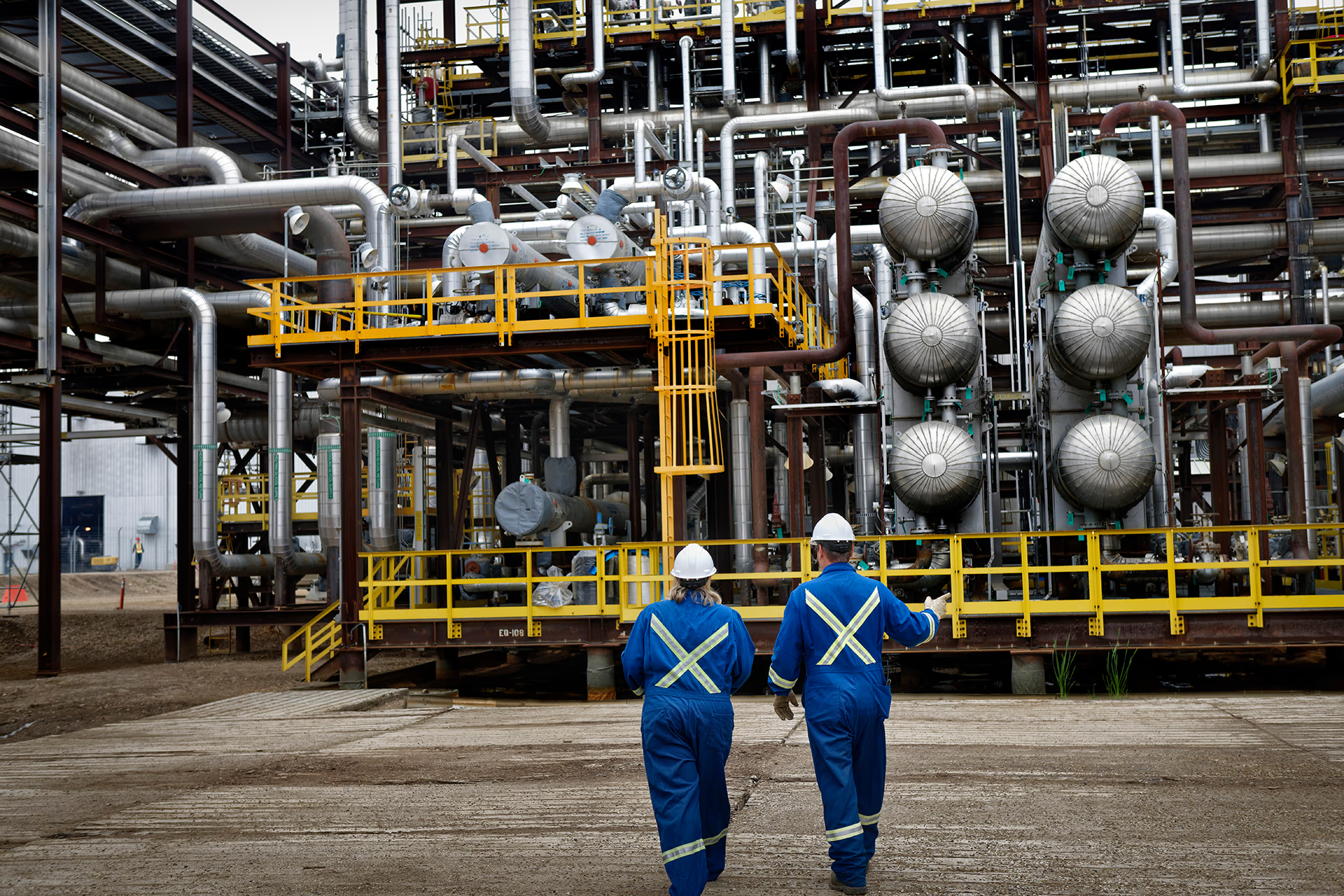
Canadian Natural Resources Targets Record 1.6 Million BOE Per Day in 2026 as Albian Oil Sands Mines Reach Full Capacity
Canadian Natural Resources Targets Record 1.6M BOE Per Day in 2026 as Albian Oil Sands Mines Reach Full Capacity.
Canadian Natural Resources Limited is on course for a record production year in 2026, targeting output of 1.6 million barrels of oil equivalent per day (BOE/d) across its global portfolio after cementing full ownership of the Albian oil sands mines in northern Alberta. The milestone reflects the payoff from a years-long strategy of acquiring and optimizing existing oil sands infrastructure rather than chasing greenfield growth.
Albian Mines Now Fully Owned, Output Rising Toward 340,000 Bbl/Day
CNRL became the sole owner of the 315,000-acre Albian oil sands complex in the Fort McMurray region after completing an asset swap with Shell Canada. The transaction removed a long-standing joint-venture structure and allowed CNRL to apply its low-cost operating model across the entire property. Shell received non-oil sands assets in return.
In 2025, CNRL posted record annual production of 1,571 thousand BOE/d, representing year-over-year growth of 15 percent. The Albian complex alone is expected to reach a record 340,000 barrels per day in 2026, provided no major planned maintenance shutdowns occur. Albian produces bitumen that is upgraded on-site to synthetic crude oil (SCO), a premium product that trades close to West Texas Intermediate (WTI) benchmarks. With WTI recently trading near USD 97 per barrel following the partial unwinding of the Iran risk premium, CNRL receives roughly C$134 per barrel for its upgraded Alberta barrels at a 1.38 Canadian dollar exchange rate.
The broader Western Canadian Select (WCS) heavy blend, by contrast, settled at a USD 16.15 discount to WTI in early April 2026, implying a WCS price of approximately USD 81 per barrel. That differential has widened compared to earlier levels, adding pressure on non-upgrading oil sands producers who sell diluted bitumen rather than SCO. CNRL's integrated upgrading position at Albian insulates it from the heaviest portion of that discount.
A $15 Billion Expansion Pipeline Tempered by Jackpine Deferral
In November 2025, CNRL unveiled more than $15 billion in planned oil sands expansions across its Fort McMurray assets. The company has consistently grown production through sustaining capital and debottlenecking projects rather than major new mine builds, a strategy that keeps breakeven costs among the lowest in the heavy oil sector.
However, one notable project will not proceed on its original schedule. CNRL has deferred front-end engineering and design work and capital commitment for the approximately $8.25 billion Jackpine mine expansion. The company cited unresolved federal regulatory policy on carbon pricing and methane emissions as the reason for pushing the project back. The deferral underscores the tension between Alberta's oil sands expansion ambitions and federal climate policy that producers say creates planning uncertainty for large capital investments.
A recent energy framework agreement between the Alberta and federal governments is expected to unlock new investment in data centres, emissions-reduction technology and oil sands growth, but producers say tangible clarity on carbon pricing is still needed before committing billions to decade-long projects.
Industry Context: Drilling Activity and Canadian Market Access
The Canadian Association of Oilwell Drilling Contractors projects an average of 213 active drilling rigs operating across Canada in 2026, up from 201 in 2025, with roughly 5,709 wells expected to be drilled. Service rig activity is also forecast to rise, with an average of 458 units projected compared to 447 last year. The modest increase reflects a cautious but constructive industry outlook despite ongoing price volatility tied to Middle East geopolitical developments.
For CNRL, 2026 is shaping up as a year defined by execution rather than exploration. With the Albian mines fully integrated and a record production target in place, the company's near-term focus is on maximizing throughput from existing infrastructure. Longer-term, the Jackpine expansion represents a potential step change in Albian capacity, but investors and analysts will be watching for clarity on federal carbon policy before that project moves forward.
The Trans Mountain Expansion pipeline, now operational and moving Alberta bitumen to British Columbia for Pacific Basin export, provides Canadian producers including CNRL with greater market access and reduces dependence on US Gulf Coast pricing. That optionality matters more as WCS differentials widen and Alberta producers seek to diversify their export routes. For more on Canadian crude pipeline infrastructure, see coverage of the South Bow Corporation Prairie Connector pipeline proposal, which would add 450,000 barrels per day of Alberta crude capacity to Gulf Coast markets.
Published by Oil Authority, edited by Adam Humphreys
Submit a Correction
Spotted a factual error? Free account required to submit a correction.