Enbridge Postpones 250,000-Bpd Mainline Phase 2, Redirects Capital to Flanagan South and US Gulf Coast
Enbridge postponed its 250,000-bpd Mainline Phase 2 indefinitely, pivoting to Flanagan South and Southern Access, adding 150,000 bpd for US Gulf refiners.
Enbridge Inc. indefinitely postponed the second phase of its Mainline crude pipeline expansion on Thursday, citing producer reluctance to commit volumes and the absence of binding federal-Alberta oil sands policy. The project would have added 250,000 barrels per day of export capacity from Alberta. Enbridge had previously targeted in-service by the end of 2028. The postponement accompanied the company's second-quarter 2026 financial results and a secured growth backlog that reached $41 billion, built largely from US-based infrastructure.
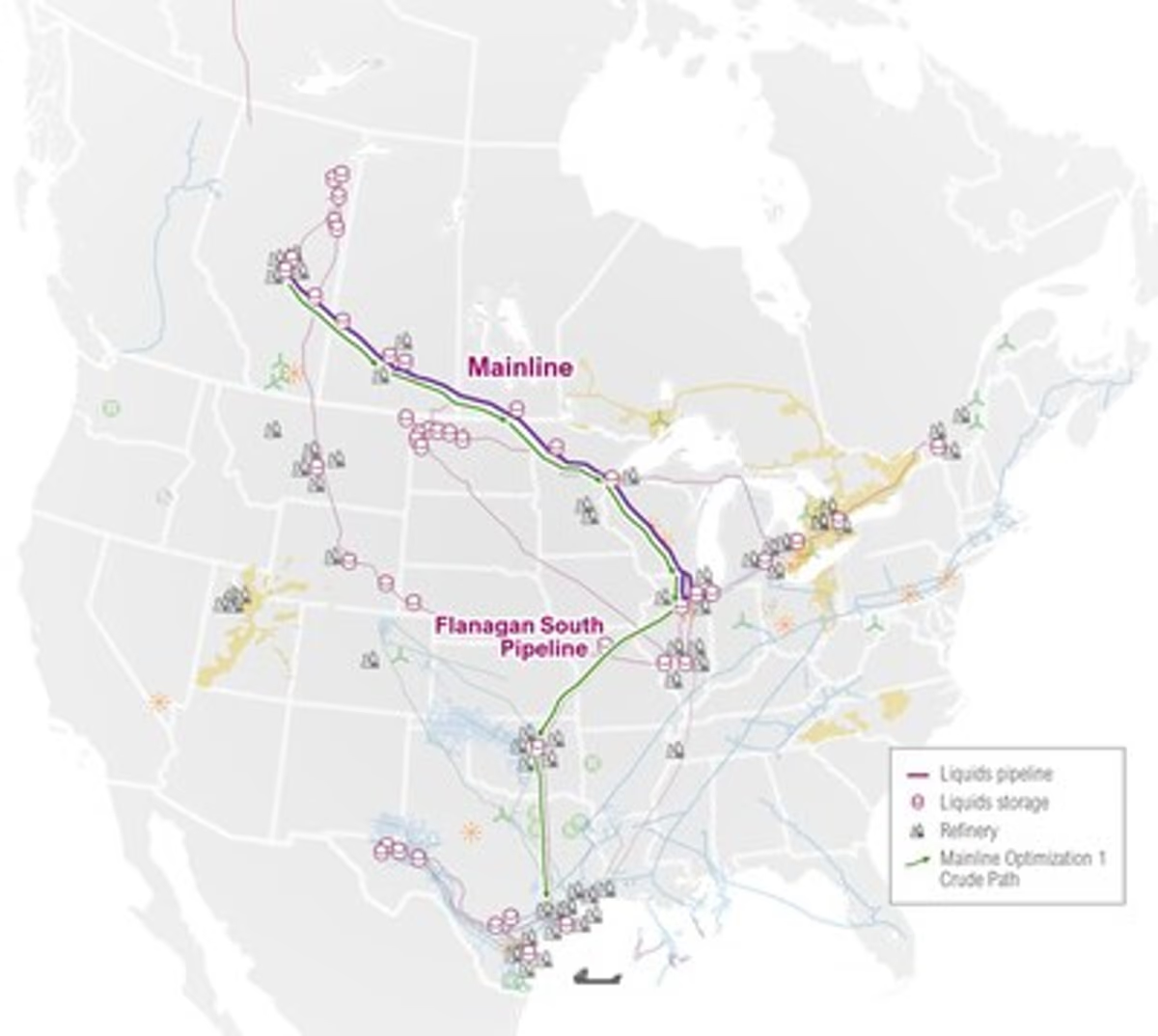
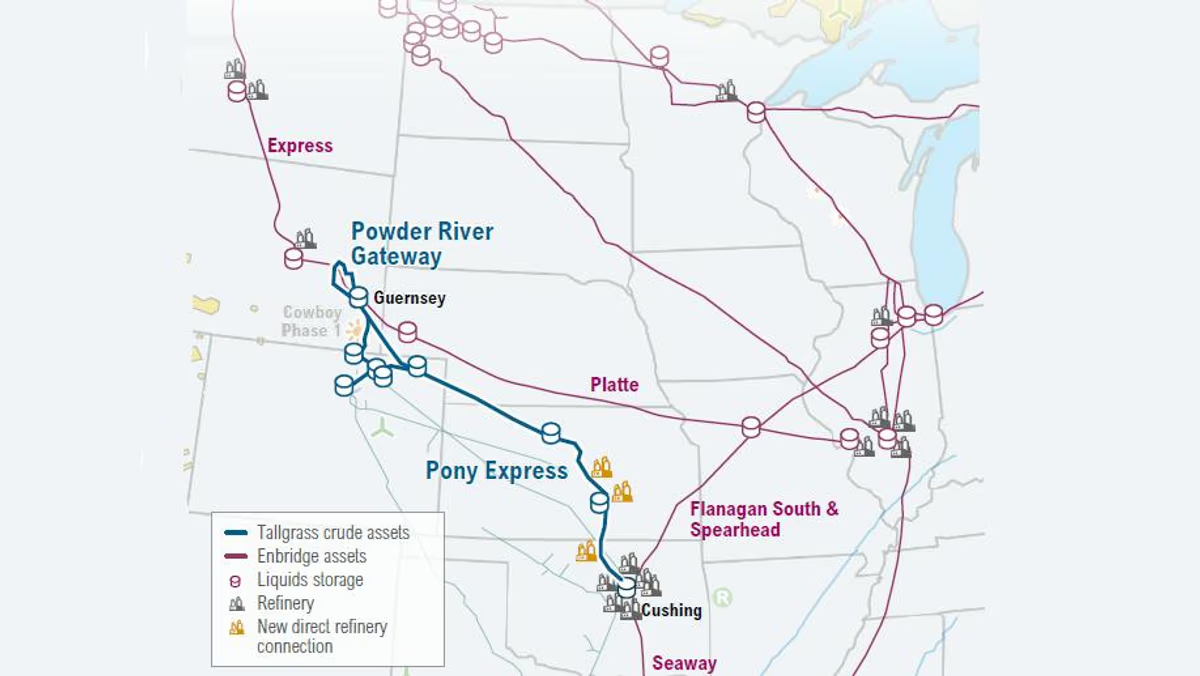
CEO Greg Ebel said capital will redirect instead to two US-based liquids systems. Flanagan South Expansion adds 100,000 barrels per day of throughput capacity. Southern Access Extension adds an additional 50,000 barrels per day. Both systems connect to the Mainline network at Illinois and deliver crude to Gulf Coast and midcontinent refining centers. Combined, they total 150,000 barrels per day, or 60% of the capacity the deferred Canadian project would have provided.
WCS Differential at Risk as Egress Gap Widens
WTI crude traded at $84.80 per barrel intraday Thursday, according to OilPrice.com at 2:07 p.m. Mountain Time. Western Canadian Select has traded approximately $12.40 per barrel below WTI in recent weeks, according to CalRock brokerage data. The Alberta Energy Regulator's base case for 2026 projects the WCS-WTI spread near $12 per barrel, a forecast premised on adequate pipeline egress from Alberta.
Deferring 250,000 barrels per day of additional Mainline export capacity raises the risk that the WCS discount widens beyond the AER's base case by late 2028. Oil sands producers have benefited from the Trans Mountain Expansion, which entered service in 2024 and added roughly 590,000 barrels per day of capacity to Canada's West Coast. TMX serves primarily Asia-Pacific buyers and does not relieve pressure on Gulf Coast-bound heavy crude routes that the Mainline handles.
As Oil Authority reported when Middle East refinery disruptions drove a short-term spike in Western Canadian Select prices, the differential can widen sharply when export pathways tighten. The Mainline Phase 2 delay creates a structural constraint on southbound egress from Alberta that geopolitical shocks cannot fix. Without a firm in-service date, producers seeking to grow oil sands output face narrowing pipeline options through the late 2020s.
Policy Uncertainty Stalls Producer Commitment
Colin Gruending, Enbridge's president of liquids pipelines, said producers will not make binding capacity commitments "until there is more policy and regulatory certainty." The federal government and Alberta reached a joint oil sands agreement in mid-2026 that Enbridge called potentially transformative. Most of the deal's provisions remain non-binding, and neither government has written them into legislation.
Enbridge has reframed the project to reflect this uncertainty. Mainline Optimization Phase 2 is now described as "a suite of expansion opportunities" rather than a single sanctioned project. That formulation keeps the option open while deferring any capital commitment until shippers sign binding long-term throughput agreements. Investment decisions will follow government policy, not precede it.
Ebel framed the company's US pivot as consistent with long-term demand trends. Energy security and infrastructure reliability "are more important than ever," he said, citing geopolitical volatility as a driver of firm long-term capacity investment. The secured growth backlog reached $41 billion at quarter-end, a $1 billion increase during Q2 driven primarily by US-based gas infrastructure sanctioned in the period.
Strong Q2 Financials Underlie the Strategic Shift
Enbridge reported adjusted EBITDA of $4.8 billion in Q2 2026, up from $4.6 billion in Q2 2025. Distributable cash flow was $2.9 billion, in line with the prior year. The company reaffirmed full-year 2026 adjusted EBITDA guidance of $20.2 to $20.8 billion, with approximately 5% compound annual growth projected in EBITDA, DCF per share, and EPS thereafter.
Enbridge sanctioned three US infrastructure projects during Q2, all focused on natural gas export capacity. Line 5 Wisconsin relocation is a $1 billion, 41-mile re-route expected in service in early 2027. Bay Runner Twin will expand capacity for Rio Grande LNG, operational by 2030. The TTC Connector, a 300 MMcf/d line to Freeport LNG, enters service by year-end.
Liquids Pipelines adjusted EBITDA held flat at $2.3 billion for the quarter, reflecting stable Mainline throughput. Gas Transmission adjusted EBITDA grew $37 million year over year to $1.4 billion, boosted by rate case settlements. Gas Distribution and Storage added $38 million to reach $878 million for the quarter.
Published by Oil Authority, edited by Adam Humphreys
Submit a Correction
Spotted a factual error? Free account required to submit a correction.