Barzan Facility Explosion at Ras Laffan Injures 54 and Derails QatarEnergy LNG Restart as EU Gas Storage Falls to 45.56%
QatarEnergy's LNG restart stalls after a Ras Laffan explosion on June 21 left 54 injured and 18 missing, as EU gas storage sits at just 45.56%.
An explosion and fire at the Barzan gas processing facility inside Ras Laffan Industrial City struck during startup operations on Sunday, June 21, injuring 54 workers and leaving 18 unaccounted for as of early Monday. Qatar's Ministry of the Interior attributed the blast to "a technical malfunction during operations at a factory in Ras Laffan Industrial City." Search and rescue teams from Qatar's Internal Security Force and Civil Defence were still on site Monday morning.
Restart Timeline Now Uncertain
QatarEnergy had been preparing to restore LNG exports following the tentative reopening of the Strait of Hormuz. Iranian strikes on the Ras Laffan complex in March 2026 already forced a force majeure declaration, curtailing output significantly. Three QatarEnergy LNG tankers were heading toward Hormuz when Sunday's explosion occurred, per Bloomberg shipping data cited by OilPrice.com.
QatarEnergy's restart plan called for 50% production capacity within one month and 80% within two months, contingent on safe Hormuz transit. The Barzan facility processes gas from Qatar's North Field that feeds Ras Laffan's 14 production trains. Startup timelines for gas processing units typically run weeks to months depending on damage scope. QatarEnergy had not issued a formal production impact assessment as of early Monday.
Ras Laffan: 14 Production Trains, Two Setbacks in 2026
Ras Laffan is the world's single largest LNG export facility. QatarEnergy operates the complex's 14 production trains with joint venture partners including ExxonMobil, Shell, TotalEnergies, and ConocoPhillips. The March 2026 Iranian strikes damaged two of those 14 units, reducing output by roughly 17%, per Wikipedia's Ras Laffan entry.
QatarEnergy estimated that the March 2026 damage costs the complex approximately $20 billion per year in lost revenue, with full repairs taking up to five years. Spread across Qatar's nameplate LNG capacity of approximately 77.4 million tonnes per year, that loss works out to roughly $13.64 per MMBtu. Every additional month of curtailment represents more than $1.67 billion in deferred revenue to QatarEnergy and its JV partners.
Europe's Storage Deficit and the TTF-Henry Hub Spread
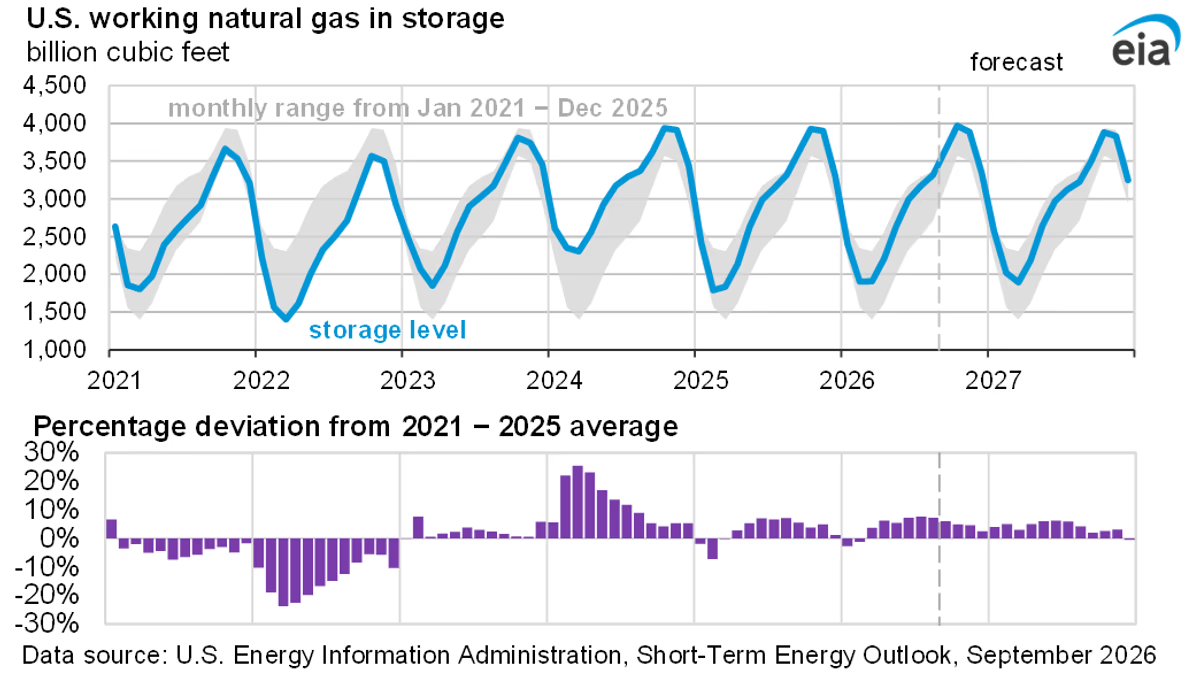
EU gas storage facilities stood at 45.56% of capacity as of this week, per Trading Economics, compared with 54.38% at the same point last year and roughly 14% below the five-year average. That deficit is 10.7 percentage points below the year-ago level heading into summer replenishment season. Qatar historically supplies roughly 20% of global LNG trade, making each additional week of Ras Laffan curtailment material to European injection targets.
TTF European gas traded at 42.35 EUR per megawatt-hour on Monday morning, up 0.60% overnight, per Trading Economics. Converting to energy-equivalent terms, TTF stands at approximately $13.27 per MMBtu. Henry Hub natural gas settled at $3.26 per MMBtu, per CME data cited by Rigzone on Monday. The TTF-to-Henry Hub spread of roughly $10.00 per MMBtu underlines how exposed European buyers remain to any further LNG supply disruption from Ras Laffan.
Barzan's Role and ExxonMobil's Exposure
The Barzan gas development project was built by QatarEnergy and ExxonMobil to supply Qatar's domestic grid, with first gas delivered in 2015. It draws on Qatar's North Field, the world's largest natural gas reservoir, shared with Iran's South Pars formation. ExxonMobil's presence at Ras Laffan extends beyond Barzan to positions in Qatargas 1, RasGas 1, and RasGas 2.
The new explosion at Barzan adds operational risk to ExxonMobil's multi-train JV portfolio at Ras Laffan. Neither ExxonMobil nor QatarEnergy had issued executive statements as of early Monday. QatarEnergy also had not yet disclosed the financial impact of Sunday's incident separately from the $20 billion annual figure cited for the March 2026 damage. A prior Oil Authority analysis noted that Hormuz mine clearance timelines of up to six months and 500 stranded vessels were already complicating the restart; Sunday's Barzan explosion adds a production-side complication to that logistical challenge.
Published by Oil Authority, edited by Adam Humphreys
Submit a Correction
Spotted a factual error? Free account required to submit a correction.