Trans Mountain Targets 1.2 Million Barrels Per Day as Hormuz Crisis Drives Pacific Crude Demand
Trans Mountain's Mainline Optimization Project adds 210,000 bpd by 2028, targeting 1.2 million bpd capacity as Japan's crude imports collapsed 66%.
Trans Mountain Corporation is pursuing a phased capacity expansion to lift throughput from 890,000 barrels per day to 1.2 million barrels per day by 2029. The push toward full capacity comes as the Strait of Hormuz crisis reshapes global crude trade flows toward Pacific supply routes.
Open Season and Near-Term Capacity Additions
The Crown corporation launched an open season in early April, seeking shipper commitments for 72,000 additional barrels per day. The open season targets an increase in long-term contracted utilization from 80 percent to 90 percent of available capacity. Chief Executive Officer Mark Maki stated in March that the company expects to secure full committed capacity, citing the supply crunch created by the Middle East conflict.
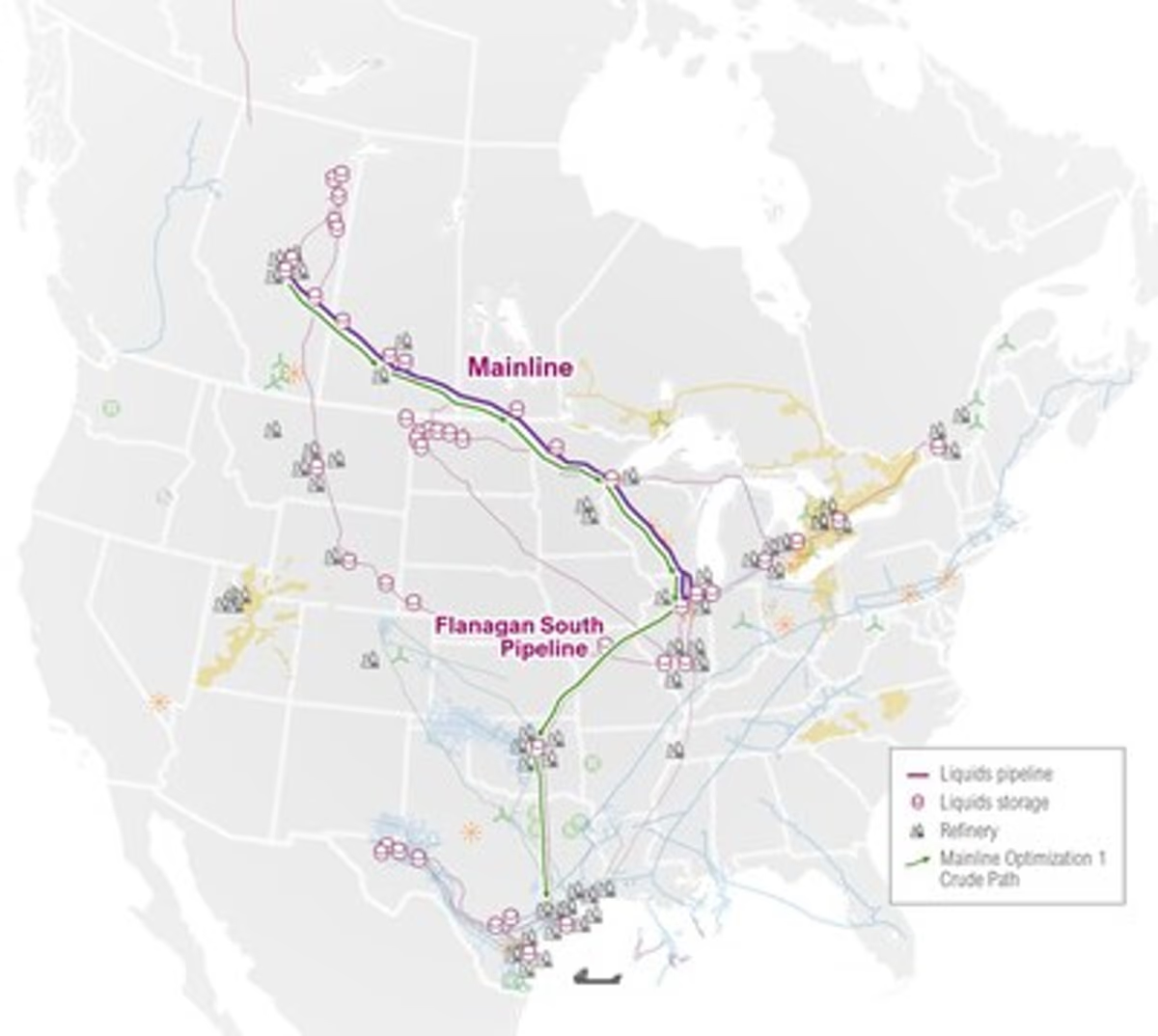
Two incremental capacity measures are underway alongside the open season. A drag reduction agent program injects chemicals into the pipeline stream to reduce friction and deliver an additional 90,000 barrels per day in the near term. The Mainline Optimization Project, which Trans Mountain has accelerated from an original 2030-2031 timeline to end of 2028, adds a further 210,000 barrels per day.
Mainline Optimization: 210,000 bpd by End of 2028
The Mainline Optimization Project upgrades the existing pipeline corridor without adding a new line. Combined with the drag reduction agent program, these two initiatives add 300,000 barrels per day of additional Pacific-bound capacity beyond the original 890,000 bpd design. Total system capacity reaches the 1.2 million barrels per day target at that point, with Trans Mountain's Westridge Marine Terminal in Burnaby, British Columbia, as the downstream endpoint for tanker loading to Asian buyers.
Japan's Demand Collapse Signals Strategic Opportunity
Japan's crude imports fell 65.7 percent in April 2026 year-over-year, dropping to 850,000 barrels per day, per Japanese government trade statistics published May 29. Saudi exports to Japan declined nearly 58 percent. UAE shipments to Japan fell 69.4 percent. Japan's petroleum authorities conducted their largest-ever release of strategic petroleum reserves to offset the shortfall.
Japanese buyers are now sourcing rare cargoes from Azerbaijan and Latin America. The Westridge Marine Terminal positions Alberta crude for direct Pacific delivery to Japan Sea-capable tankers. No major Canadian crude contracts for Japan have been publicly announced, but Alberta crude routed via Westridge bypasses the Hormuz corridor entirely.
Alberta Producer Value: A $5.74 Billion Increment
The Mainline Optimization's 210,000 bpd throughput increment translates to 76.6 million additional export barrels per year for Alberta producers. Western Canadian Select typically trades at a $12 to $15 per barrel discount to WTI in the post-TMX expansion era. With WTI at $88.94 per barrel as of Friday May 29, per OilPrice.com, a midpoint $14 differential implies WCS at $74.94 per barrel. At that level, 210,000 bpd of additional throughput generates an estimated $5.74 billion in incremental annual export value, an Oil Authority calculation.
Shippers and Parent-Company Stakes
Trans Mountain Corporation is a federal Crown corporation, purchased by Canada from Kinder Morgan in 2018. Its primary contracted shippers include Suncor Energy, Cenovus Energy, Imperial Oil, and Canadian Natural Resources. Imperial Oil is 73 percent owned by ExxonMobil Corp, making Trans Mountain throughput central to ExxonMobil's Canadian upstream export strategy. Each of these companies benefits directly from the Mainline Optimization's accelerated 2028 completion target.
When the original TMX expansion completed in 2024, WCS-WTI differentials narrowed from pre-expansion levels above $15 per barrel. Pipeline access to Pacific markets was the structural driver of that improvement. The Mainline Optimization and drag reduction agent program extend that advantage by adding 300,000 barrels per day of additional Pacific-bound capacity.
Published by Oil Authority, edited by Adam Humphreys
Submit a Correction
Spotted a factual error? Free account required to submit a correction.