Canada Signs Major 20-Year LNG Pact with Germany
Canada signs a 20-year deal to ship 1 million tonnes of LNG a year to Germany from B.C.'s Ksi Lisims terminal. Total volume: 20 million tonnes.
Germany is signing for 1 million tonnes per year of Canadian LNG. Natural Resources Minister Tim Hodgson will announce the deal Wednesday in Vancouver alongside Nisga'a Lisims Government president Eva Clayton. The buyer is SEFE, the state-owned trader Berlin pulled out of Gazprom Germania in 2022 for €6.3 billion. The seller is Ksi Lisims LNG, a 12 million tonne per year floating terminal proposed for Nisga'a Nation territory about 80 kilometres north of Prince Rupert.
The contract is conditional. Ksi Lisims has regulatory approval but the partners have not yet committed actual construction dollars. That commitment is called a Final Investment Decision, or FID. It's the moment when the companies involved put real money on the line to start building. Until FID is taken (industry expects later this year), the SEFE deal is a 20-year purchase agreement for LNG that doesn't physically exist yet.
One million tonnes of LNG converts to roughly 1.4 billion cubic metres of natural gas, enough to heat about 1.5 million German households for a year, or 1.5 percent of Germany's pre-war annual demand. At full 12 Mtpa nameplate, Ksi Lisims would cover closer to 18 percent of pre-war German demand. Across all of Canada's announced LNG capacity (LNG Canada Phase 1 is already shipping, plus Cedar LNG, Woodfibre LNG, and Ksi Lisims under development), Canadian exports could clear 50 million tonnes a year by the early 2030s. That's enough to displace Russian pipeline gas across multiple European buyers with capacity left over for Asian customers.
The PRGT pipeline is sized for 3.6 billion cubic feet a day. Ksi Lisims at 12 Mtpa needs roughly 1.7 bcf/d, leaving headroom for Phase 2 expansion or additional offtake without building a new line. The Montney basin upstream, where the gas itself comes from, holds an estimated 449 trillion cubic feet of recoverable gas, more than a century of supply at current Canadian production rates.
SEFE Signs 20 Years of Offtake on a Plant That Isn't Built Yet
Globe and Mail reporting Tuesday puts the SEFE agreement at up to 20 years of supply starting in the early 2030s. Reuters' source confirmed the 1 Mtpa volume. Ksi Lisims, SEFE, and Hodgson's office all declined to comment before the announcement.
That makes three large European buyers Western LNG has now lined up. Shell and TotalEnergies signed 20-year purchase agreements earlier in the project's life. Combined, the three contracts cover roughly one-third of the plant's 12 Mtpa nameplate. The remaining 8 Mtpa is uncommitted.
Why Germany Is Reaching Past Norway and Qatar
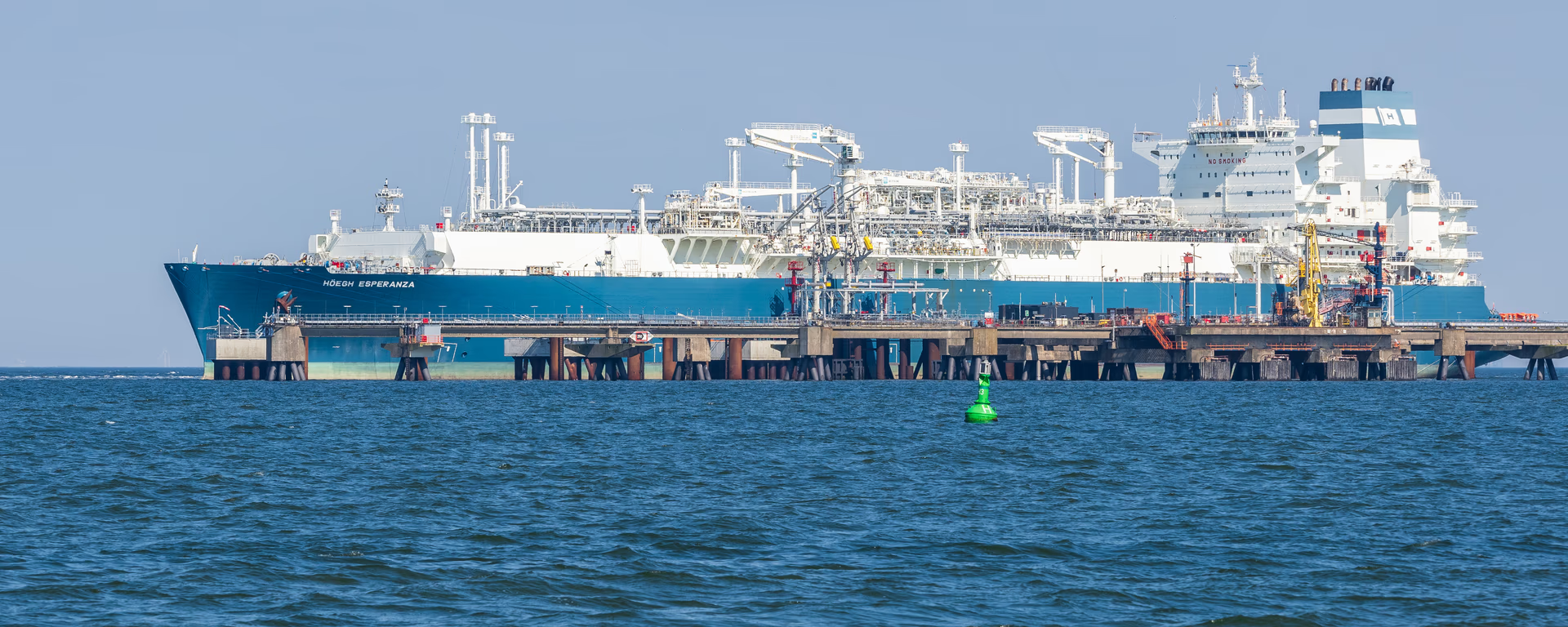
SEFE's job is to spread Germany's gas supply across more than one country, especially away from Russia. Norway and Qatar sell cheaper molecules. The U.S. Gulf has more spare capacity. Canada is more expensive than both, and Germany is paying the premium for two reasons.
First, Berlin wants suppliers spread geographically. Canada is the only large Atlantic source that isn't American or Middle Eastern.
Second, Canadian gas tracks Henry Hub (the U.S. price benchmark) but ships from Canadian soil. If Washington ever caps or taxes LNG exports to keep U.S. gas cheap at home, German contracts at U.S. terminals get squeezed first. Canadian cargoes sit outside that political risk.
I've watched a string of B.C. LNG announcements (Pacific NorthWest LNG, Aurora LNG, Prince Rupert LNG) get celebrated and quietly walked back before reaching FID. Ksi Lisims sits in a different position: regulatory approval in hand, the federal Major Projects Office fast-tracking review, and three offtake contracts now signed, which is the commercial threshold most project-finance lenders need before releasing construction capital.
The PRGT Pipeline Is Where the Math Gets Harder
Ksi Lisims needs gas from the Montney basin, more than 800 kilometres inland near Fort St. John and Dawson Creek. That gas reaches the coast via the Prince Rupert Gas Transmission line. PRGT crosses more than 1,000 creeks, streams, and rivers along its route.
Pipeline costs have been the killer for B.C. LNG. Coastal GasLink came in at $14.5 billion, more than twice its original budget. Anil Hira, who runs the Clean Energy Research Group at Simon Fraser University, puts the all-in Ksi Lisims plus PRGT capex at roughly $26 billion against the $10 billion headline figure cited around the announcement.
A $16 billion delta between the headline and Hira's number changes the project's break-even price. Hira's line in the Globe: LNG "is only competitive with pipelines when it is shipped over extremely long distances," and Europe has "closer pipeline suppliers" that are "two to five times cheaper." If tolls and tariffs push the Canadian landed cost above U.S. Gulf LNG into Northwest Europe, SEFE's accountants will notice.
Royalties, Jobs, and Nisga'a Equity
The Nisga'a Nation holds an ownership stake in the project alongside Houston-based Western LNG and the Canadian gas-producer consortium Rockies LNG. Eva Clayton, president of the Nisga'a Lisims Government, calls the project "a transformational opportunity" for Indigenous economic self-determination. The equity structure means the Nation participates directly in project revenue and any future capital appreciation, beyond what a flat royalty deal would deliver.
LNG Canada Phase 1 peaked at around 7,500 construction workers on site in 2023. Ksi Lisims pulls from the same labour pool: trades from B.C., Alberta, and First Nations communities along the PRGT corridor, with hiring preference for Nisga'a members and other Indigenous nations along the route written into the impact-benefit agreements.
Permanent operations are smaller in headcount, larger in compensation. The terminal runs roughly 250 to 350 full-time positions at full nameplate, plus several hundred more upstream in the Montney near Fort St. John, Dawson Creek, and Grande Prairie, Alberta. LNG operator wages typically range $130,000 to $180,000 a year.
Royalties flow in four directions. British Columbia collects natural gas royalties from Montney production. The Nisga'a Nation receives project revenue through its equity stake. Ottawa collects federal corporate tax. Impact-benefit agreements deliver direct payments to First Nations along the pipeline route. With a 20-year SEFE offtake plus a 40-year baseline asset life, the revenue cycle covers two generations of Nisga'a treaty implementation and a similar arc for the B.C. and federal treasuries.
What Needs to Happen Before Construction Starts
Western LNG, the Houston-based operator, has not set a public FID date. Premier David Eby framed Ottawa's role plainly: "British Columbia is throwing the ball up and it's giving the federal government a chance to take that alley-oop and dunk it." In plain English, B.C. wants federal financing support, a pipeline indemnity, or both.
The strategic logic outlasts any single contract. Germany needs supply that doesn't depend on Russian goodwill or American export policy. Canada needs export markets that don't run through a single buyer in Washington. A 20-year LNG line between B.C. and Wilhelmshaven anchors that relationship for two decades. Carney has pushed trade diversification away from U.S. dependence since taking office, and the SEFE deal is the first energy-infrastructure piece to fit that strategy at scale.
Watch two things in the next ninety days. First, whether Hodgson's announcement includes Canada Infrastructure Bank participation or a federal loan guarantee. Second, whether the remaining 8 Mtpa gets sold to Asian buyers (KOGAS, JERA, CPC) before year-end to clear the bank financing condition. Without either, the SEFE deal stays on paper.
Published by Oil Authority, edited by Adam Humphreys
Submit a Correction
Spotted a factual error? Free account required to submit a correction.