The World Needs Canadian Oil Now More Than Ever, So Why Are We Still Not Building Pipelines?
The World Needs Canadian Oil Now More Than Ever, So Why Are We Still Not Building Pipelines?. Approximately 150 kilometres of pipe were installed in Alberta.
On March 20, 2026, Brent crude settled at $112.19 per barrel, up 3.26% on the day and roughly 50% higher than where it started the year. West Texas Intermediate hit $98.32. Western Canadian Select traded at $83.18. Goldman Sachs warned that triple-digit oil could persist through 2027 if the Strait of Hormuz remains restricted. The Energy Information Administration revised its 2026 Brent forecast above $95 for the next two months. US gasoline prices hit $3.91 per gallon, the highest since October 2022.
The cause is straightforward. The Strait of Hormuz, through which 20 million barrels per day flow (roughly 20% of global petroleum consumption), has been effectively closed for 19 days. QatarEnergy reported that missile attacks reduced its LNG export capacity by 17%, with repairs potentially taking up to five years. The IEA coordinated the largest emergency stockpile release in its history: 400 million barrels, including 172 million from the US Strategic Petroleum Reserve. Analysts at Bernstein called the action one that "will have limited impact on the trajectory of oil prices," noting the disrupted supply far exceeds what stockpiles can release daily.
Canada Has the Oil. It Cannot Move It.
Canada holds approximately 163 billion barrels of proven oil reserves, ranking third or fourth globally behind Venezuela (303 billion), Saudi Arabia (267 billion), and depending on methodology, Iran. At current consumption rates, Canada has roughly 189 years of domestic supply. Production reached a record 5.3 million barrels per day in 2025, with oil sands output alone targeting 4.85 million barrels per day in 2026, according to the Canadian Energy Centre. Canada has nearly doubled its oil production since 2008, when output was approximately 2.8 to 3.0 million barrels per day. Oil sands production alone has nearly tripled from 1.2 million barrels per day to over 3.4 million.
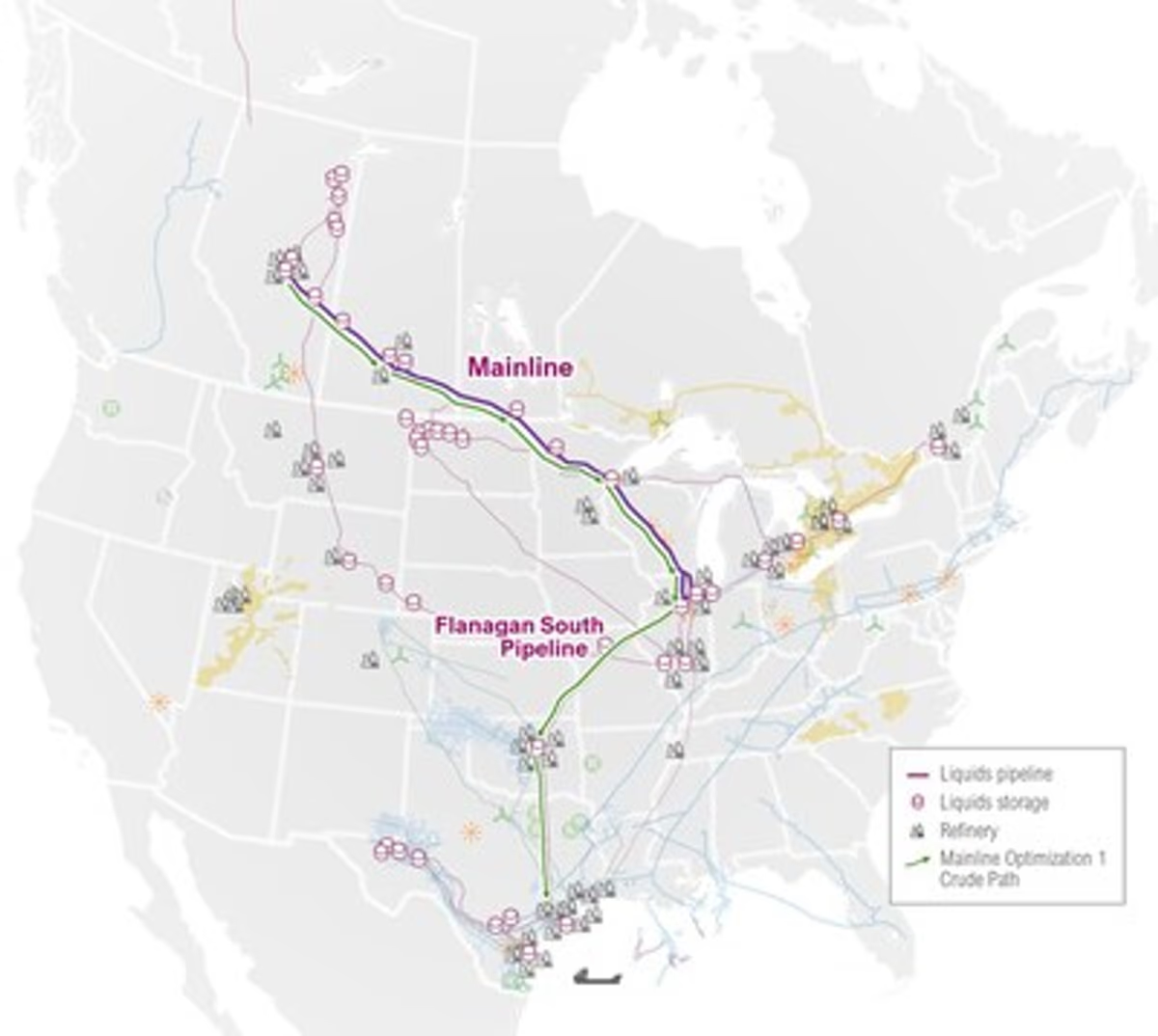
The problem is not supply. It is infrastructure. Canada Energy Regulator data shows the country is approaching pipeline capacity limits, with spare capacity reduced to approximately 120,000 barrels per day at the end of 2025. The Enbridge Mainline carries 3.2 million barrels per day. The expanded Trans Mountain Pipeline operates at 890,000 barrels per day capacity, averaging 730,000. Keystone handles 610,000. Pipelines could be fully constrained as early as Q1 2026 and almost certainly by winter 2026-2027, according to Oil Sands Magazine analysis.
Meanwhile, Fortune magazine reported in March 2026 that "the answer lies across the Pacific, in Canada." LNG Canada shipped its first cargo from Kitimat in June 2025. The facility reaches Asian markets without passing through the Strait of Hormuz, the Strait of Malacca, or the South China Sea. It is a structural insurance policy against exactly the crisis the world faces today.
Western Canadian Select: The World's Most Affordable Barrel
One of the most persistent myths about Canadian heavy oil is that it is inferior or limited in its applications. The reality is the opposite. Western Canadian Select, a blend of conventional heavy crude and oil sands bitumen with an API gravity of 19 to 22, trades at a consistent discount to WTI, averaging US$17.20 per barrel below benchmark pricing. As of March 2026, the discount sits at approximately $12 per barrel, meaning refiners purchasing WCS are buying feedstock at roughly $86 per barrel while WTI trades near $98.
That discount exists because of quality differentials and transportation costs from landlocked Alberta, not because of any limitation in what the oil can produce. Modern complex refineries equipped with coking, hydrocracking, and desulfurization units can process heavy Canadian crude into the complete spectrum of refined products: gasoline, diesel, jet fuel, kerosene, heating oil, LPG, naphtha, and the full range of petrochemical feedstocks including ethylene, benzene, and xylene, which become plastics, synthetic rubber, textiles, fertilizers, pesticides, and pharmaceuticals. Heavy crude also produces lubricating oils, paraffin wax, petroleum coke for aluminum smelting, sulfur, and asphalt for road construction. A 42-gallon barrel of crude yields approximately 45 gallons of refined products due to processing gains, according to the EIA.
Bitumen upgraders in Alberta convert raw bitumen into synthetic crude oil (SCO), a light, sweet crude that can be refined into anything a conventional light oil barrel produces. US Gulf Coast and Midwest refineries have been specifically configured to handle heavy Canadian crude because cheaper feedstock directly improves refining margins. Even with US tariffs under discussion, heavy Canadian crude remains among the most cost-competitive barrels available to American refiners. Since the Trans Mountain Expansion came online in May 2024, Canadian crude exported to Asia is priced against Brent (typically higher than the US-benchmarked WCS price), meaning producers capture higher revenues on Pacific sales while Asian buyers still receive competitively priced supply that bypasses every major global chokepoint.
Keystone XL: A $1.3 Billion Lesson in Government Getting in the Way
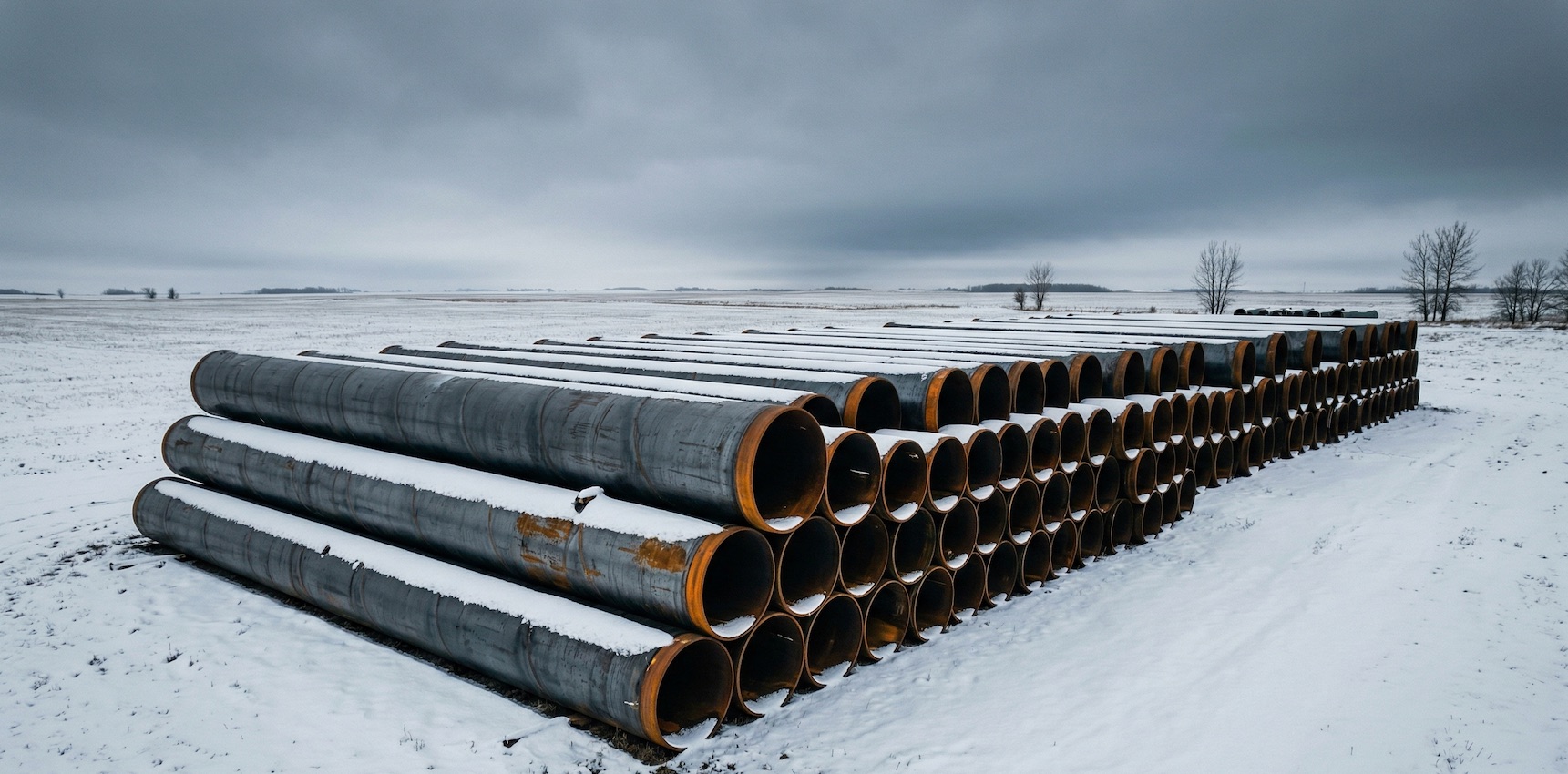
The Keystone XL saga is perhaps the clearest modern example of government intervention overriding sound economic principles at a cost to global energy security. Alberta taxpayers invested C$1.5 billion in equity and provided a C$6 billion loan guarantee in 2020 to advance the 1,947-kilometre pipeline designed to carry 830,000 barrels per day from Hardisty, Alberta to Steele City, Nebraska. Approximately 150 kilometres of pipe were installed in Alberta. Two pumping stations were constructed. That represents roughly 8% of the planned route.
President Obama rejected the project in 2015 on ideological grounds, despite State Department environmental reviews finding minimal climate impact. President Trump approved it in 2017, recognizing the economic and energy security benefits. President Biden revoked the permit on his first day in office in January 2021, calling it inconsistent with climate objectives. TC Energy took a $3.3 billion write-down, reducing its Keystone XL assets to $175 million. The Alberta Auditor General confirmed that Alberta taxpayers lost $1.333 billion. TC Energy filed a US$15 billion NAFTA claim that was thrown out by a three-judge arbitration panel in July 2024.
The pipeline would have moved 830,000 barrels of Canadian heavy crude per day to US Gulf Coast refineries specifically designed to process it. Instead, those refineries continued importing heavy crude from Venezuela and Saudi Arabia, often shipped through the Strait of Hormuz, the very chokepoint now disrupting global markets. The economic first principles were always clear: secure, overland supply from America's largest trading partner, through the longest undefended border on earth, from a stable democracy. Successive governments chose symbolism over supply.
The Prairie Connector: South Bow's Second Attempt
On March 5, 2026, South Bow Corporation (TSX: SOBO), the company spun off from TC Energy in October 2024 to manage its oil pipeline business, launched a binding open season for what analysts call a resurrection of Keystone XL under a new name: the Prairie Connector. South Bow CEO Bevin Wirzba is seeking long-term shipper commitments through March 30, with a 60-day review period to follow before a final investment decision.
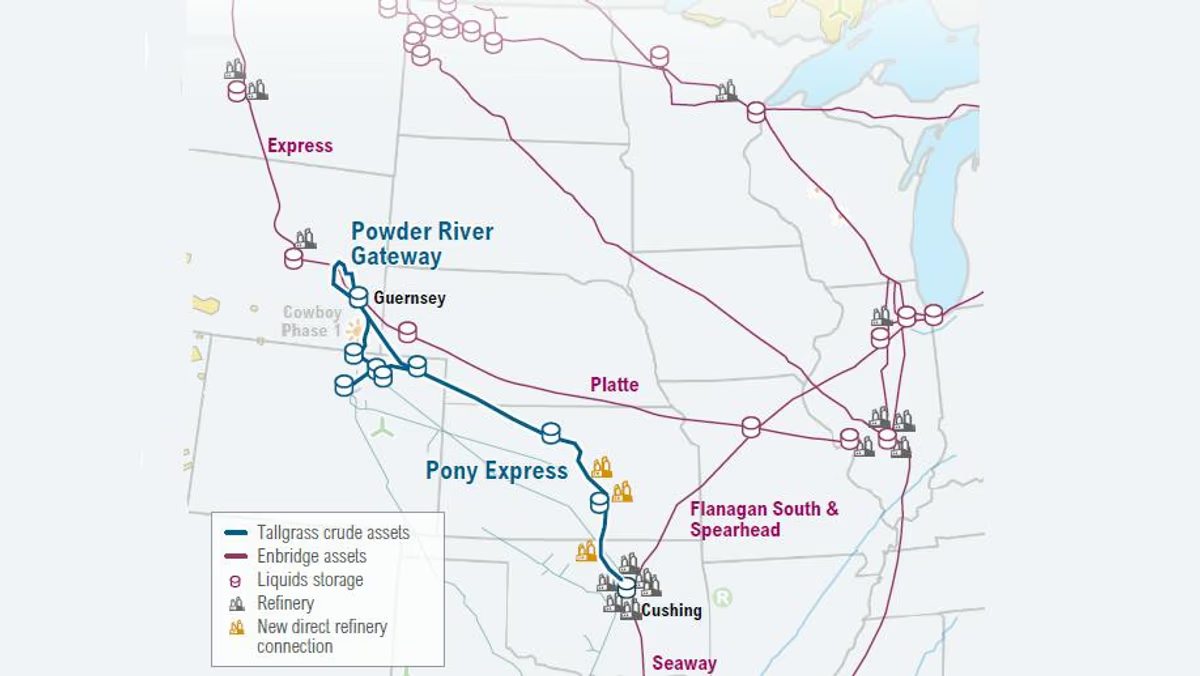
The project would reuse the 150 kilometres of Keystone XL pipe already installed in Alberta and connect to a new 36-inch, 1,038-kilometre crude oil transmission line built by US partner Bridger Pipeline LLC, a subsidiary of True Companies based in Casper, Wyoming. Bridger, led by Executive Vice President Tad True, filed its application with the Montana Department of Environmental Quality on January 28, 2026. The proposed route runs from the US-Canada border in Phillips County, Montana, to Guernsey, Wyoming, with capacity of up to 550,000 barrels per day. Over half the new pipeline in Montana and all of it in Wyoming would follow existing rights-of-way.
From Guernsey, an additional 425-mile segment would be needed to connect to the existing Keystone mainline at Steele City, Nebraska, and from there to Cushing, Oklahoma; Patoka, Illinois; and the US Gulf Coast. According to Matthew Lewis of Plainview Energy Analytics, this is the most credible downstream configuration. If completed, the Prairie Connector would increase Canada's crude exports to the United States by more than 12%.
President Trump signed an executive order on his first day back in office in January 2025 rescinding Biden's revocation of the Keystone XL presidential permit, describing Biden's policies as "inflationary, illegal and radical." However, a new presidential permit will be required for the Prairie Connector's border-crossing segment. All Canadian permits remain valid per the Canada Energy Regulator, and Saskatchewan announced in February 2025 that it would consider all pipeline permits crossing its territory as "pre-approved."
Prime Minister Mark Carney raised the prospect of reviving Keystone XL during an October 2025 White House meeting with Trump. A federal source told Reuters that Carney "certainly was aware that there would be some private-sector interest" from South Bow before the meeting. Adam Waterous, CEO of Strathcona Resources, publicly backed the proposal, stating: "The utility of a pipeline to the south is that it is a tool to achieve a tariff agreement to protect principally Canada's steel, auto and aluminum sectors, while also allowing the Canadian oil sector to grow." Strathcona plans to grow production from 125,000 barrels per day in 2026 to 300,000 by 2035.
The challenges remain political more than economic. Richard Masson, former CEO of the Alberta Petroleum Marketing Commission, noted: "It brings up all the same issues. For those who wanted Keystone XL cancelled, this is all the same stuff." He added: "Even if the Trump administration supports the plan, there is no guarantee that the next U.S. administration would." South Bow's Wirzba, having watched TC Energy lose billions, is proceeding with caution: "We will not sacrifice our capital allocation discipline through advancing any project."
The Venezuela Contradiction
The irony of the current situation deserves direct examination. The Trump administration is exploring hundreds of billions in Venezuelan oil investment while America's largest trading partner sits on 163 billion barrels of proven reserves connected to a pipeline corridor that has already been partially built, previously approved by this same president, and killed by his predecessors purely on political grounds. Venezuela, ranked by the World Justice Project as 142nd out of 142 countries on the Rule of Law Index, with a World Bank governance score of -2.15 (compared to Canada's +1.47), is somehow being considered as an energy partner over Canada, a NATO ally with the world's strongest property rights protections, transparent regulatory systems, and a shared continental defence agreement.
The United States spends an estimated $81 billion per year to protect global oil supply routes, according to Securing America's Future Energy (SAFE), roughly 16% of the Department of Defense base budget. Cumulative US military spending to secure Persian Gulf oil flows has reached an estimated $7.3 trillion since 1976, according to the National Energy Policy Institute. This represents a hidden subsidy of at least $11.25 per barrel, and some estimates exceed $30 per barrel. Canadian oil, delivered overland through pipelines, requires zero military protection and passes through zero chokepoints. The economic case is not complicated.
Energy East: The Pipeline That Would Secure NATO's Energy Future
The Energy East pipeline was proposed in 2013 to carry 1.1 million barrels per day from Hardisty, Alberta, to Saint John, New Brunswick, across 4,500 kilometres. It would have been the longest pipeline in North America, converting approximately 3,000 kilometres of existing natural gas pipeline to carry diluted bitumen. The estimated cost was C$12 billion. TransCanada cancelled it in October 2017, citing expanded environmental review requirements, changed economics, and taking a $1 billion write-down.
Eastern Canada currently imports approximately 490,000 barrels per day of crude oil at a cost of $19.5 billion annually (2023 CER data). Of that, 72.4% comes from the United States, 12.9% from Nigeria, and 10.7% from Saudi Arabia. The Irving Refinery in Saint John, Canada's largest at 320,000 barrels per day capacity, relies on marine shipments because it has no pipeline connection to western Canadian supply.
The strategic argument for Energy East extends beyond Canadian borders. Europe has reduced Russian oil imports from 3.5 million barrels per day in 2021 to 0.4 million barrels per day in 2024. The EU adopted regulations in January 2026 to prohibit Russian LNG and pipeline gas imports starting March 18, 2026. EU Energy Commissioner Dan Jorgensen warned against "replacing a dependency on Russian energy with another dependency on the US," noting the United States could supply 75% of EU LNG imports by 2030.
A revived Energy East, connected to an Atlantic export terminal, would provide NATO allies with a direct supply route from the world's third or fourth largest proven reserve holder, a democracy with strong rule of law, transparent regulatory frameworks, and no history of weaponizing energy exports. The NATO Association of Canada has explicitly called for Canada to become "an allied energy superpower." NATO energy security expert Can Ogutcu stated: "We need to be sure that we're going to have security of supply of production in the U.S. and in Canada." Energy East should logically be part of any European defence fund strategy to diversify away from Russian and Middle Eastern dependence. Japan sources 90% of its crude from the Middle East, mostly through Hormuz. South Korea sources 70%, with over 95% routed through the same chokepoint.
Quebec Is Changing Its Mind About Pipelines
Quebec has historically been the primary political obstacle to west-to-east pipelines. In 2019, only 33% of Quebecers supported Energy East. But a February 2025 SOM-La Presse poll found that 59% of Quebecers now support reviving Energy East. An Angus Reid poll showed Quebec support jumping 14 points to 47%. An MEI-Ipsos survey found 67% of Quebecers supported a natural gas pipeline and LNG project when framed as reducing Europe's reliance on Russian gas. When framed as economic independence from the United States, Quebec support rose from 39% to 56%. Nationally, 75% of Canadians now favour new pipelines to the East Coast or British Columbia, a 14-point increase year-over-year.
The shift is driven by US tariff threats and sovereignty concerns. Canadians increasingly recognize that importing Saudi, Nigerian, and American oil (often refined from Canadian crude) while sitting on 163 billion barrels of domestic supply is an economic and strategic failure.
Manitoba's Northern Energy Gateway to the World
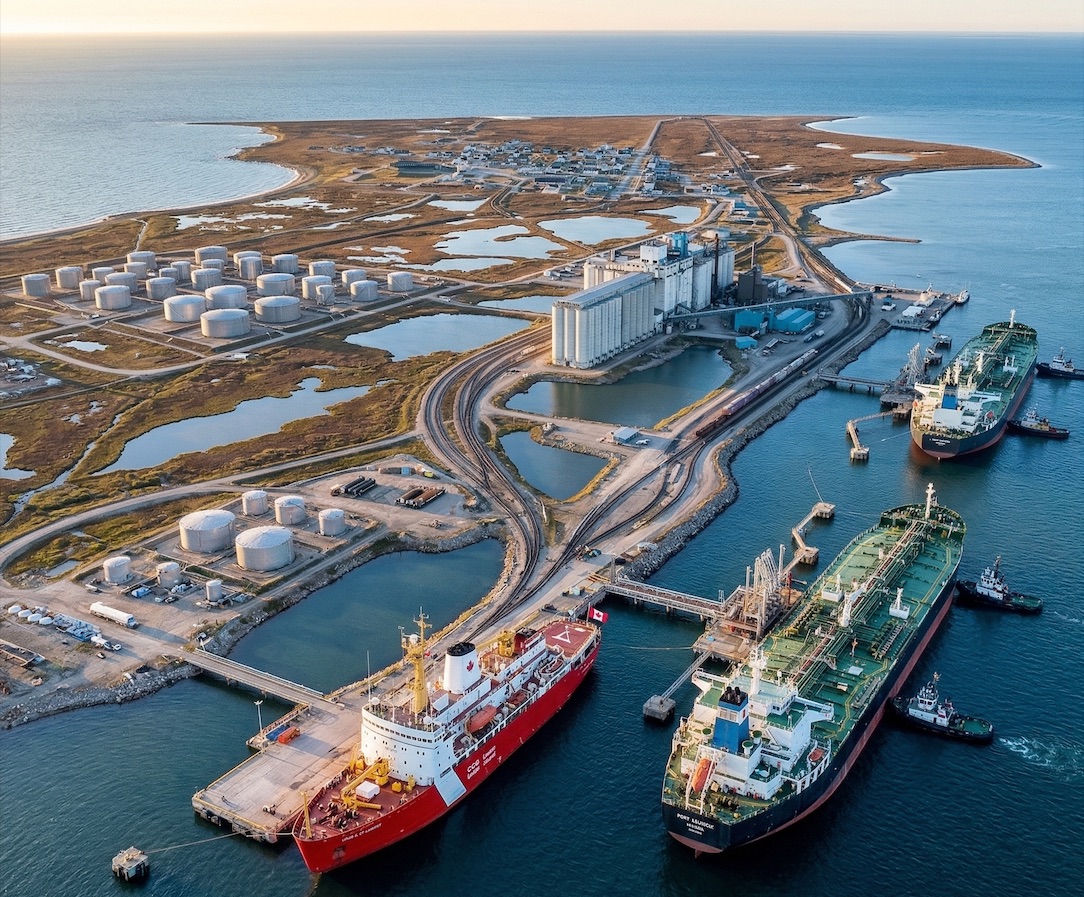
Manitoba Premier Wab Kinew has championed the expansion of the Port of Churchill as a northern energy corridor with direct access to global shipping lanes. The Western Energy Corridor organization has mapped a 1,560-kilometre route from western Canada to Churchill, proposing a combination of natural gas transmission, oil pipeline, and LNG export terminal. A Manitoba and Alberta company called NeeStaNan, with First Nations ownership, received authorization from Canada's energy regulator to export LNG through subarctic waters. Governments have committed over $260 million in port upgrades, rail, all-weather road construction, and icebreaker feasibility studies. The federal Major Projects Office has listed Churchill Plus as a "transformative project." Kinew has tied expansion to Arctic sovereignty, noting: "Canada has a lot of great plans for the future, but there's only one port and one rail line that feeds the Arctic."
What Alberta Is Doing About the Global Energy Crisis
Alberta is positioning itself to free the world from conflict-driven oil by providing low-cost, responsibly produced energy from a stable, democratically elected government with a demonstrated commitment to environmental sustainability. In October 2025, Premier Danielle Smith directed Energy Minister Brian Jean to boost Alberta oil production to 6 million barrels per day by 2030 and 8 million barrels per day by 2035, effectively doubling current output. In November 2025, Smith and Prime Minister Mark Carney signed a landmark Memorandum of Understanding calling for one or more new pipelines to the British Columbia coast, privately built and financed, with Indigenous co-ownership, carrying at least 1 million barrels per day. A pipeline application must be submitted to the Major Projects Office by July 1, 2026.
Jean articulated the geopolitical stakes in February 2026: "Alberta and BC and Saskatchewan could actually change the fate of the world just based on what we do with our energy." BMO Capital Markets reports that producers have submitted project proposals with combined capacity of 4.1 million barrels per day, enough to more than double current oil sands production.
Alberta's environmental credentials are strengthening by the year. Emissions intensity across the oil sands has declined 26% since 2012 while production increased 96%, according to provincial government data. Per-barrel greenhouse gas emissions have fallen approximately 30% since 1990. Oil sands emissions currently sit at roughly 70 megatonnes annually against a provincial cap of 100 megatonnes, leaving significant headroom for growth without exceeding environmental limits. The Smith-Carney MOU includes Alberta's agreement to mandate a 75% cut in methane emissions by 2035 relative to 2014 levels. When measured on a full lifecycle basis, from extraction to end use, BMO research shows oil sands crude now emits just 4 to 6% more than the global average, a gap that carbon capture technology is rapidly closing.
On the Fraser Institute's Global Petroleum Survey, Saskatchewan ranks 3rd globally and Alberta ranks 9th for oil and gas investment attractiveness. Compare that to the countries the world currently depends on for marginal supply: Venezuela ranks at the very bottom, Russia's eastern regions are among the 10 least attractive, and Iran is not investable at all under current sanctions. Canada offers transparent regulation, strong property rights, a functioning judiciary, and carbon pricing, the exact governance framework that long-term institutional investors require.
The Canadian Carbon Capture Advantage
Canada does not merely talk about reducing emissions. It funds the work, measures the results, and commercializes the technology. Alberta was the first jurisdiction in North America to price industrial carbon emissions, beginning in 2007. Since then, the province's Technology Innovation and Emissions Reduction (TIER) system has collected over C$4 billion from large emitters. That revenue has been reinvested directly into clean technology: Emissions Reduction Alberta (ERA) has committed nearly $1 billion toward 316 projects valued at over $10.3 billion, achieving a remarkable 10-to-1 leverage ratio with private capital. These investments are projected to deliver cumulative reductions of 28 million tonnes of CO2 equivalent by 2030 and 93 million tonnes by 2050.
The results are measurable. Alberta committed to cut methane emissions 45% below 2014 levels by 2025 and achieved 44% by 2021, four years ahead of schedule. ERA invested $95 million in 52 methane-focused projects worth $267 million total, and the technologies progressed from concept to commercialization in four to five years, faster than the typical six to eight year cycle. Alberta's power sector achieved a 40% emissions reduction between 2005 and 2020. Total provincial emissions have declined nearly 10% in six years since 2015.
Andrew Leach, Professor of Economics and Law at the University of Alberta and architect of the province's climate policy framework, has noted that Alberta's carbon pricing system "makes low-cost resource developments and low-energy input resource developments cheaper than they would have otherwise been, while the ones it makes more expensive are those with really high greenhouse gas emissions." The system creates a direct financial incentive for producers to invest in cleaner extraction methods. As Leach has observed, given the choice between "stringent regulation or flexible regulation with pricing, they're going to choose the flexible regulation with pricing every time," and that flexibility has driven real innovation.
The energy companies themselves are investing at scale. Shell's Quest CCS facility near Edmonton, the world's first at an oil sands upgrader, has captured and stored over 9 million tonnes of CO2 since beginning operations in 2015. The Oil Sands Alliance (formerly Pathways Alliance), whose six members, Canadian Natural Resources, Cenovus Energy, ConocoPhillips Canada, Imperial Oil, MEG Energy, and Suncor Energy, represent approximately 95% of Canada's oil sands production, is developing a $16.5 billion carbon capture and storage network. The project would connect over 20 oil sands facilities via a 400-kilometre pipeline to underground storage near Cold Lake, targeting 10 to 12 million tonnes of CO2 captured per year by 2030, scaling to 40 million tonnes by 2050. An additional $7.6 billion is committed to complementary emissions reduction technologies. Over 40 potential CCS projects are at various planning stages across Alberta.
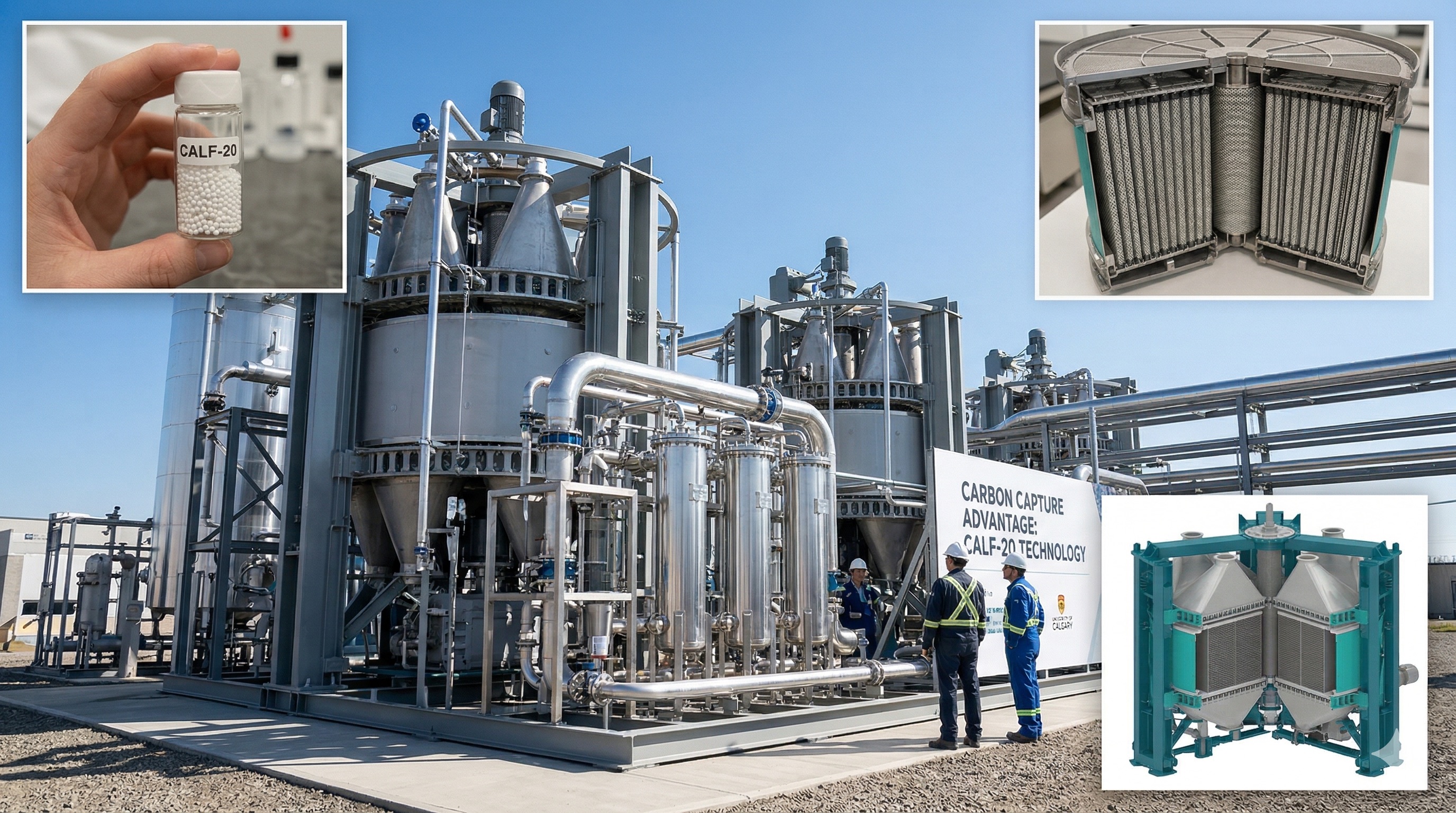
Dr. George Shimizu at the University of Calgary developed CALF-20 (Calgary Framework-20), a metal-organic framework with exceptional CO2 absorption capacity. The 2025 Nobel Prize in Chemistry, awarded for the development of metal-organic frameworks, specifically referenced CALF-20 in its scientific background documents. Svante Inc. has opened a factory in Burnaby, BC, manufacturing carbon capture filters capable of processing up to 10 million tonnes of CO2 annually, equivalent to emissions from 2.3 million cars. A spinoff company, Existent Sorbents, is already working with oil sands producers and a major steel factory to deploy the technology at industrial scale.
Alberta has invested approximately $2 billion in carbon capture over the past decade. The Alberta Carbon Trunk Line has a designed capacity of 14.6 million tonnes per year, with over 16 million tonnes of CO2 safely captured and stored since 2015 across the province's major projects. The goal is not theoretical: it is to make Alberta oil among the lowest-carbon barrels produced anywhere on earth, and the data shows the trajectory is on track.
The Price Outlook and the Canadian Energy Investment Case
History offers a blunt warning about what happens when oil prices remain at current levels. In 2008, crude surged to $147.30 per barrel in July. Research by James Hamilton at CEPR concluded that "had there been no increase in oil prices between 2007:Q3 and 2008:Q2, the US economy would not have been in a recession." Oil price shocks explained a 5% cumulative reduction in US real GDP during the financial crisis. US petroleum consumption contracted by 1.2 million barrels per day, the largest decline since 1980. Twenty-five airlines went bankrupt in the first six months of 2008. The Cato Institute documented that nine out of 10 postwar recessions began shortly after a major spike in the price of oil.
The pattern is repeating. Moody's chief economist Mark Zandi puts recession odds at 49% over the next 12 months. Oxford Economics warns that $140 per barrel sustained for two months would push the eurozone, UK, and Japan into contraction and bring the US economy to a "standstill." Nobel laureate Joseph Stiglitz warns of stagflation. The WTO projects global merchandise trade growth could fall to just 1.4% if prices persist, down from 4.6% in 2025. South Korea has activated a 100 trillion won ($68 billion) market stabilization program. Every $10 per barrel sustained increase reduces global GDP by approximately 0.1% and adds 0.2 percentage points to inflation, according to the Dallas Federal Reserve.
Canada could literally offset these costs to the global economy. With 163 billion barrels of proven reserves, production capacity approaching 5.5 million barrels per day and a mandate to reach 8 million by 2035, chokepoint-free shipping routes to both oceans, and carbon capture technology referenced by the Nobel committee, Canadian oil is the most obvious answer to the world's energy security crisis. Had pipeline infrastructure been built over the past decade instead of blocked by successive governments, millions of additional barrels would already be flowing to global markets, dampening the price spike that now threatens a worldwide recession.
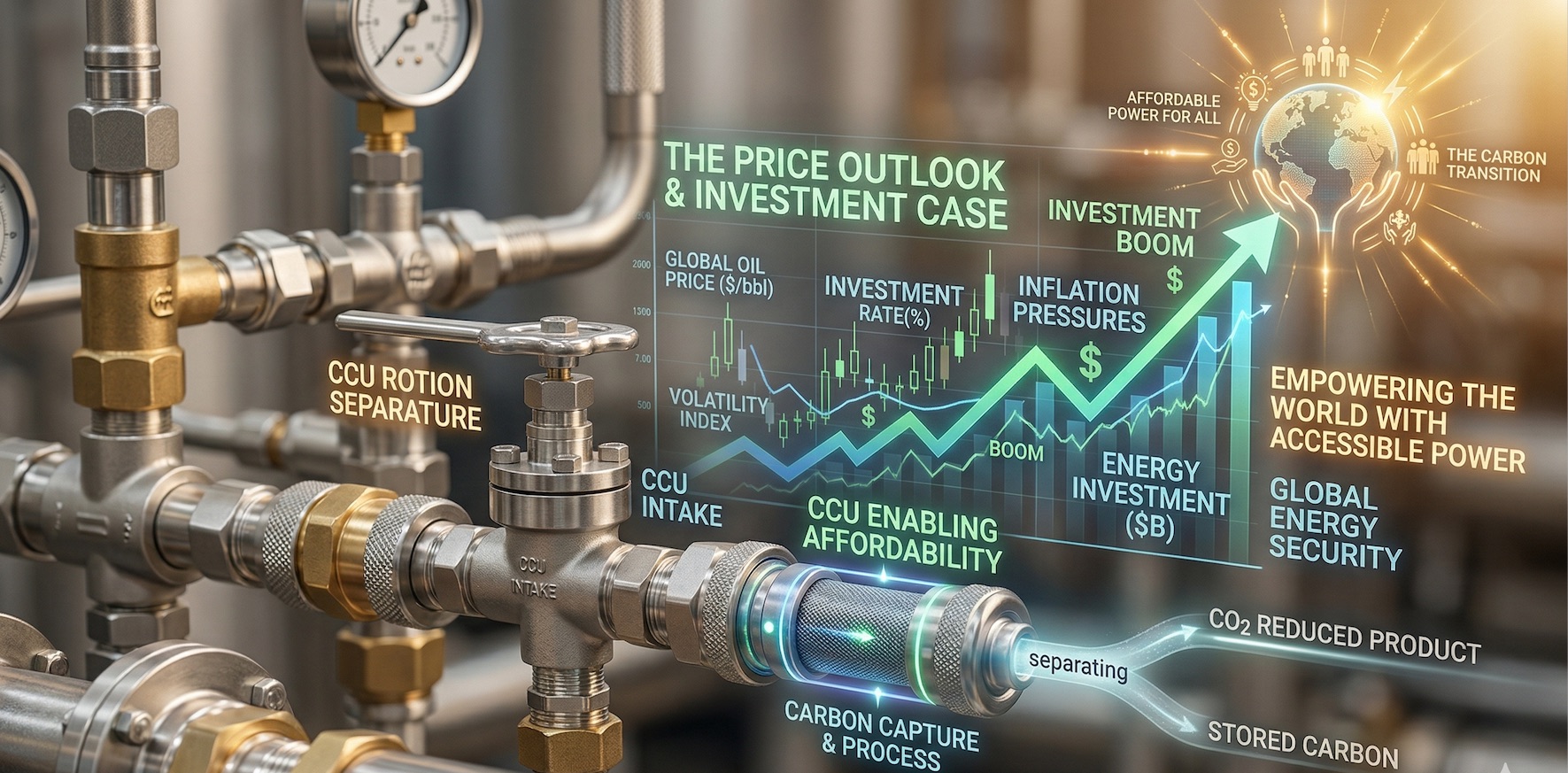
Trevor Tombe, economist at the University of Calgary, calculates that a sustained 50% oil price increase costs Canadian households nearly $1,000 per year and pushes inflation over 1 percentage point higher. But Tombe notes that Canada produces 1.9 billion barrels annually, meaning producer gains at $200 per barrel would be "4 to 5 times larger" than consumer costs. For Alberta specifically, every $1 US increase in oil prices generates approximately $680 million annually for provincial coffers. Goldman Sachs projects Brent could reach $120 short-term and $150 in a bull case. Even in a base case with de-escalation, Goldman sees Brent at $71 by Q4 2026 and $80 by 2028 as underinvestment constrains supply.
The CER projects Canadian production reaching 5.8 million barrels per day by 2030 and peaking at 6.1 million by 2042. Foreign direct investment in Canada reached its highest level since 2007 in 2025. Since the Trans Mountain expansion came online in May 2024, Canadian crude exports to Indo-Pacific markets went from virtually zero to an average of C$571 million per month. US ownership of Canadian energy companies has risen from 20% to approximately 40% of some producers. Total deal value in the Canadian energy sector reached $37.8 billion in 2025, the highest since 2017.
A Sleeping Energy Superpower Awaiting Willing Partners
The answer to the world's energy crisis is not complicated. It is Canada.
Canada holds the third or fourth largest proven oil reserves on earth: 163 billion barrels, enough to supply the nation for 189 years at current consumption. It has world-leading carbon capture technology recognized by the Nobel committee. It has a carbon pricing system that has collected $4 billion and reinvested it into clean technology delivering measurable results. It has cut methane emissions 44% ahead of schedule. It produces heavy crude that trades at a $12 to $17 discount to global benchmarks, making it among the most affordable barrels on the planet, and contrary to myth, that crude can be refined into every product light oil produces: gasoline, diesel, jet fuel, petrochemicals, plastics, pharmaceuticals, and more. It has chokepoint-free shipping routes to both the Atlantic and Pacific that bypass the Strait of Hormuz, the Strait of Malacca, and the South China Sea. It has a World Bank Rule of Law score of +1.47, placing it among the most stable and transparent nations on earth. It has never weaponized energy exports, never sanctioned an ally, and never threatened to withhold supply for political leverage.
Canada's western provinces are eager and willing to build the infrastructure the world needs. Alberta's energy minister has a mandate to double production to 8 million barrels per day by 2035. Saskatchewan has pre-approved all pipeline permits. Manitoba is investing $260 million in a northern energy gateway through Churchill. British Columbia is home to LNG Canada, the first major LNG export facility on the Pacific coast. The Canada-Alberta MOU calls for at least 1 million barrels per day of new pipeline capacity to tidewater, with applications due by July 2026. Producers have submitted proposals for 4.1 million barrels per day of new capacity. Seventy-five percent of Canadians support new pipelines. Even Quebec, historically the biggest obstacle, now shows majority support at 59%.
Everything is in place except the political will to act at the pace the world requires. The reserves exist. The technology exists. The companies are ready. The capital is available. The markets are desperate. The western provinces are aligned. The public supports it. Canada is a sleeping energy superpower, holding 163 billion barrels of proven reserves behind a wall of insufficient pipeline capacity, waiting for willing partners and governments to invest in a future that benefits not just Canadians but the entire free world.
The world spends $81 billion per year and has spent $7.3 trillion since 1976 protecting oil supply routes through conflict zones. Every $10 increase in crude costs the global economy 0.1% of GDP. Moody's puts recession odds at 49%. Brent trades above $112. The Strait of Hormuz is closed. And the fourth largest proven oil reserve on earth, held by a stable democracy with Nobel-referenced carbon capture technology, sits waiting for pipelines to be built.
The question is no longer whether Canada has the oil. The question is how much longer the world can afford to pretend it does not need it.
Published by Oil Authority, edited by Adam Humphreys
Submit a Correction
Spotted a factual error? Free account required to submit a correction.