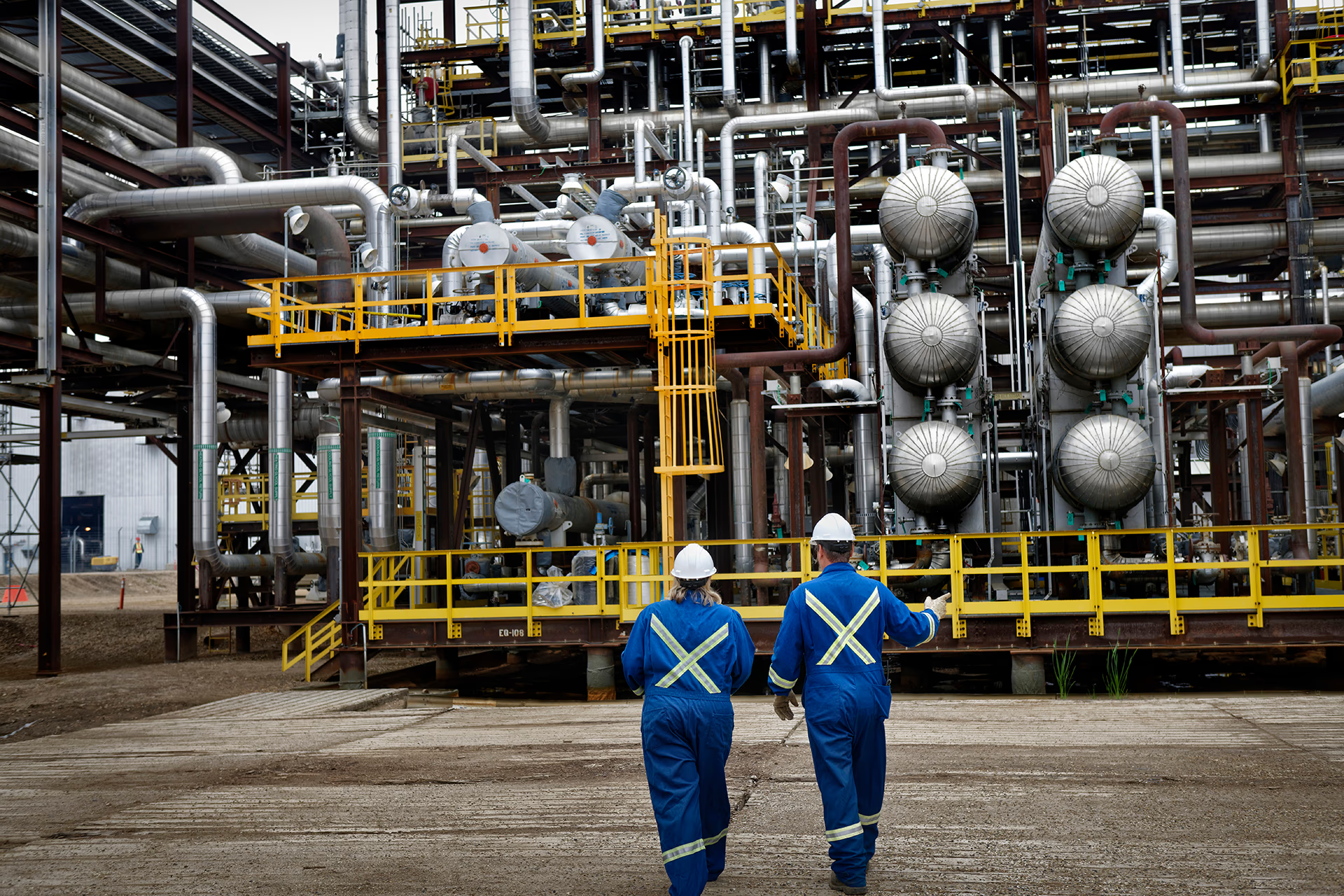
Cenovus Posts Record Oil Sands Production and $4.99 Billion Adjusted Funds Flow, Raises Output Guidance
Cenovus hit a quarterly oil sands record at 786,400 BOE/d in Q2 2026, generating $4.99B in adjusted funds flow and lifting its full-year output guidance.
Cenovus Energy delivered $4,986 million in adjusted funds flow in the second quarter of 2026, the best quarterly performance in the company's history. Total upstream production reached 970,400 barrels of oil equivalent per day, up 27% from 765,900 BOE/d in the same period last year. Net earnings came in at $2,870 million, or $1.53 per diluted share. CEO Jon McKenzie described the quarter as the company's "best-ever quarterly financial results" in a statement released July 29.
Oil Sands Assets Break Production Records
The oil sands segment set a quarterly record at 786,400 BOE/d, driven by record output at both Christina Lake and Sunrise. Christina Lake produced 372,100 barrels per day, a new all-time high for that asset. Foster Creek added 214,500 barrels per day, while Sunrise contributed 65,700 barrels per day and Lloydminster thermal reached 103,100 BOE/d.
Christina Lake and Foster Creek carry distinct acquisition histories within Cenovus. The two SAGD projects were jointly developed through the FCCL Partnership, owned 50% by Cenovus and 50% by ConocoPhillips. Cenovus acquired ConocoPhillips' 50% stake in 2017 for approximately US$13.3 billion, consolidating full ownership of both projects. Since then, Cenovus has operated them as wholly owned assets and driven successive production records at Christina Lake.
Sunrise, located in the Athabasca region of northeastern Alberta, was previously a 50% joint venture with BP. Cenovus acquired BP's remaining 50% interest in 2022, completing its consolidation of all four major oil sands operations. The 2021 acquisition of Husky Energy added an Atlantic offshore division, Asia Pacific operations, and a U.S. refining arm to the portfolio. Cenovus's U.S. refining segment processed 349,800 barrels per day in Q2 2026 at 96% utilization, giving the company downstream exposure to capture refining margins on a portion of its own heavy crude.
Financial Results: Funds Flow, Debt, and Shareholder Returns
Total revenues reached $17.4 billion in Q2 2026, up from $12.4 billion in the first quarter of the year. Adjusted funds flow of $4,986 million translated to $2.66 per diluted share. Free funds flow reached $3,786 million after $1,200 million in capital investment. The company returned $1.4 billion to shareholders: $1.0 billion in share buybacks covering 26.2 million shares, and $400 million in base dividends at $0.22 per share.
Net debt fell $2.7 billion during the quarter to $5,388 million. That figure crossed the $6 billion threshold in Cenovus's shareholder return policy, which directs 75% of excess free funds flow to buybacks and dividends. The company targets long-term net debt of $4.0 billion, implying roughly $1.4 billion in further balance sheet reduction from the current position. Capital investment guidance for full-year 2026 remains $5.0 to $5.3 billion.
WCS Discount Adds Context to Record Results
Western Canadian Select last published at $66.91 per barrel, the most recently available quote as of July 29 per OilPrice.com, which carries an 11-hour feed delay for WCS. WTI crude was trading at $84.60 per barrel in late morning on the CME, up 6.74% on the session. The WCS-WTI spread of $17.69 per barrel reflects the heavy oil discount that Alberta SAGD producers contend with. At Cenovus's oil sands volume of 786,400 barrels per day, that spread implies a daily revenue gap of approximately $13.9 million compared with WTI-equivalent light crude pricing, or roughly $1.27 billion over a 91-day quarter.
Oil Authority recently tracked a single-session 8.7% decline in WCS that followed a ceasefire unwinding in the Hormuz region. That episode shows how geopolitical pressures in the Middle East can widen the already-sizeable heavy oil discount for Alberta producers. Cenovus's downstream assets in Canada and the United States allow the company to capture refining margins on a portion of its own oil sands output, partially offsetting the WCS pricing gap relative to light crude benchmarks.
Production Guidance and Upcoming Milestones
Cenovus raised its 2026 full-year production guidance to 970,000 to 1,010,000 BOE/d, up 25,000 BOE/d from the prior range. Management confirmed the company is on track to reach 1 million BOE/d during July 2026. West White Rose, the offshore Newfoundland project where Cenovus holds a 72.5% operating interest alongside Suncor Energy, is expected to produce first oil in late Q3 2026. The company also sanctioned the diluent solvent aided process, a new in situ recovery technique projected to add 5,000 to 10,000 barrels per day by 2028.
Oil sands operating costs came in below the midpoint of prior guidance. The updated full-year range is $10.75 to $11.75 per BOE, improved from the previous $11.25 to $12.75. Foster Creek benefited from a completed enhanced sulphur recovery project that management expects will reduce per-barrel operating costs by $0.50 to $0.75. Canadian refining throughput guidance was raised by 5,000 barrels per day to a range of 110,000 to 115,000 barrels per day.
Published by Oil Authority, edited by Adam Humphreys
Submit a Correction
Spotted a factual error? Free account required to submit a correction.