Keyera, AltaGas, CN Back $240M ACE Rail Terminal
Keyera, AltaGas, and CN backed a $240 million propane and butane rail terminal moving 45,000 bpd from Fort Saskatchewan to Prince Rupert by mid-2028.
Keyera, AltaGas, and CN announced on Wednesday a joint commitment to advance the Alberta Corridor Export (ACE) Rail Terminal, a $240 million propane and butane export project anchored in Alberta's Industrial Heartland near Fort Saskatchewan. The facility will move approximately 45,000 barrels per day of liquefied petroleum gas from Keyera's NGL processing complex to West Coast export markets, with the Port of Prince Rupert positioned as the primary destination. Expected in-service is mid-2028.
Three-Way Partnership Roles
The arrangement layers each company's existing infrastructure. Keyera Corp. will own and build the terminal on its own land, an investment that adds roughly $100 million to its 2026 capital guidance with the balance falling into 2027 and 2028. CN provides rail haulage on its mainline corridor connecting the Edmonton and Fort Saskatchewan industrial cluster to Prince Rupert. AltaGas Ltd. brings the West Coast export platform, including its existing propane export capacity that has been a key channel for Western Canadian NGLs reaching Asian buyers.
Keyera CEO Dean Setoguchi said the project reflects the company's continued focus on strengthening and extending Keyera's integrated value chain while providing customers with an efficient solution to diversify market access. AltaGas CEO Vern Yu added that leveraging unit train capability enhances operating efficiency and reduces costs, creating greater value for customers while strengthening the global competitiveness of Canadian energy. CN CEO Tracy Robinson called the terminal strategic, trade-enabling infrastructure that adds capacity between the Industrial Heartland and West Coast gateways.
Capacity in Context
The 45,000 barrels per day flow rate equates to about 16.4 million barrels of propane and butane per year. At Mont Belvieu LPG benchmarks in the $0.90 to $1.00 per gallon range observed during early May 2026, those volumes carry a notional annual gross revenue of roughly $620 million to $690 million if priced to North American markets. Asian buyers typically pay a Mont Belvieu plus delivery premium that has averaged $4 to $6 per barrel since the start of the Hormuz crisis, raising the effective netback for West Coast exports above what Gulf Coast routings can deliver.
For Keyera, the terminal complements its existing fractionation and storage capacity at Fort Saskatchewan, which already processes most of the propane and butane recovered from Western Canadian Sedimentary Basin liquids-rich gas. The unit train loop, which allows full trains to be loaded without breaking apart, is comparable to the operating concept AltaGas uses at its Ridley Island Propane Export Terminal to compress per-barrel logistics costs.
Canada's West Coast Pivot Continues
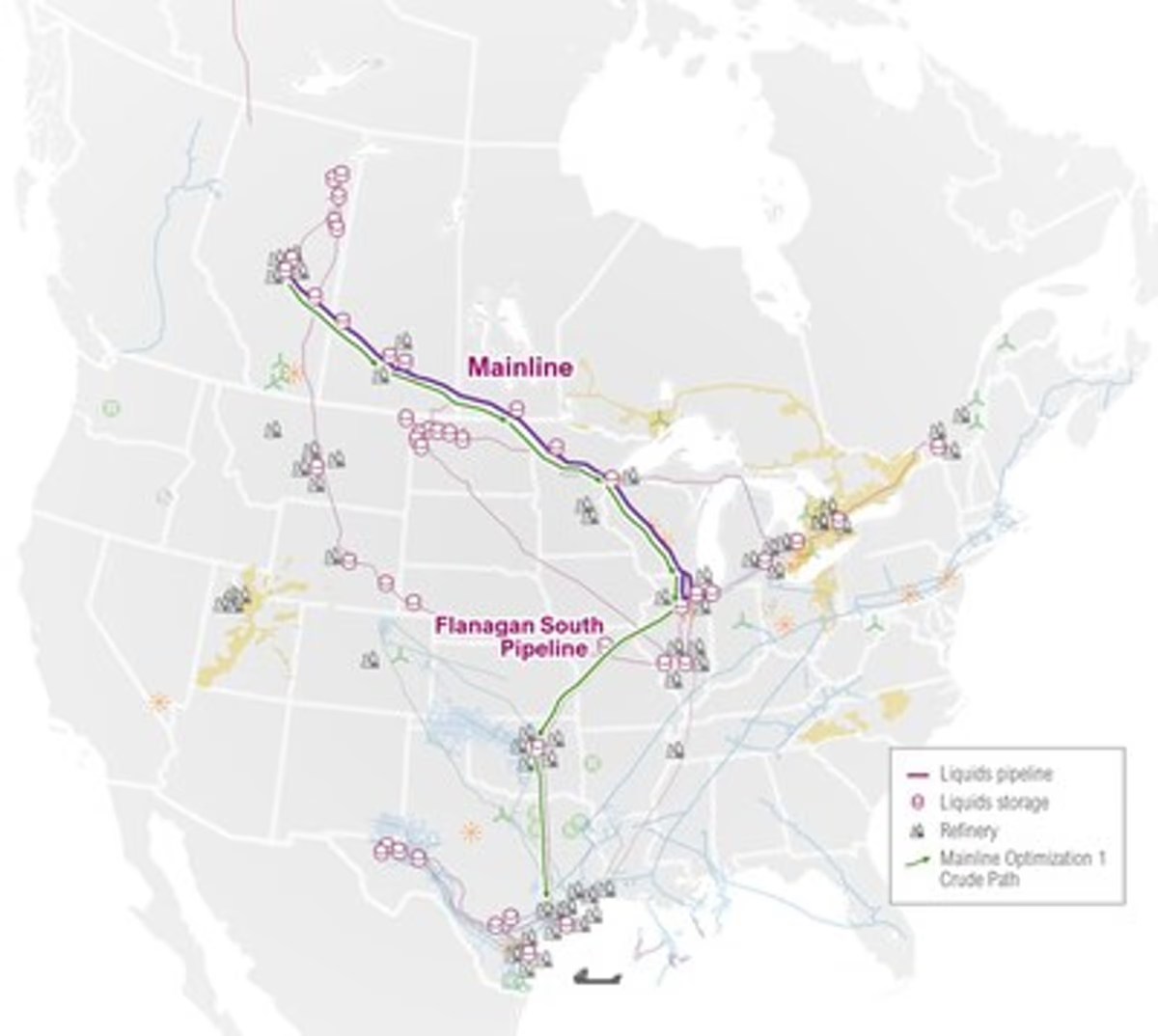
The ACE announcement lands as Canadian producers continue to redirect exports away from the United States toward Pacific Rim buyers. The Trans Mountain Expansion has now loaded more than 500 Aframax cargoes from Westridge for delivery to Asia, narrowing the WCS-WTI differential, as Oil Authority covered in the TMX Westridge milestone. Enbridge has flagged 250 thousand barrels per day of additional WCSB egress to the Gulf Coast through its Mainline Optimization, detailed in the Enbridge egress build-out. ACE adds the NGL piece of that diversification story.
Alberta Premier Danielle Smith's office, which has pushed for additional West Coast capacity following the Canada-Alberta federal-provincial energy memorandum signed in early May, welcomed the announcement. CIBC analyst Robert Catellier said in a May 20 note that Alberta's broader 2028 timing for a million-barrel-per-day west coast oil pipeline is a best-case scenario given permitting realities, but the ACE timeline appears credible because it leverages existing CN track and existing AltaGas dock space.
Forward-Looking Demand Picture
Wood Mackenzie projects Asian LPG demand growing more than 4 percent annually through 2030, with India alone adding nearly 12 million tonnes of import capacity by then. RBC Capital Markets has flagged West Coast Canadian propane as one of the few NGL sources able to compete with United States Gulf cargoes on time-to-Asia, given the roughly seven day shipping advantage from Prince Rupert versus Houston. Keyera said offtake economics are supported by long-term commercial arrangements with AltaGas and CN, though specific volumes contracted to anchor shippers were not disclosed.
Published by Oil Authority, edited by Adam Humphreys
Submit a Correction
Spotted a factual error? Free account required to submit a correction.