Pakistan Pays $20.70 Per MMBtu for Spot LNG, Highest Since 2022, as QatarEnergy Force Majeure Extends Through August
Pakistan bought emergency spot LNG at $20.70/MMBtu, highest since 2022, as QatarEnergy's force majeure through August leaves Islamabad scrambling.
Pakistan's state-owned LNG importer purchased a spot cargo at $20.70 per million British thermal units for July 21-22 delivery, the highest price the country has paid since 2022. The purchase marks the fourth emergency spot buy for July as contracted supplies from Qatar remain suspended. QatarEnergy extended its force majeure through the end of August 2026, leaving Pakistan to bridge the gap through the open market.
QatarEnergy Force Majeure: Four Months and Counting
Iranian strikes on the Ras Laffan LNG complex on March 4, 2026, wiped out approximately 17 percent of Qatar's LNG export capacity, according to Fox Business. QatarEnergy declared force majeure on the same day. The company has extended that force majeure twice, pushing the suspension of contracted deliveries through the end of August. A tanker attack near the Strait of Hormuz on July 9 halted Qatar's plans to gradually restore output, according to Bloomberg reporting dated July 9, 2026. Pakistan's Qatar-sourced flows collapsed from roughly 800,000 tonnes in January 2026 to below 50,000 tonnes by April.
Contract Price Versus Spot: A 76 Percent Gap
Pakistan holds long-term QatarEnergy contracts priced at 13.37 percent and 10.2 percent of Brent crude, according to Pakistan LNG Ltd tender documentation. At Friday's ICE Brent settlement of $88.10 per barrel, those contract prices equate to approximately $11.79 per MMBtu and $9.00 per MMBtu. Pakistan paid $20.70 per MMBtu on its most recent spot cargo, a 76 percent premium above the higher contract tier. The country paid four progressively higher spot prices through July: $16.74, $17.37, $18.23, and $20.70 per MMBtu, a 24 percent escalation in three weeks.
Hormuz Disruption Cuts Global LNG Supply
The Strait of Hormuz carries approximately one-fifth of global LNG supply, according to the IEA's July 2026 Oil Market Report. IEA Executive Director Fatih Birol said on July 16 the disruption is "the greatest threat to global energy security in history." He cited a loss of more than 2 billion cubic metres of gas supply per week from Qatar and the UAE combined, per IEA data. Birol warned the global economy has just weeks before Hormuz closures trigger irreversible economic damage. No LNG tankers were observed exiting the Strait for several consecutive days this week, according to Foreign Policy Journal on July 18, 2026.
BP Singapore and TotalEnergies Fill the Gap
BP Singapore, a trading arm of BP, was the counterparty on Pakistan's $20.70 per MMBtu cargo for July 21-22 delivery. TotalEnergies Gas and Power Limited, a subsidiary of TotalEnergies, supplied an earlier July cargo at $17.37 per MMBtu. Mozambique and Oman provided partial relief but could not cover the full shortfall, according to Foreign Policy Journal reporting. Pakistan purchased US-sourced LNG at $18.40 per MMBtu in May to bridge earlier supply gaps, signaling that American exporters are gaining ground as a Hormuz-displacement alternative.
Henry Hub at $2.922 Per MMBtu Points to US LNG Export Opportunity
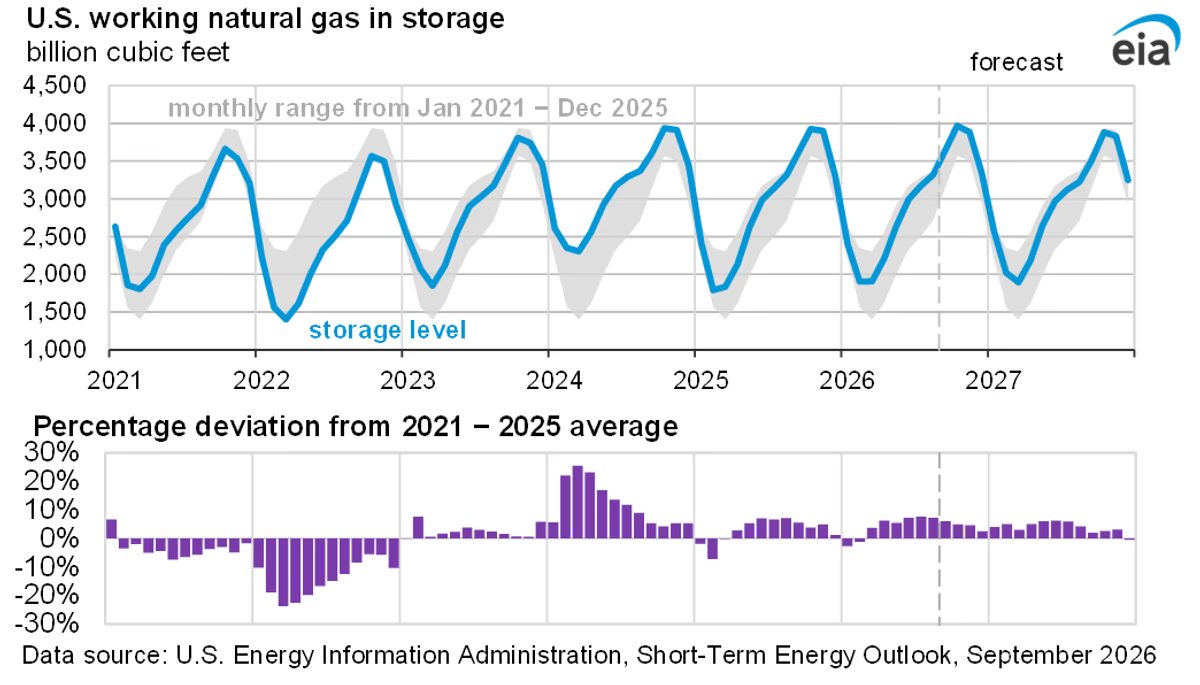
CME Henry Hub natural gas settled at $2.922 per MMBtu in Friday's session, gaining 2.24 percent, according to OilPrice.com data accessed July 18, 2026. The spread between US Henry Hub gas and Pakistan's latest spot LNG cargo stands at $17.78 per MMBtu. That margin, before liquefaction and shipping costs, represents the export incentive for US LNG facilities. Pakistan expects to rely on spot market purchases through September 2026, when QatarEnergy contracted volumes are expected to resume, according to Energy Update Pakistan in July 2026. Rising summer temperatures and reduced solar output during monsoon season compound the power supply shortfall, according to Muhammad Awais Ashraf of AKD Securities.
Context: OPEC+ Response Trails the Scale of Hormuz Disruption
Oil Authority covered the broader supply response earlier this week. OPEC+'s planned August output increase of 188,000 barrels per day covers just 2 percent of the estimated Hormuz supply gap. The LNG market faces a structurally identical mismatch: spot cargoes available on short notice cannot replace long-term contracted Ras Laffan volumes. QatarEnergy's force majeure now extends to its fourth consecutive month, with no confirmed restart date for full Ras Laffan output.
Published by Oil Authority, edited by Adam Humphreys
Submit a Correction
Spotted a factual error? Free account required to submit a correction.