West Coast Oil Pipeline and Northern Shield Energy Corridor Would Add 1.5 Million Barrels Per Day as Canada Diversifies from US Market
Canada's two pipeline corridors target 1.5M bbl/d of tidewater access, worth $1.8B to $3.65B annually if WCS-WTI discount narrows for Alberta producers.
Canada advanced two major oil infrastructure proposals in July 2026, moving faster on pipeline approvals than at any point since the Trans Mountain pipeline reached first oil in May 2024. Prime Minister Mark Carney and Alberta Premier Danielle Smith announced the West Coast Oil Pipeline on July 2. Ontario Premier Doug Ford and Smith unveiled the Northern Shield Energy Corridor on July 6. Together the projects would add 1.5 million barrels per day of new pipeline capacity for Alberta crude bound for non-US markets.
West Coast Oil Pipeline: $35 Billion to Reach Tsawwassen from Bruderheim
The West Coast Oil Pipeline would carry 1 million barrels per day from Bruderheim, northeast of Edmonton, to a new deep-water export terminal at Roberts Bank near Tsawwassen on British Columbia's south coast. The route follows the existing Trans Mountain corridor, keeping the project within a proven right-of-way and clear of the federal tanker moratorium zone protecting B.C.'s northern coast. Cost estimates range from $35 billion to $43 billion, with project completion targeted between 2032 and 2034.
Trans Mountain Corporation, the federally owned pipeline operator, would lead planning and construction. Canada and Alberta would each hold equal ownership stakes, with Indigenous Peoples reserved a meaningful equity participation. Pembina Pipeline Corporation (TSX: PPL) signed a non-binding Heads of Agreement on July 2 to take a 10 percent economic interest during construction, with the option to increase that stake to 20 percent once the pipeline enters commercial operation.
Pembina CEO Scott Burrows said the project "represents a once-in-a-generation opportunity to advance nation-building energy infrastructure that strengthens Canada's economy and expands access to global markets for Canadian energy." Alberta committed $18 million to early planning costs. The federal Major Projects Office has until October 1, 2026 to designate the project as a national interest filing under the Building Canada Act, enabling a construction start as early as September 1, 2027, subject to Indigenous consultation requirements. Definitive agreements are targeted for September 2026.
Northern Shield Energy Corridor: Hardisty to Sarnia at 500,000 Barrels Per Day
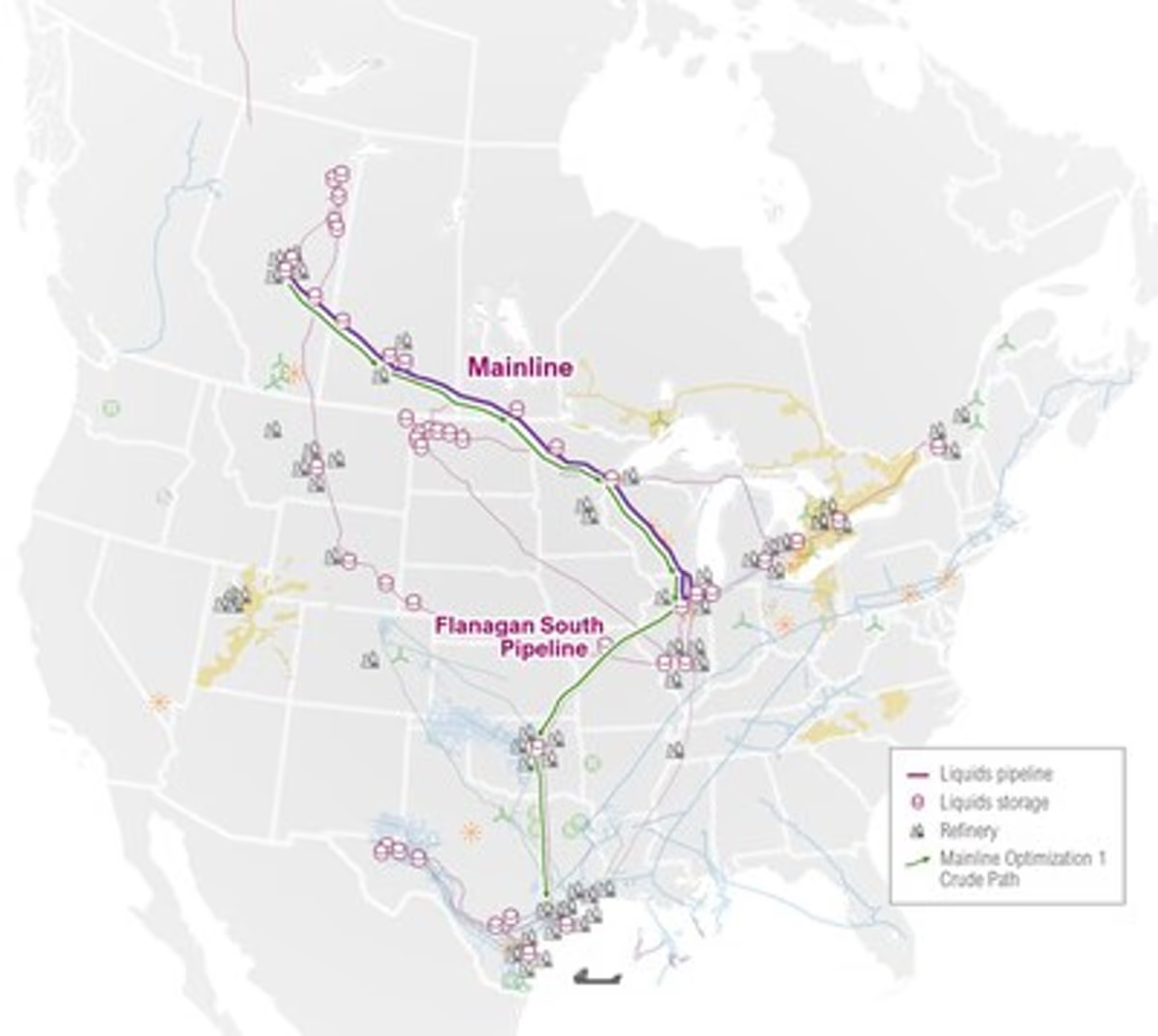
Alberta and Ontario unveiled the Northern Shield Energy Corridor at a Calgary announcement on July 6. The proposed pipeline would run 3,300 kilometres from Hardisty, Alberta, through Regina and Winnipeg, to oil refineries in Sarnia, Ontario. Initial throughput would be 500,000 barrels per day, with capacity expandable to 800,000. Saskatchewan has joined the inter-provincial agreement, and a feasibility study is expected by end of 2026.
Ford called the corridor a worker protection measure: "Our plan to build the Northern Shield Energy Corridor is a plan to protect workers in Ontario, Alberta and every part of the country." Smith framed it as a sovereignty initiative: "The world is asking Canada to step up and provide stable, democratic and reliable energy supply." No private proponent has yet been named, and capital cost estimates are not available.
The WCS Discount Math: What New Tidewater Capacity Could Mean for Alberta Revenue
Western Canadian Select settled at $14.95 per barrel below WTI for August delivery at Hardisty on July 8, per brokerage CalRock. WTI crude traded in an intraday range of $71.76 to $75.29 on the CME on July 9. Brent crude reached $79.25 per barrel as of 8:05 a.m. ET on July 9, per ICE trading data cited by Fortune, placing the Brent-WCS spread at roughly $21 per barrel.
As Oil Authority reported, the Trans Mountain Expansion narrowed the WCS-WTI discount from $18.65 per barrel in 2023 to $12.40 per barrel by adding 590,000 barrels per day of tidewater access. The discount has since widened back to $14.95, driven by Hormuz reopening flows and weak Chinese heavy crude demand, per EnergyNow. The proposed West Coast pipeline would add 1 million barrels per day, some 69 percent more tidewater capacity than the Trans Mountain Expansion added. Each $1-per-barrel improvement in the WCS-WTI differential on 1 million barrels per day translates to $365 million per year in additional Alberta oil revenue. A narrowing proportional to Trans Mountain's $6.25/bbl improvement, scaled to the larger pipeline's capacity, could yield a $5-to-$10-per-barrel reduction, worth $1.8 billion to $3.65 billion per year for Alberta producers.
Pathways Carbon Capture: The Climate Condition Embedded in the Pipeline Deal
Alongside the pipeline announcement, Canada and Alberta advanced the Pathways Project, which operates under the Oil Sands Alliance banner as one of the world's largest planned carbon capture and storage initiatives. The alliance commits to reducing oil sands emissions by 16 million tonnes per year by 2045, with 6 million tonnes coming from a carbon capture and storage facility by January 1, 2035. Additional reductions of 10 million tonnes would follow through 2040 and 2045. In exchange, the federal government will slow the annual carbon tax escalation for oil sands producers from 2 percent to 1 percent for compliant operators.
The Pathways member companies are Canadian Natural Resources, Suncor Energy, Cenovus Energy, Imperial Oil, and ConocoPhillips. Together they account for the majority of Alberta oil sands production. The carbon tax relief and the tidewater pipeline work in tandem: the pipeline expands the market for each barrel, while the carbon capture commitment reduces the regulatory cost of producing those barrels.
ExxonMobil and ConocoPhillips Benefit Through Canadian Subsidiaries
Imperial Oil is 70.4 percent owned by ExxonMobil and serves as the US major's primary Canadian upstream and downstream operating company. Its Sarnia refinery sits at the proposed eastern terminus of the Northern Shield Energy Corridor, and Northern Shield's completion would deliver Alberta crude directly to that refinery at a potentially narrowed WCS differential. ConocoPhillips operates its Canadian upstream business as a direct subsidiary; its Pathways participation ties Canadian carbon compliance obligations to the new 1 percent annual carbon tax escalation rate rather than the previous 2 percent.
Energy Minister Tim Hodgson underscored the investment rationale for public pipeline ownership, noting that Trans Mountain "is a money maker, generating oodles of cash" for the federal government. Carney said Ottawa aims to double Canada's non-US exports within a decade. "Canada controls our own energy and our future," Carney said at the July 2 announcement.
Asian Markets and the US Tariff Backdrop
The dual pipeline proposals respond directly to tariffs on Canadian energy exports under Donald Trump's second administration. Canada's government noted that two-thirds to three-quarters of Pacific coast crude exports already reach Asian markets through Trans Mountain. Expanding tidewater access by 1 million barrels per day would reduce Alberta producers' pricing exposure to US benchmark levels and US refinery demand cycles. Smith has set a target of doubling Alberta's total oil production to 8 million barrels per day over 10 to 15 years, a volume that would require new infrastructure beyond the existing US-linked pipeline network.
Published by Oil Authority, edited by Adam Humphreys
Submit a Correction
Spotted a factual error? Free account required to submit a correction.