EU Gas Storage at 74% Trails Last Year by 92 LNG Cargoes as TTF Holds Above €86 per MWh
EU gas storage is 74.10% full versus 83.04% last year, a gap worth 92 LNG cargoes, while TTF sits above €86 and US storage runs 45 Bcf above average.
Europe enters late October with less gas in the ground than a year ago. AGSI+ data showed EU storage 74.10% full on Friday, October 16, against 83.04% a year earlier, as reported by energynews.pro. Germany stood at 60.19%, versus 75.92% last year. Dutch TTF front-month gas traded between €86 and €88 per MWh on Friday, near its highest level since late 2022, per Yahoo Finance.
The Storage Gap in Cargo Terms
The 8.94 percentage point gap to last year looks abstract until it is converted into LNG. Assuming EU working capacity of 1,131 TWh, the figure used in market reports built on Gas Infrastructure Europe data, the shortfall is 101 TWh. A standard 175,000 cubic metre LNG carrier delivers roughly 1.1 TWh, an Oil Authority assumption. That puts the gap at 92 cargoes.
Those cargoes are not available on the usual terms. Global Risk Management's Arne Lohmann Rasmussen said storage levels leave Europe vulnerable to cold weather and further disruption to Middle East LNG exports. He estimates TTF could reach €100 per MWh if conditions worsen.
Qatar Is the Missing Variable
Qatar is reportedly exporting at 20% to 30% of its LNG capacity, according to energynews.pro. LNGInsights puts the damage at Ras Laffan at 12.8 million tonnes per year of disabled capacity, roughly 17% of Qatar's total. That figure comes from a single aggregator, so treat it as indicative.
The loss lands on Asia and Europe at once. LNGInsights listed JKM at $29.89 per MMBtu and TTF at €86.54 per MWh, or $28.55 per MMBtu, on October 16. Those are indicative aggregator quotes, not Platts or ICE settlements. Our report on South Korea's coal and nuclear pivot showed how Asian buyers are cutting spot purchases to avoid that bidding war.
Norway Adds a Pipeline Squeeze
Yahoo Finance reported that outages at several Norwegian facilities, including reduced processing at Kårstø, cut pipeline gas to Western Europe earlier this week. Global LNG Hub's October 13 weekly update flagged production constraints at the Dvalin and Heidrun fields in the prior week. Colder weather lifted prices in that period.
Mild forecasts held prices steady on Friday. TTF still finished the week up almost 6%, its third straight weekly gain. Colder weather later in October is the upside risk.
The US Side: Storage Is Comfortable
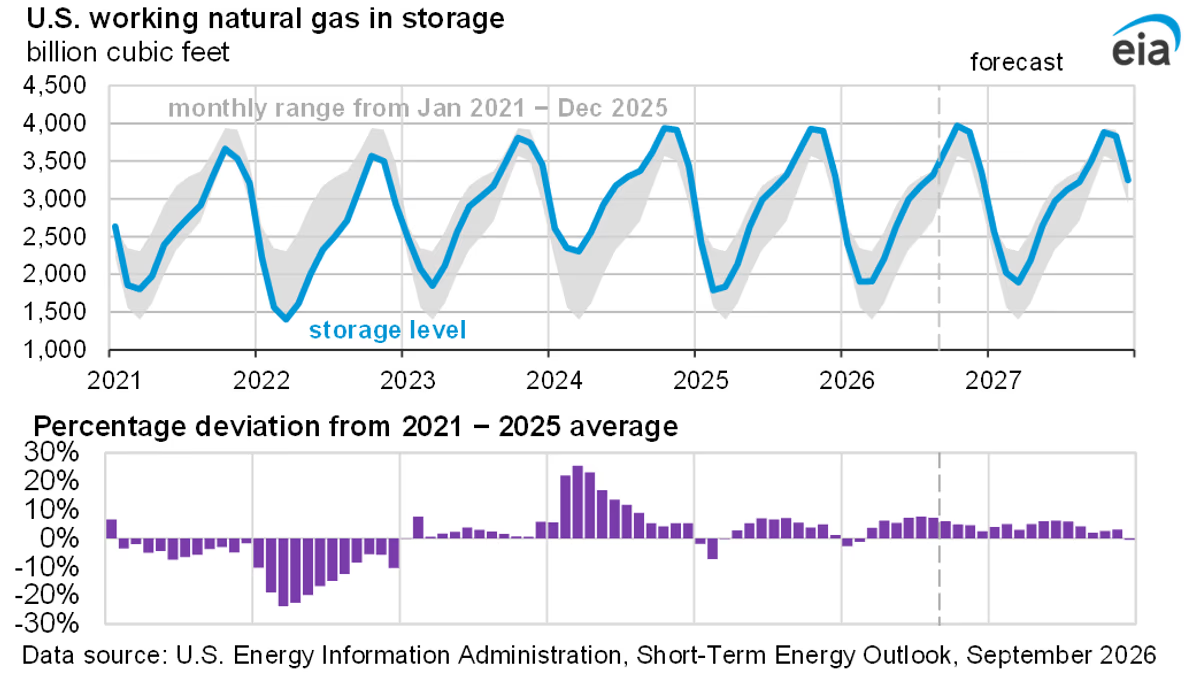
US gas faces the opposite problem. EIA's weekly storage report for the week ending October 9 showed 3,567 Bcf in the Lower 48, a 67 Bcf injection. Inventories stand 45 Bcf above the five-year average of 3,522 Bcf, a 1.3% surplus. They remain 143 Bcf below a year ago.
Henry Hub traded at $3.07 per MMBtu on October 16 per LNGInsights, against a 2026 average forecast of $3.48 in EIA's October outlook. EIA projects $3.16 for 2027. At $28.55 for TTF, the gross gap between Europe and the US is $25.48 per MMBtu.
One Bcf per day of gas is about 1.04 million MMBtu. At that gap, each Bcf per day of US LNG feedgas represents roughly $26 million of gross daily spread before liquefaction fees, shipping and regasification. Export terminal capacity, not price, limits how much of that spread US producers can capture.
Forecasters Disagree by €30 per MWh
Citi's fourth-quarter base case for TTF is €56 per MWh, according to market reports, far below Friday's €86 to €88 range. Global Risk Management sees €100 if conditions worsen. The spread between those views is the Hormuz risk premium plus the weather. Our coverage of BP's gas trading update showed how much traders are already earning from that volatility.
Watch list
- Sunday evening and Monday TTF open, with Gulf incidents able to gap prices.
- EIA's next storage report on Thursday, October 22.
- EU storage prints from AGSI+ daily, with Germany the weakest large market.
Published by Oil Authority, edited by Adam Humphreys
Submit a Correction
Spotted a factual error? Free account required to submit a correction.