Trans Mountain, Pembina Sign On to Pacific Pipeline
Trans Mountain will lead and Pembina takes 10% of Alberta's 1-million-bpd line from Bruderheim to Roberts Bank, priced at $35.2 to $43.7 billion.
Trans Mountain Corporation will lead Alberta's 1-million-barrel-per-day Pacific pipeline, and Pembina Pipeline Corporation has signed on for an equity stake, Premier Danielle Smith and Prime Minister Mark Carney announced in Calgary on July 2, 2026. The project that had no confirmed route and no builder days earlier now has both.
The selected southern route runs from Bruderheim, northeast of Edmonton, to the Roberts Bank terminal in Delta, BC, largely following the existing Trans Mountain corridor. Alberta's submission to the federal Major Projects Office, filed July 1 to meet its self-imposed deadline, prices the line at $35.2 billion to $43.7 billion. Earlier the same day in Vancouver, Carney and BC Premier David Eby reaffirmed the North Coast tanker ban as part of the Canada-British Columbia Cooperative Prosperity Agreement; Roberts Bank sits south of the moratorium zone, so the route complies with it.
Trans Mountain Leads, Pembina Takes 10% With No At-Risk Capital Before a Final Investment Decision
"Canada controls our own energy and our future," Carney said in the government's announcement. Under a non-binding Heads of Agreement signed by the Government of Canada, the Province of Alberta, Trans Mountain Corporation, the Alberta Petroleum Marketing Commission and Pembina, the federal Crown corporation that runs the existing line will serve as lead proponent, responsible for construction, the regulatory process, Indigenous engagement and eventual operations. Canada and Alberta hold equal partnership in the project, with a meaningful equity stake reserved for Indigenous Peoples.
Pembina takes a 10% economic interest through construction, with the option to add up to another 10% once the line enters commercial operation, and commits no at-risk development capital before a final investment decision. "The Project represents a once-in-a-generation opportunity to advance nation-building energy infrastructure that strengthens Canada's economy and expands access to global markets for Canadian energy," Chief Executive Scott Burrows said in the company's statement. "We are proud to bring our development and execution expertise to a project of this national significance. Our participation will be evaluated through the same disciplined lens we apply to every capital decision."
Burrows was explicit about the limits: "We have approached our involvement in a way that is measured, that preserves our financial flexibility, and that incorporates meaningful protections, so that any participation remains consistent with our financial guardrails and creates durable value for our shareholders." The company says it would participate as "an experienced industry operator able to provide an independent perspective on cost, schedule, and execution, complementing, rather than replacing, the lead Project proponent." Due diligence and definitive agreements are targeted for September 2026, and Pembina's final investment decision remains discretionary.
Ottawa paired the pipeline announcement with advancement of the Pathways oil sands carbon capture project and regulatory reforms intended to speed approvals and support oil sands production growth. The two governments say the combined projects would support roughly 175,000 jobs, a government estimate that will face scrutiny as engineering firms up.
Carney's Signed Text Ties the Ban to a Future Route and Stops Short of Calling It Permanent
The agreement says Ottawa "commits to maintaining the federal North Coast tanker ban, in accordance with the proposed route of a new trans-provincial pipeline under the bilateral agreement between Canada and Alberta." Carney and Eby said the ban would be "fully maintained." Eby said BC "will not be going to court to fight a pipeline project."
The phrase "in accordance with" is the tell. The ban holds, and the selected route respects it: Roberts Bank sits outside the moratorium zone, which covers only the north coast. The ban is not called permanent, and its future remains tied to the route now on the table.
The 2019 Act Bans Loading Crude Over 12,500 Tonnes but Exempts LNG
The Oil Tanker Moratorium Act, in force since 2019, bars vessels carrying more than 12,500 tonnes of crude or persistent oil from loading at ports on BC's north coast. Transport Canada says it restricts loading, not passage, and excludes liquefied natural gas, gasoline, jet fuel and propane.
That is why the same deal that blocks crude terminals also speeds four coastal LNG projects. Gas is outside the ban.
Analysts Ask Who Ships and What Return the Crown Will Accept
Trans Mountain had been positioning for the role for months. "The federal government has expressed a strong desire to have a private proponent move the project forward, but they know very well that we're here and what we're capable of doing," Chief Executive Mark Maki said in a May interview. Thursday made that official. What the announcement did not include is shipper commitments, the contracted barrels that underwrite any pipeline's tolls.
"Who pays for the pipe; do they have any guaranteed shippers; is there solid interest from oil sand producers that are backing this; who operates it; and, certainly, the route are all of interest," said Al Salazar, head of macro oil and gas research at Enverus, ahead of the announcement. Salazar said the more concrete details the province could provide, the more it could assure oil producers of the pipeline's viability. Thursday settled the route and the operator; guaranteed shippers and producer backing remain open. BMO Capital Markets analysts wrote in February that they "struggle to see a scenario" where established operators invest in new Canadian pipelines "unless adequate return protection" is provided, a caution Pembina's capped, no-at-risk-capital structure illustrates. RBC chief economist Frances Donald told a Calgary audience the deeper problem is policy whiplash: "This is an entire sector that has repeatedly been pushed into a position where it could not grow." Industries need consistency over an extended period, she said, to be confident enough to invest.
Until This Week, Ebel Called It a 'Pipeline to Nowhere' and Every Named Firm Declined to Build
Enbridge Inc. Chief Executive Greg Ebel has led the industry push to lift the ban. The moratorium "effectively makes that export pipeline illegal," he said in an October speech to the Empire Club of Canada. "No company would build a pipeline to nowhere." Ebel said 97% of Canadian crude exports went to the U.S. in 2023, leaving producers with "the risk of having only one customer."
Enbridge declined to build it. Ebel said the company would advise on the project but not lead or fund it. TC Energy Corp. never committed. As late as June 30, Carney had confirmed the line lacked private-sector financing. Thursday's agreement answers that vacancy in an unconventional way: a federal Crown corporation leads, and the private capital, Pembina's, arrives capped and conditional.
"We're not competitive if it takes five to 10 years to approve a project, or you can't actually ship your oil because of a tanker ban," said Lisa Baiton, chief executive of the Canadian Association of Petroleum Producers.
Smith Files a 1-Million-Barrel Line With a Loan Guarantee She Hopes Not to Use
Smith submitted the one-million-barrel-a-day proposal backed by $14 million in provincial planning funds. "The window of opportunity is open now. Recent global events have made it clear that Canada's safe and reliable sources of oil, gas and critical minerals are vital to the world's economy," she said in Calgary. "Obviously it will take time and there is much work ahead of all of us, but I say to all people across Alberta and across Canada, we will get the job done." She had earlier ruled out spending $34 billion in provincial funds, citing a "loan guarantee mechanism" to backstop early development instead. Conservative Leader Pierre Poilievre, who holds an Alberta seat, wants the ban and the federal assessment law repealed, saying Ottawa should "get out of the way."
Trans Mountain Ran 86% Full in 2025, Hit Apportionment in June, and Peaked Near 91%
Trans Mountain shows why a new line is in question at all. Canada's only tidewater crude pipeline hit apportionment for the first time since its May 2024 expansion in June 2026, with shipper nominations exceeding its 890,000-barrel-per-day capacity. As Oil Authority reported on June 17, 2026, Asian demand surged after Hormuz supply disruptions redirected Pacific refiners toward Canadian crude. The system averaged 761,000 barrels per day in 2025, 86% of capacity, set a record 807,000 in the fourth quarter, about 91% full, and the company forecasts 88% utilization in 2026.
The full pipeline is also a paying one. Trans Mountain returned $1.7 billion to the federal government in 2025 and another $448 million in the first quarter of 2026, split between interest payments and cash dividends, bringing total returns to $2.2 billion since the expanded system opened in May 2024. The Crown corporation Ottawa was once desperate to sell now funds its owner, which is part of why the government is comfortable letting it lead the next line.
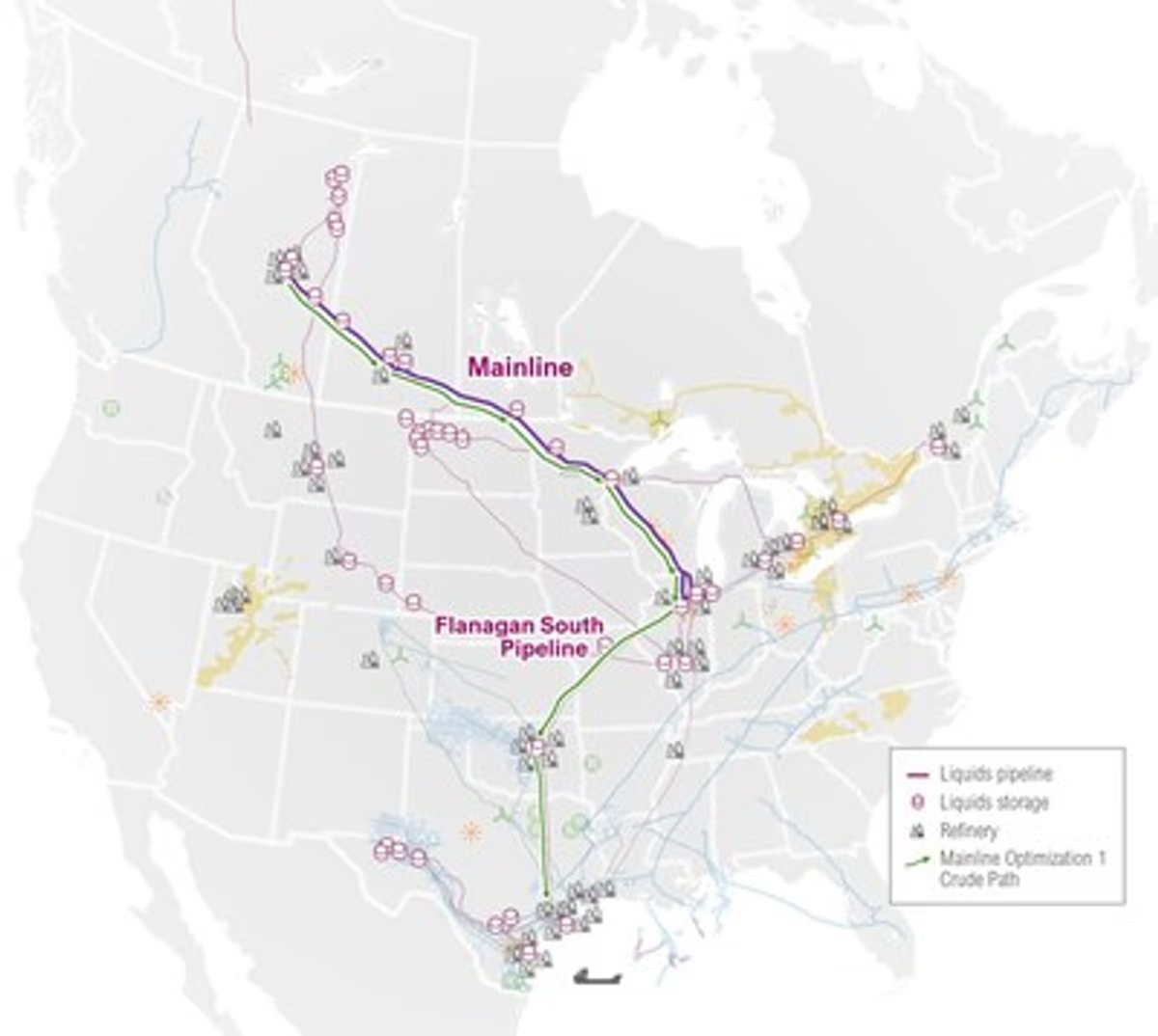
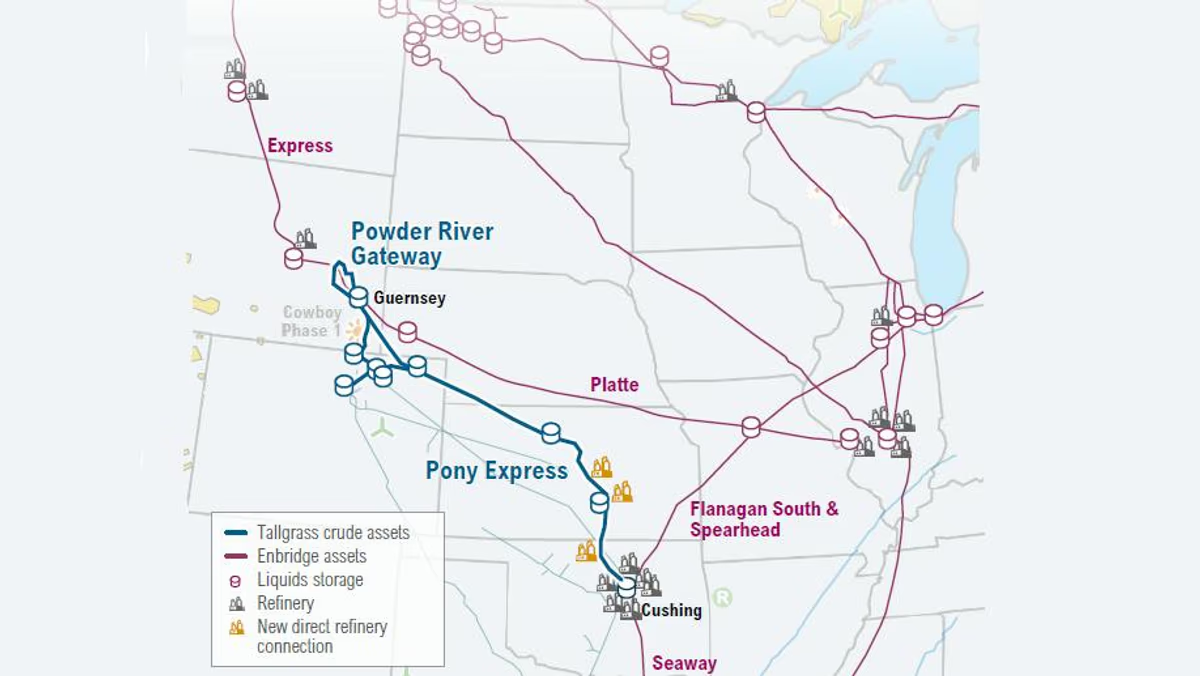
Trans Mountain plans to add roughly 90,000 barrels per day with drag-reducing agents by 2027, then pump stations and pipe to reach about 1.14 million by 2028. Other new egress is incremental. Enbridge's Mainline optimization and the Bridger Pipeline's 400,000-barrel expansion add capacity at the margin. S&P Global expects western Canadian output to grow about one million barrels per day this decade and spare pipeline space to disappear by the end of 2026. The proposed West Coast line is the only project large enough to close that gap, and, until Thursday, the one without a builder.
Western Canadian Select crude was assessed at $56.23 per barrel in Thursday trading, against a WTI settlement of $68.45 per barrel on Thursday's CME close, per TradingEconomics; both benchmarks are tracked live on Oil Authority's oil prices page. The $12.46 WCS-WTI differential persists despite Trans Mountain running at full throughput, confirming that existing pipeline infrastructure cannot close the price gap.
What the Differential Costs Alberta Producers
At Trans Mountain's full 890,000-bpd throughput, a $12.46 WCS-WTI spread translates to $11.09 million per day in foregone netback revenue for Alberta heavy oil producers. That figure reaches $4.05 billion per year in unrealized producer value. Earlier this year, when the WCS-WTI spread peaked at $16.15 per barrel in April 2026, the same throughput implied a $5.25-billion annual drag. A new 1-million-bpd pipeline that narrowed the differential by $5 per barrel would generate $1.83 billion per year in additional producer netback, with each additional dollar of improvement adding $365 million annually.
Oil Sands Producers with the Most at Stake
The pipeline's largest potential shippers are Canada's four major oil sands operators. Suncor Energy produces more than 800,000 barrels per day from the base oil sands mine, Firebag, and Fort Hills. Canadian Natural Resources is Canada's largest single heavy crude producer, operating Horizon and Kirby. Cenovus Energy, which acquired Husky Energy's upstream assets in 2021, produces Christina Lake and Foster Creek bitumen that trades as WCS in export markets.
Imperial Oil, 69.6% owned by ExxonMobil, operates Kearl and Cold Lake and would rank among the highest-volume shippers on a new Pacific corridor. Kearl produces more than 270,000 barrels per day of diluted bitumen, one of the highest individual mine volumes in Canada. MEG Energy's Christina Lake project produces more than 100,000 barrels per day and the company has consistently sought expanded Pacific export access. For ExxonMobil, a confirmed Pacific corridor for Imperial's bitumen would reduce Canadian price discount exposure across the parent company's global crude trading portfolio.
Southern Route and the Federal Approval Path
The selected option, known as the Southern Route, reaches tidewater below the North Coast tanker ban zone, avoiding the corridor that blocked Northern Gateway after a federal court rejected that project in 2016. The Roberts Bank terminal in Delta anchors the export end, and the Major Projects Office will now begin consultations with Indigenous groups, provinces and territories toward listing the line as a project of national interest under the Building Canada Act. Under the Alberta-Canada energy MOU finalized in May 2026, the designation is targeted for October 1, 2026, with final permits to begin construction in place by September 1, 2027.
Alberta's submission details two routing options, an Original Corridor and an Optimized Corridor, both generally following the existing Trans Mountain system between Wabamun, Alberta, and Hope, BC. The line would run 1,200 to 1,250 kilometres of steel pipe up to 42 inches in diameter, driven by roughly 11 pump stations drawing 440 to 460 megawatts. About 92% of the Original Corridor sits within 100 metres of already disturbed land or infrastructure; the Optimized Corridor runs 82% within the same band. Six corridors were studied before the province selected this one.
Each end gets a terminal with 15 tanks and about 6.5 million barrels of storage. Bruderheim serves as the receipt hub, collecting crude from Alberta's pipeline grid. The Roberts Bank marine terminal would load very large crude carriers, 1.9 to 2.2 million barrels per shipment, across two berths. The corridor crosses a section of Jasper National Park and the traditional territories of roughly 90 to 125 Indigenous communities. The Roberts Bank terminal itself sits within Tsawwassen First Nation Treaty lands, which is where the consultation load concentrates.
The Alberta Indigenous Opportunities Corporation is designated as the vehicle for potential Indigenous co-ownership. Sovereign wealth funds have signaled interest in acquiring minority stakes of 15% to 30%, according to June 10 reporting by Oil Authority. Indigenous consultations and BC provincial approvals remain outstanding hurdles ahead of the September 2027 construction target.
Pathways Carbon Capture Advances in Tandem, Pairing New Egress With a 16-Megatonne Emissions Cut
The pipeline moved forward the same day as the Pathways oil sands carbon capture and storage project, advanced under the same Canada-Alberta framework. The Pathways Alliance, whose members are Suncor, Canadian Natural Resources, Cenovus, Imperial Oil, MEG Energy and ConocoPhillips Canada, has proposed capturing carbon dioxide from oil sands facilities and piping it to underground storage in the Cold Lake region. Ottawa says the initiative would cut oil sands emissions by about 16 million tonnes annually, contribute more than $16 billion to GDP and support upward of 40,000 jobs a year.
The pairing is the political architecture of the deal. New export capacity advances alongside decarbonization of the barrels that would fill it, and the regulatory reforms and growth incentives intended to expand oil sands production feed both.
CIBC Calls the 2027 Start a Best-Case Scenario, and Pathways Approval Is a Legal Precondition
What stands between Thursday's announcement and a shovel in the ground is a series of hurdles, and clearing every one of them only wins the right to start. CIBC Capital Markets analysts Robert Catellier and Rogan Anantharajah characterized Alberta's timing targets as "optimistic and reflective of a best-case scenario" in a May note. Even if the September 2027 construction start holds, oil would realistically flow around 2033 or 2034.
The Pathways link is not just political pairing; it is a legal gate. Under the Canada-Alberta agreement, approval and commencement of Phase 1 of the Pathways project "will be a precondition to the commencement of the approved bitumen pipeline." Carney put it plainly on Thursday: "No Pathways, no pipeline."
British Columbia holds conditions of its own. The Canada-BC agreement says the province "must share meaningfully" in the project's economic benefits, with mechanisms under discussion including an annual royalty payment and an environmental response fund. Ottawa and Victoria set a December 1, 2026 deadline to settle those financial commitments, alongside renegotiated revenue sharing on the existing Trans Mountain system and coastal protection measures. Eby has said BC will not fight the line in court; he has not said passage will be free.
Producers Drilled 11,226 Wells in 2014 and About 4,700 by 2016 as the Workforce Shrank
The pipeline debate lands on an industry that never returned to its pre-2014 size. Producers drilled 11,226 wells in 2014. After crude collapsed that autumn, the count fell about 58% to roughly 4,700 by 2016, according to the Canadian Association of Oilwell Drilling Contractors. Active rigs fell from about 1,600 at the 2014 peak to roughly 600 in 2025, per Baker Hughes and CAOEC data.
The workforce shrank with it. Direct oil and gas extraction employment fell from about 64,300 in 2014 to about 54,200 in 2024, according to federal Canadian Industry Statistics. The drilling and services side was hit far harder, with the contractors' association reporting job losses near 57% through the downturn, because rig crews rise and fall directly with the number of wells drilled.
The near-term trend is still down. Enserva, the energy services association, forecast total wells drilled would fall about 9% in 2025, led by a 16% drop in British Columbia, with a further 4% decline in 2026. Each active rig supports scores of field jobs and service-sector spending across Western Canadian towns, which is why egress and new projects matter beyond the daily oil price.
Calgary's Downtown Vacancy Rose From 9.8% in 2014 to a 32.7% Peak, Erasing $12 Billion in Tower Value
The 2014 crash is still visible in Calgary's core. Downtown office vacancy stood at 9.8% at the end of 2014, near a boom-era low. It climbed to 17.4% within a year and peaked at 32.7% in 2021, the highest of any major Canadian city, according to CBRE. It still sat at 30.4% at the end of 2025.
The collapse hollowed the tax base. Downtown office tower values fell more than $12 billion in three years to 2019, cutting about $300 million in tax payments and shifting the load onto businesses outside the core. Tens of thousands of head-office and service jobs left downtown over the decade.
The City of Calgary has since spent public money converting empty towers to housing. Its conversion program has cleared about 2.7 million square feet across 21 projects and aims for 6 million by 2031. Even so, the city does not expect vacancy back near 20% until 2031. That decade of lost office jobs and eroded tax revenue deepened the economic alienation that polling now links to Alberta's separatist sentiment.
Zero Equalization for Alberta, $13.6 Billion for Quebec, and a Cancelled Energy East Feed the Alienation
The frustration predates this pipeline. Alberta contributes heavily to federal revenues but receives no equalization, while Quebec draws the largest share, $13.6 billion of $26.2 billion in 2025-26, according to Finance Canada. British Columbia and Saskatchewan also receive nothing.
Economists say the formula also flatters Quebec's books. Alberta's non-existent sales tax is counted as if it were levied at the national average, but Hydro-Quebec's electricity is counted only at the below-market rates the utility actually charges, not at what the power would fetch. The profits Quebec forgoes by underpricing its electricity never enter its measured fiscal capacity. "There's no intellectual justification for this treatment," said Trevor Tombe, a University of Calgary economist who studies fiscal federalism. His analysis found that pricing Quebec's power about 3 cents per kilowatt-hour higher, near Ottawa-level rates, would have cut the province's equalization entitlement by 29% in 2021-22. "There's no quick fix here. But the current system is unfair and inefficient, and we should try to do better," said Michael Smart, a University of Toronto economist.
Albertans have registered the grievance at the ballot box. In an October 2021 referendum, 61.7% voted to remove the equalization principle from the Constitution, according to Elections Alberta, though a single province's vote carries no legal force. Routes east have also stalled. TransCanada cancelled the 1.1-million-barrel Energy East line in 2017, citing changed circumstances after regulators widened its review to include greenhouse gas emissions.
These grievances feed the sentiment polling measures. In Angus Reid Institute surveys, most Albertans still favour staying in Canada, but even among them 93% say the province struggles to sell its resources as a landlocked exporter. Alberta votes on its place in the country on October 19.
Asian Buyers Will Pay for Barrels That Skip Chokepoints
Global buyers are watching. About one-fifth of seaborne oil moves through the Strait of Hormuz, and the IEA called the 2026 disruption there the largest supply shock in oil-market history. Japanese and South Korean buyers have signalled they will pay more for barrels that skip such chokepoints. Canada's regulator says more than 95% of crude exports went to the U.S. in 2024.
Alaska Has Shipped Crude Past BC Since 1985, but a Kitimat Line Would Thread Hecate Strait
Alaska has shipped crude past BC for four decades. Tankers carry more than 80 million barrels a year of North Slope crude from Valdez down the Pacific, routed since 1985 west of a voluntary zone about 70 nautical miles offshore. Foreign tankers already cross the inshore waters the law protects, because it bans loading, not transit.
The coastal case is about the route. Alaskan crude runs the open Pacific. A Canadian line ending at Kitimat or Prince Rupert would thread Douglas Channel, Hecate Strait and Dixon Entrance, where Environment Canada records gales with 5-to-7-metre seas. In 1989 the single-hulled Exxon Valdez spilled about 257,000 barrels onto 1,300 miles of shoreline. U.S. law has since required double hulls and tug escorts. The risk is real, and lower than it was.
BC Backs Gas While Resisting Crude, and the Ban's Future Rides on a Route Not Yet Drawn
Ottawa and Victoria have fought over oil before. The Supreme Court of Canada ruled in 2020 that BC could not restrict bitumen through Trans Mountain, since interprovincial lines are federal. BC's fiscal position adds pressure. Moody's and S&P downgraded the province in April 2025, its fourth cut in four years, with Moody's citing "a continued weakening in governance and fiscal and debt management." The same government backed LNG Canada and Cedar LNG, and Thursday's deal speeds four LNG terminals. British Columbia has resisted crude and tankers while supporting gas.
The ban holds, and the route now on file avoids it. What remains is the hurdle course: Pathways Phase 1 approval, definitive agreements in September 2026, BC's benefit terms by December 1, a discretionary final investment decision, and Indigenous consultations on a corridor priced as high as $43.7 billion. The finish line of that course is only the starting line, a legal right to put a shovel in the ground in September 2027, with oil no earlier than 2033.
Published by Oil Authority, edited by Adam Humphreys
Submit a Correction
Spotted a factual error? Free account required to submit a correction.